

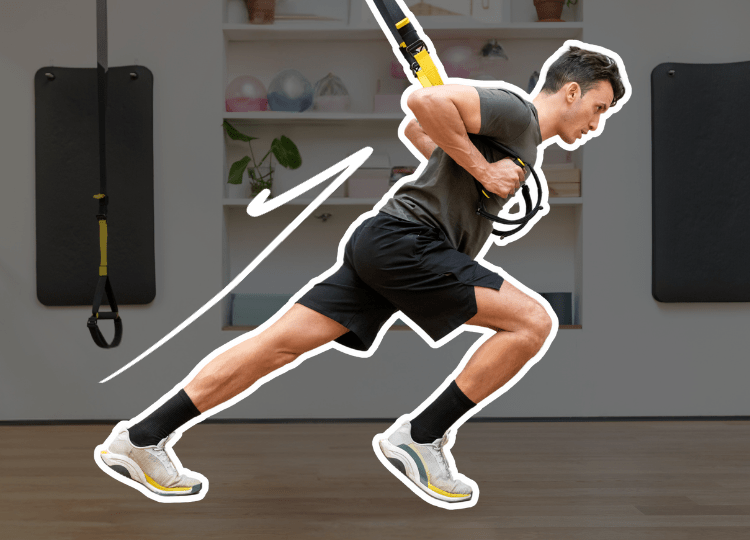
Originally developed by Randy Hetrick, a former US Navy SEAL, who improvised the first version from a jiu-jitsu belt and parachute webbing to keep his team fit while on deployment, the TRX suspension trainer has since become one of the most widely used training tools in gyms and home workouts worldwide… and for good reason.
Suspension trainers are affordable, portable, and surprisingly versatile. More importantly, the instability created by the straps means your core is engaged during virtually every movement, making suspension training one of the most efficient ways to build functional strength and stability simultaneously.
This 15-minute workout targets the whole body and requires nothing beyond a suspension trainer and somewhere to anchor it. Follow it three times a week for a straightforward, effective fitness plan, or pair it with other training for a more varied programme.

Create and follow 100’s of TRX workouts and track your progress with the Alpha Progression app.
ADVERTISEMENT
Equipment Needed
To follow this workout plan, you’ll need access to either a TRX trainer, or another brand of suspension trainer.
“TRX” is the name of a brand, which is arguably the market leader of suspension trainers… but there are a lot of copycat brands on marketplaces like Amazon, often for much cheaper.
Many people use the word “TRX” to actually describe any sort of suspension trainer.
We’ll leave it up to you whether you want to invest in a premium TRX trainer, or a cheaper alternative suspension trainer.
Perfect travel equipment
Suspension trainers like TRX are super light-weight and easy to transport. This makes them the perfect piece of fitness equipment for those who travel and still want to get an effective workout in. But don’t let their simplicity fool you, they are still a really effective tool to help you get stronger and fitter.
TRX Workout Plan PDF
We’ve turned this TRX workout plan into a PDF so you can print it off and use during your next workout. The PDF also includes links to exercise demonstrations as well.
Workout Summary
| Primary Goal | Functional Strength, Balance and Cardio |
| Muscles Targeted | Full Body |
| Training Level | Beginner, Intermediate and Advanced |
| Program Duration | Ongoing |
| Average Workout Duration | 15 Minutes |
| Training Days Per Week | 3 Days |
| Required Equipment | TRX Suspension Trainers |
| Printable Version | View here |
Programming explained
This TRX workout plan includes 6 exercises. Instead of counting reps or sets, you’ll be doing each exercise for 1 minute, followed by 1 minute rest. This will give it a HIIT/circuit training flair and not only help build functional strength but also improve cardiovascular fitness and muscular endurance too.
It’s also worth noting that the instability created by the suspension trainer means your core is working harder than it would during equivalent exercises on a stable surface. Research confirms that suspension exercises activate core muscles more effectively than similar movements performed on stable surfaces or Swiss balls, so even exercises that aren’t primarily targeting the core are giving it a meaningful workout.
Full Body TRX Workout Plan for Beginners
| Exercise | Duration | Rest |
|---|---|---|
| TRX Squats | 1 minute | 1 minute |
| TRX Chest Press | 1 minute | 1 minute |
| TRX Bicep Curls | 1 minute | 1 minute |
| TRX Row | 1 minute | 1 minute |
| TRX Mountain Climbers | 1 minute | 1 minute |
| TRX Good Mornings | 1 minute | 1 minute |
TRX Exercise Details
Below, we’ve provided some details on each exercise, including how to perform the exercise properly, as well as tips for making the movements more challenging.
This is one of the big benefits of TRX trainers, in that with a subtle change in stance, you can often make the movement easier or harder, making it a great option for beginners. Instead of trying to push through a workout plan that leaves you feeling incredibly sore for weeks, you can adjust the movements to suit your level of fitness for a more sustainable approach.
Warm up
Remember to warm up before starting this workout. Include stretches that target your whole body as this workout routine will engage and activate all your major muscle groups.
TRX Squats
Squats are a fantastic bodyweight exercise and TRX suspension trainers give you so many options to adapt the movement to change the level of difficulty.
For beginners, this squat is very similar to a regular air squat. You’re holding the TRX trainer as a guide, but you want to really focus on pushing through your legs to power yourself up. If you’re struggling with the regular air squat, the TRX trainers allow you to leverage your upper body strength to help support the movement, making it a great option for beginners who want some extra help during a squat.
Similarly, this ability to use your upper body to help can be useful in rehabilitation and recovering from an injury.
For added difficulty, we’d recommend doing TRX pistol squats. This single leg variation is much more challenging and you can use the TRX trainer for extra support during the movement.
TRX Chest Press
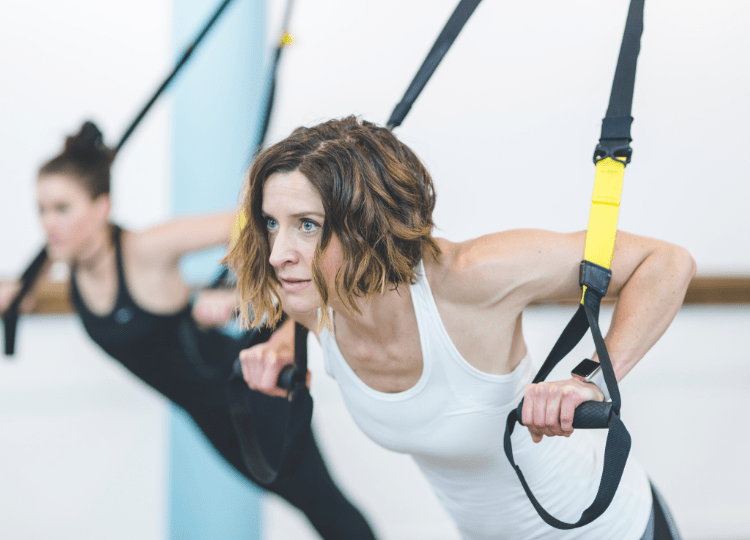
The TRX chest press is a great upper body exercise to do with your TRX trainer.
This replicates a push-up/bench press action, but in an upright position. You’ll lean forward and use your chest, triceps and shoulders to help push your body back into an upright position.
Compared to push-ups or a bench press, you’ll notice your triceps are activated even more, to help provide extra stability during the movement.
As you lean forward, you’ll also notice your core is also heavily engaged to provide stability during the movement.
TRX Bicep Curls
Activating the biceps is often more challenging with bodyweight movements compared to lifting free weights… however, the TRX bicep curl offers an effective method for really focusing on the biceps.
Your back and shoulders will also help support the movement.
You can also leverage slow, eccentric repetitions like you would for negative bicep curls.
TRX Row
The TRX row has a similar starting position to the bicep curls, but the grip and movement pattern is different.
For TRX rows, the focus is on squeezing your back and shoulders muscles to help bring your body towards the handles. You want to be bending at the elbows.
You can adjust your foot placement to target more of your shoulders or mid-back.
A more upright starting position will be easier too.
TRX Mountain Climbers
TRX mountain climbers are a great way to really leverage the functionality of suspension trainers.
By moving each leg towards your chest, you’ll really activate your abs and obliques (which is great if you’re starting to get bored of doing oblique crunches over and over again).
If you’re struggling, you can also pause in a plank position for a moment, before resuming the mountain climbers.
Compared to doing regular mountain climbers on the floor, you’ll notice your shoulders and arms are more activated during the exercise to provide stability for your body.
TRX Good Mornings
To finish up this TRX workout plan, TRX Good Mornings will engage your glutes and hamstrings effectively.
Unlike regular Good Mornings, the TRX trainer allows you to use your upper body during the movement too, creating a more complete exercise.
The key to Good Mornings is to focus on hinging at the hips and really squeeze your glutes to return to the starting position.
FAQs
Can you build muscle with TRX training?
Yes, and the research backs this up. An eight-week TRX programme commissioned by the American Council on Exercise produced significant increases in strength across leg press, bench press, and endurance tests.
Separate research also suggests that over time, bodyweight suspension exercises may promote greater improvements in muscle endurance than barbell exercises.
That said, for maximum hypertrophy, aim for the 8–12 rep range and incorporate slow eccentric repetitions to keep muscles under tension for longer. The one limitation to be aware of is progressive overload, with no external weight to add, you’re limited to adjusting body angle and tempo to increase difficulty, which can become a ceiling for more advanced lifters.
Can you do TRX training every day?
This really depends on what type of TRX training you’re doing. Your body will need a rest to really benefit from the exercise, so we’d recommend doing TRX training 3 times a week, alongside other forms of exercise. At a maximum, we’d opt for 5 days a week TRX training, giving yourself two days to recover and rest.
Can TRX burn fat?
Yes, TRX suspension trainers lend themselves well for HIIT and circuit training, which is a great way to burn calories and burn fat.
Is TRX better than weights?
It really depends what you mean by “better”… both TRX and weights can help you get stronger and fitter, but there are so many other factors at play, such as what your goals are and what type of fitness program you’re following.
Research published in the Journal of Sports Science and Medicine found suspension training to be comparable to traditional weight training across measures including strength, power, speed, and endurance, which is a stronger endorsement than many people expect.
However, there’s an important caveat: if your primary goal is maximum strength or muscle mass, traditional weight training has an advantage because you can progressively add load in a way that bodyweight-only training can’t fully replicate.
Where TRX genuinely excels is in building functional strength, core stability, and muscular endurance, and its portability and accessibility make it a more realistic option for many people. Using both in combination is likely the most well-rounded approach.
Bottom Line
The TRX suspension trainer is one of the most versatile and well-researched pieces of fitness equipment available at its price point. This 15-minute workout builds functional strength, burns calories, and improves cardiovascular health, and the instability of the straps means your core is getting a meaningful workout throughout, regardless of which exercise you’re doing.
Three sessions a week is a solid starting point. As you get stronger, increase the duration of each exercise, progress to more challenging variations like the pistol squat, or repeat the full circuit for a 30-minute session. The key, as with any training programme, is consistency over time.
Related Articles