

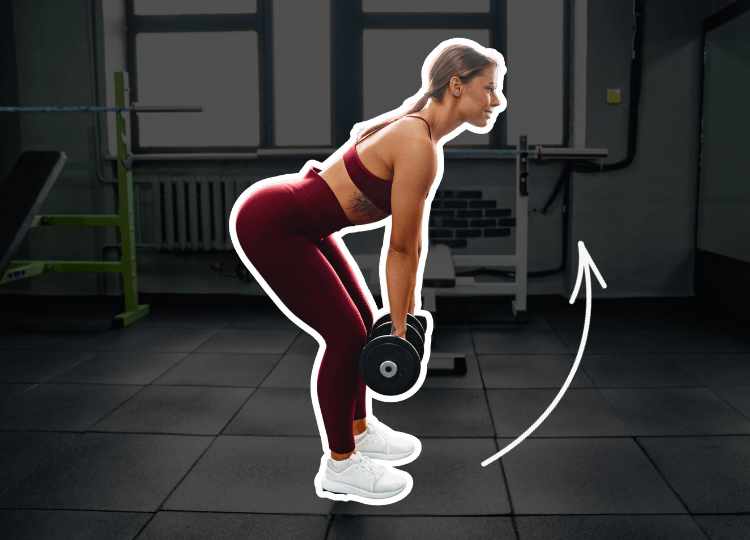
The lower back is one of the most commonly neglected muscle groups in training… and one of the most commonly injured.
It connects the upper and lower body, underpins almost every hinging and rotational movement in sport and daily life, and plays a central role in spinal stability and posture.
Yet most people only think about it when something goes wrong.
The good news is that you don’t need a gym full of equipment to address this. A pair of dumbbells is enough to build a genuinely effective lower back routine, and the exercises in this guide will strengthen not just the erector spinae, but the deeper stabilising muscles that research consistently links to lower back pain prevention and recovery.
What actually is the “lower back”?
The lower back refers to the muscles, tendons and ligaments in the lumbar region, directly above the glutes. There are two layers of muscle here that matter for training.
The superficial layer is dominated by the erector spinae, a group of three muscles (spinalis, iliocostalis, and longissimus) that run vertically along either side of the spine. These are the muscles most people think of when they talk about lower back strength, and they’re primarily responsible for extending the spine and keeping the torso upright.
The deeper layer is where the multifidus sits, and this is arguably more important for spinal health than the erector spinae. The lumbar multifidus muscles are critical stabilisers of the spine’s neutral zone, and dysfunction in these muscles is strongly associated with low back pain.
In this guide, we’ve listed out the 9 best lower back exercises with dumbbells, including how to perform each movement safely as well as tips for making the most out of them. Most of these exercises will also engage other muscle groups too (primarily the glutes, hamstrings, lats and upper back), so you can decide how to best incorporate them into your existing workouts.
It’s difficult to “isolate” the lower back from the rest of the posterior chain, but this simply means you can focus on compound movements that work multiple muscle groups at once.
At a Glance – Best Lower Back Exercises with Dumbbells
- Dumbbell Romanian Deadlift
- Dumbbell Bent Over Row
- Dumbbell Good Mornings
- Dumbbell Back Extensions
- Dumbbell Bird Dog Rows
- Dumbbell Swing
- Dumbbell Renegade Rows
- Dumbbell B Stance Deadlift
- Dumbbell Side Plank
Dumbbell Romanian Deadlift
The dumbbell Romanian deadlift (also known as a “RDL” for short) is a great way to activate and strengthen the lower back, glutes and hamstrings.
Unlike a conventional deadlift that involves pushing down through your legs and pulling a weight (e.g. dumbbells) to an upright position… the Romanian deadlift is all about hinging at the hips.
This hinging movement requires good strength and mobility around the hips, lower back, glutes and hamstrings.
You can also do single leg dumbbell Romanian deadlifts to help combat muscular imbalances and train each side individually. This is also useful if you only have access to lighter dumbbells and want a way to add progression. Single leg variations will also test your balance and stability too.
Dumbbell Bent Over Row
Although the dumbbell bent over row is largely seen as an exercise for the mid back, upper back and lats, it is also a great way to engage the lower back too.
Leaning forward with a straight back and straight legs requires you to hinge at the hips. This will engage the glutes, hamstrings and lower back, ensuring they help keep the spine stable and counteract the impact gravity is having on your upper body.
If you’re doing bent over rows for the lower back, you might find it’s more effective to opt for lighter weights and more repetitions, so you are in that unstable position for longer and thus keeping the lower back muscles engaged and working for longer (time under tension training).
You could even use a balance pad or a tool like the Terra Core to add more progression to the exercise too.
Dumbbell Good Mornings
Dumbbells are a great way to add weight to the Good Morning exercise. We’d recommend opting for a light weight to begin with and focus on slow, controlled movements.
Good Mornings involve hinging at the hips… similar to a Romanian deadlift, but the weight is usually held on your upper back/shoulders. A dumbbell can be held directly behind the head or on the shoulders to create that extra resistance during the exercise. If this doesn’t feel comfortable, try holding a dumbbell in front of your chest instead (but ensure you maintain a straight back).
As you bring yourself back to an upright position, you should feel your posterior chain engaged and activated.
Especially when using dumbbells, we wouldn’t recommend using heavy weights… save that for exercises like deadlifts. Good Mornings are all about slow and controlled movements, and leveraging smart training styles like TUT (time under tension) and eccentric training to build muscle and strength.
Dumbbell Back Extensions
Back extensions are a great option for those looking to really double down on the lower back. You can do bodyweight variations, but it’s most common to see this exercise performed on a 45 degree back extension bench. This helps deactivate other muscle groups during the “hinging” movement so that your lower back muscles take more of the load… which makes them work harder and grow.
Bad technique with back extensions can lead to injury though, so ensure you are taking things nice and slow… and focus on small, controlled movements, as opposed to a big swinging movement.
You can also perform them on a GHD machine (which we think is the best use for GHDs, unlike GHD sit ups!)
For dumbbell back extensions, you simply hold a dumbbell in front of your chest during the exercise, to add extra resistance to the movement.
Dumbbell Bird Dog Rows
The Bird Dog Row is a relatively unknown exercise but it is incredibly useful for developing better strength and stability in the back and core.
We would recommend Bird Dog Rows or Weighted Bird Dogs for those who are perhaps looking to ease back into things. Due to the core and glutes being recruited to support the movement, your lower back doesn’t take the same load as other back exercises, which means you can take things nice and slowly.
Although it’s technically your core and glutes that are doing most of the stabilizing, your lower back still needs to support the spine and help to maintain that straight back during the rows.
The movement will test your balance too and help promote better rowing technique.
Coach’s Tip: Research has shown that pausing at the top of each row with the arm and opposite leg fully extended for 2–3 seconds before lowering is significantly more effective for developing the multifidus muscles specifically. This brief hold significantly increases the demand on both the multifidus and the core stabilisers.
Dumbbell Swing
The dumbbell swing is a simple alternative to the kettlebell swing… for those who perhaps don’t have access to a kettlebell.
The movement is largely the same as with a regular kettlebell swing, but holding a dumbbell.
Technique is everything with “swinging” exercises, and you can cause serious back issues like a slipped disc if you adopt poor form (usually due to trying to lift too much weight).
This sort of exercise is also great to include in HIIT workouts and for those who want a simple all-round exercise that works lots of muscle groups.
Dumbbell Renegade Rows
The dumbbell renegade row is similar to the bird dog row in terms movement mechanics, but it involves adopting a plank position as opposed to a quadruped position. This means your core (both your abs and lower back) are more heavily engaged during the movement to maintain stability.
To do dumbbell renegade rows, you ideally need a pair of hex dumbbells (which have a flat edge). If not, you’ll need to think about how to ensure the dumbbells don’t slide when you’re applying force to them. A thick yoga mat can sometimes work well.
Renegade rows are a great exercise for those looking for a versatile exercise that will engage lots of muscle groups.
Dumbbell B Stance Deadlift
B Stance deadlifts are a great compound exercise that offer a middle-ground between conventional deadlifts and the single leg variation. One leg is positioned as a “kickstand”, to support the movement and provide balance, without actually contributing much muscular endeavour to the exercise. Ultimately, this means you can train each leg separately, which is great for those without access to heavy dumbbells.
Compared to single leg deadlifts, the B stance variation requires less balance, so if that’s a limiting factor, this can be a more suitable way to train your muscles (although we’d recommend prioritizing some balance exercise training if that is the case).
Our guide on B Stance deadlifts includes more tips on perfecting this movement.
Dumbbell Side Plank
The side plank is a really underused exercise that is perfectly designed to strengthen your mid-section (abs, obliques and lower back).
A dumbbell side plank increases the difficulty from regular side planks, so make sure you’re confident with the bodyweight version first.
A dumbbell can either be held on your waist to increase the load or held vertically by extending your arm (this makes it even more challenging by creating more instability during the movement).
The dumbbell side plank is another great way to target lots of muscles in the upper body, including the lats, shoulders and obliques… as well as the lower body.
Try holding this position on each side for a specified duration and repeat this for 3 sets. Over time, track how you are improving.
FAQs About Lower Back Dumbbell Exercises
What Muscles Make Up the “Lower” Back?
The primary muscles of the lower back are the erector spinae, made up of three muscles: the spinalis, iliocostalis, and longissimus, and the multifidus, which sits deeper and plays a critical role in stabilising the lumbar spine at a segmental level.
The quadratus lumborum, which runs from the lower ribs to the pelvis, also contributes to lower back strength and lateral stability. The latissimus dorsi is sometimes mentioned in this context but is more accurately described as a mid-back muscle rather than a lower back muscle.
Why is Lower Back Strength Important?
A strong lower back supports the spine and hips, improves posture, and reduces the risk of injury during both training and everyday activities. Research consistently links lower back weakness, particularly weakness in the multifidus, to chronic lower back pain, and shows that targeted strengthening can meaningfully reduce pain and disability.
Beyond injury prevention, lower back strength is also a limiting factor for major compound lifts like squats and deadlifts, so improving it tends to have a cascading benefit across the rest of your training.
Dumbbells Vs Barbells for Lower Back Exercises
If you are looking to add resistance to lower back exercises, both dumbbells and barbells are great options. Typically, barbells allow you to add greater load, which is better if you’re training for absolute strength. Dumbbells are usually preferred for home workouts and also lend themselves better for unilateral training.
What’s the Best Exercise to Strengthen the Lower Back?
There is no absolute “best” exercise for the lower back… it will largely depend on personal preferences, goals and current fitness level. There are bodyweight movements like side planks which are a great starting point, and then there are movements like dumbbell Romanian deadlifts which are more advanced but better for building muscle.
Bottom Line
The lower back is too important to ignore, and too commonly undertrained until something goes wrong.
The 9 dumbbell exercises in this guide cover the full spectrum from stability-focused movements like bird dog rows and side planks, to more load-bearing options like Romanian deadlifts and good mornings, giving you everything you need to build a well-rounded lower back routine with just a pair of dumbbells.
Start with lighter weights than you think you need, lower back exercises punish poor form quickly, and focus on slow, controlled repetitions with a brief hold at the top of each movement. Two to three sessions per week, consistently over several weeks, is where the meaningful strength gains and injury prevention benefits start to accumulate.
If you’re dealing with existing lower back pain rather than training preventatively, consult a physiotherapist before starting, the right exercise selection for rehabilitation may differ from what’s listed here.
Related Articles