

Wrist pain can make upper body training feel almost impossible. Push-ups, bench press, overhead work… the wrist is involved in almost every movement, and when it’s uncomfortable, it has a habit of derailing entire workouts.
But training around wrist pain is more achievable than most people think. With the right exercise selection, grip adjustments, and a few smart technique tweaks, you can continue building upper body strength without aggravating the wrists, and in many cases, the training itself can form part of the recovery.
Below, we’ve put together 6 wrist-friendly exercises that build genuine upper body strength, along with practical tips for reducing wrist stress across all your training.
Custom exercise recommendations
The best approach will depend on the root cause of your wrist discomfort… whether that’s arthritis, a previous injury, tendinopathy, or general weakness. Before starting any new training programme, we’d recommend consulting a physiotherapist who can assess your specific situation and confirm which exercises are appropriate for you.
Wrist-Friendly Workout Exercise List
- Forearm Plank/Side Plank – Strengthens abs and obliques
- Modified Push Up – Strengthens chest, triceps and shoulders
- Neutral Grip Dumbbell Chest Press – Strengthens chest, triceps and shoulders
- Neutral Grip Dumbbell Tricep Extension – Strengthens triceps
- Air Punches – Strengthens biceps, shoulders, back and core
- Banded Lat Pulldowns – Strengthens back and biceps
Top Related Product Recommendation 👇
STRENGTH WELL
New AI-powered app for measuring, tracking and improving your strengthspan. How strong are you for your age?
Wrist Friendly Workout for Upper Body Strength
| Exercise | Repetitions/Sets |
|---|---|
| Forearm Plank | Hold for as long as possible x 3 sets |
| Modified Push Up | 8-15 reps x 3 sets |
| Neutral Grip Dumbbell Chest Press | 8-15 reps x 3 sets |
| Neutral Grip Dumbbell Tricep Extension | 8-15 reps x 3 sets |
| Air Punches | 30 seconds x 4 rounds (30 sec rest between rounds) |
| Banded Lat Pulldowns | 8-15 reps x 3 sets |
Forearm (Low) Plank Variations
A high plank, which involves resting on your hands, can put unwanted pressure on the wrists. A simple modification is to opt for a low plank where you rest on your forearms.
This doesn’t require your wrists to support any of your bodyweight.
From this low plank position, you can also include other movements to add progression, such as lifting alternating legs as a way to engage your lower body too.
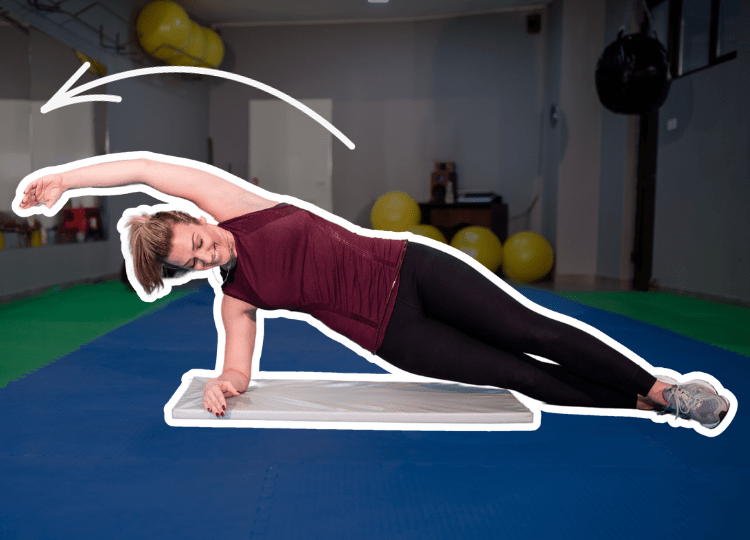
A side plank is another great plank variation that will further engage the obliques and develop better hip stability. You could also do side planks with the opposite arm extended in the air too, further engaging your shoulders and arms.
Modified Push Up
The traditional bodyweight push up can be tough on wrists, especially if you’re doing high repetitions.
Performing push ups on a bar allows you to keep your wrists straight, which may reduce the discomfort.
You could also consider doing kneeling push up on a bar as another way to regress the movement.
We also like doing incline push ups as way to ease into full push ups too… as your body is supporting less weight.
If you find using a bar is more comfortable, you can also use this to perform other push up variations such as a pike push up, to engage the shoulders and upper chest more.
Neutral Grip Dumbbell Chest Press
If modified push ups are still a go-no, a neutral grip chest press (using some form of resistance, such as a dumbbell), will help strengthen the chest without requiring you to support your bodyweight.
In a supine (lying on your back) position, you can opt for lighter weights and use slow, eccentric repetitions to leverage time under tension training principles to build muscle.
This might be a good option for those struggling to support their bodyweight during a push up or kneeling push up, as you can select light weights and slowly work your way up.
Neutral Grip Dumbbell Tricep Extension
A tricep extension, using a dumbbell, is another useful way to challenge your muscles without putting pressure on your wrists.
You can either do them seated, standing or lying on your back, so you don’t need to support your bodyweight during the movement.
You can also experiment with different grips to find the most comfortable option.
Air Punches
Air punches are surprisingly effective at getting the heart racing and blood pumping to the arms, shoulders and back.
Even without hitting a punch bag, the very motion of holding your arms up and continuously punching at a high tempo will mean you feel the burn.
You could also incorporate squats or lunges too, to turn the movement in a full-body workout itself.
If your wrists allow for it, you could try holding some light dumbbells too.
Banded Lat Pulldowns
Banded lat pulldowns allow you to build muscle and strength in the back.
You can also modify your grip so you disengage your wrists by hooking your fingers around the handle, as opposed to gripping it by using your thumb too. By using a hook grip, your wrists and forearms will take less of the load and your lats will take more… which is ideal for those wanting to build muscle in the upper body without putting pressure on the wrists.
Banded lat pulldowns also allow you to leverage eccentric repetitions too.
Tips for Maximizing Strength and Limiting Impact on Wrists
Creating an effective low impact workout isn’t just about the exercises you choose to do… the tempo that you perform the movements, for example, can also be adapted to better suit those wanting to reduce impact on joints.
Below, we discuss a few things to consider.
Leverage Eccentric Training
Eccentric training is a simple, but incredibly effective, approach to strength training. It basically involves a slower “lowering” phase of a movement. This is proven to be where a lot of the muscle breakdown (and consequent growth) happens.
This is great news for those wanting a low impact strength workout, as it means you don’t need to worry about lifting heavy weights to progress… but instead, you can incorporate slow repetitions to keep the muscles working hard and growing, without needing to put extra pressure on your joints by selecting weights that are heavy.
Use a Neutral Grip Where Possible
One of the most impactful changes you can make across all your upper body training is defaulting to a neutral grip, where the palm faces inward, wherever the exercise allows.
Research comparing different wrist grip positions during weightlifting found that participants using a neutral wrist grip reported better overall wrist function and less pain than those using an extended wrist grip.
This applies not just to the exercises in this article, but to dumbbell rows, curls, pressing movements, and any pulling exercise where grip position can be adjusted.
Stretching and Recovery
Rest days between sessions give the wrists and surrounding structures time to recover, which is especially important when training around existing discomfort.
Before each session, spend a few minutes warming up the wrists specifically, useful movements include slow side-to-side wrist rotations, wrist flexion and extension (moving the hand up and then down from a neutral forearm position), and prayer stretches where the palms are pressed together and slowly lowered toward the waist.
Start each movement gently to gauge what feels comfortable before increasing the range.
Goals
“Low impact” means different things to different people… for some, they can’t put any sort of pressure on their wrists due to something like arthritis, so workouts need to be adapted much more compared to someone who is perhaps recovering from an injury and in the final stages of their rehabilitation program.
Ultimately, your workout needs to reflect your goals and your ability.
This is why working with a Physical Therapist is always a good idea.
Consider Your Shoulder Strength
Wrist pain during upper body training isn’t always purely a wrist issue. Physiotherapy sources note that pain in one area of the upper body can sometimes be connected to weakness in surrounding structures, particularly the shoulders.
If your wrists are consistently under stress during pressing or pulling movements, it’s worth considering whether inadequate shoulder stability is contributing to the load being displaced onto the wrists. Including shoulder strengthening work in your routine, rows, external rotation exercises, overhead pressing, can help distribute the load more effectively across the upper body.
Experiment
Small grip adjustments can make a meaningful difference to how the wrists feel during training. As a general principle, keeping the wrist in a neutral position, rather than allowing it to flex or extend significantly under load, reduces shearing forces on the joint and is a sensible habit across all upper body training.
For pulling movements specifically, experimenting with a hook grip, where the fingers wrap around the handle without the thumb, can significantly reduce wrist and forearm involvement, shifting more of the load to the lats and back.
This is already mentioned in the lat pulldown section but is worth applying across any rowing or pulling exercise you include in your routine.
If you have access to a gym, you may also find some equipment doesn’t require you to engage your wrists compared to using free weights too.
Work on Forearm/Wrist Strength
This is arguably the most important long-term strategy for anyone dealing with persistent wrist discomfort during training. Research has shown that grip-strengthening exercises combined with wrist stability training significantly improved pain, function, and muscle strength in people with chronic wrist pain, making it a valuable addition to any rehabilitation or prehab programme, not just an afterthought once you’re feeling better.
Simple starting points include wrist curls and reverse curls with a very light dumbbell, wrist rotations, and grip strengthening using a rubber ball or grip trainer.
The goal is to build the supporting structures around the wrist joint so that it’s better equipped to handle training load over time. If you’re returning from injury, work with a physiotherapist to confirm the right exercises and progression for your situation.
There are also specialist tools and forearm exercise equipment that might help too.
Bottom Line
Building upper body strength with wrist pain requires the right exercise selection, sensible grip choices, and a long-term approach to building wrist and forearm strength rather than just working around the problem indefinitely.
The six exercises in this article offer a practical starting framework, but the most important step, particularly if you’re dealing with persistent or unexplained wrist pain, is to get a proper assessment from a physiotherapist before starting any new training programme. The right exercises for you will depend on the root cause of your discomfort, and what works well for one person may not be appropriate for another.
Related Articles
How to Overcome a Strength Plateau