

The conversation around fitness and longevity has evolved significantly over the last decade.
Cardiovascular health gets discussed. Strength training has finally earned its place at the table, particularly for over-50s. Sleep, nutrition, stress management… all firmly part of the picture now.
But there is 1 dimension of physical health that almost never makes the list: coordination.
The ability to move smoothly, accurately and in response to what is happening around you. To catch something unexpected. To change direction without thinking about it. To perform 2 tasks simultaneously without either one falling apart.
These are skill-based qualities, and they decline with age just as strength and cardiovascular fitness do. The difference is that almost nobody trains them deliberately.
This article makes the case for why they should, and gives you the best exercises to do something about it.

Quick Summary
- Coordination is a trainable skill that declines with age but underpins how smoothly, accurately and efficiently you move, and it is often overlooked despite its impact on performance, independence and fall risk.
- Targeted coordination training, from juggling and agility drills to cross-body and reaction work, challenges the brain and body together, driving neuroplasticity and improving both physical control and cognitive function.
- Just 10 to 15 minutes a few times per week is enough to sharpen coordination, reduce injury risk and support long-term brain health, making it a low-effort, high-return addition to any fitness routine.
What Coordination Actually Is
Coordination is the ability of the nervous system to synchronise the brain, eyes, muscles and sensory organs to produce smooth, accurate, controlled movement. It is what allows you to catch a ball without thinking about it, navigate an unfamiliar room in the dark, or drive a car while holding a conversation.
It encompasses several related qualities: timing, rhythm, spatial awareness, reaction time, hand-eye coordination, and the ability to perform multiple movements simultaneously. Most of these happen automatically and below conscious awareness, which is precisely why their deterioration tends to go unnoticed until the deficits are significant.
Pathways
Coordination is a skill rather than a purely physical attribute. That distinction matters, because it means it is developed through practice and challenged by novelty. Repetition builds the neural pathways. New challenges keep those pathways sharp.
Why It Declines and Why That Matters
The neurological basis of coordination depends heavily on the cerebellum, the brain structure responsible for motor control, movement timing and the fine-tuning of physical actions. Research published in PMC confirms that the cerebellum undergoes accelerated volume loss with age, a process that directly contributes to the coordination deficits observed in older adults: movements becoming slower, less smooth, and harder to perform in combination.
The effects show up subtly at first. A slight hesitation before changing direction. A less confident step on uneven ground. Reaction time that is just a fraction slower than it used to be.
Over time, these small deficits compound into meaningful functional limitations that affect independence, sports participation and fall risk.
Falls are the most serious downstream consequence. Exercise programmes that include coordination training have been shown to reduce fall rates in older adults by approximately 40%, according to a review published in the British Journal of Sports Medicine. That is a significant reduction from a form of training that requires no equipment and minimal time.
The Brain Connection
This is where coordination training becomes genuinely interesting from a longevity perspective.
Coordination exercises are not just physical. They require the brain and body to communicate rapidly and precisely, which means they place meaningful demand on the same neural networks that decline with age.
Research published in Frontiers in Aging Neuroscience found that coordination exercise activates the cerebellum and visual-spatial networks in the brain, and was found to influence a range of higher cognitive functions including divided attention, working memory and verbal memory.
A separate study published in PMC, comparing coordination training against strength training in older adults, found that the coordination group showed significant improvements in scores on a standardised cognitive assessment, while the strength group did not. Another study from PMC found that a 10-week cerebellar challenge programme for older adults produced measurable improvements in both physical coordination and declarative memory.
The mechanism behind this is neuroplasticity: the brain’s ability to reorganise and strengthen neural connections in response to new challenges.
Learning a motor skill, practicing a new movement pattern, or training the visual and proprioceptive systems all stimulate this process.
Training for Longevity
Check out our 7 day longevity workout plan for more ways to stay strong and mobile as you age.
Best Coordination Exercises
Juggling
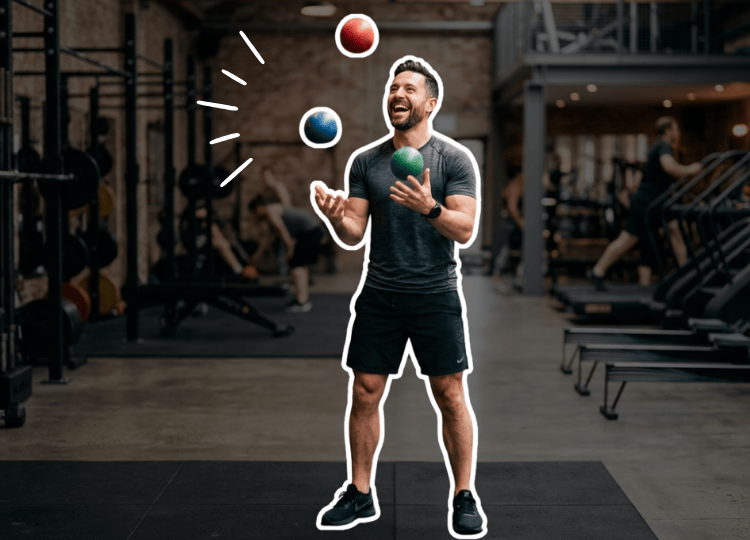
One of the most effective coordination training tools available, and not just for circus performers. Juggling requires the eyes and hands to work together in a precise rhythm while tracking multiple objects through space simultaneously. It is one of the few exercises that genuinely demands the sustained engagement of the cerebellum and visual-spatial brain networks.
Start with 2 balls, tossing 1 at a time and catching in the opposite hand. Once that pattern is consistent, introduce a 3rd ball.
The progression itself is valuable: learning a new skill, failing, adjusting and improving is exactly the kind of neural challenge that drives neuroplasticity. Even 5 to 10 minutes of practice 3 times per week produces meaningful improvement in hand-eye coordination over several weeks.
Agility Ladder Drills
An agility ladder, a flat ladder laid on the ground with rungs roughly 30cm apart, is one of the most versatile and underused coordination tools in existence. Ladder drills require the feet to hit precise positions in specific sequences, at speed, which forces the brain and lower body to coordinate rapidly and accurately.
Basic drills include stepping both feet into each rung in sequence, lateral stepping through the ladder, and the 2-in-2-out pattern where both feet step in and out of each rung as you move laterally.
As skill improves, speed can be increased and more complex patterns introduced. Performing the same drill with different foot sequences trains the brain to adapt rather than just execute a memorised pattern, which is where the real coordination benefit lies.
Ball-Against-Wall Drills
The simplest and most accessible hand-eye coordination drill available. Stand roughly 2 metres from a solid wall, throw a tennis ball against it, and catch the rebound.
That is the baseline. From there, the difficulty can be scaled almost indefinitely: increase the distance, use the non-dominant hand, alternate hands on each throw, step further away, or add reaction cues from a partner.
The key variable is unpredictability. The more varied the throws and angles, the more the brain has to process visual information rapidly and direct a precise motor response.
This mirrors real-world coordination demands far more than a fixed, predictable movement pattern. A 2019 review found that programmes including coordination exercises of this kind reduced fall rates in older adults by close to 40%.
Single-Leg Ball Toss
A step up from the standard ball drill. Stand on 1 leg and throw a tennis ball against a wall, catching the rebound. The addition of the single-leg stance forces the body to maintain balance and produce controlled upper body movement simultaneously, which is a genuine dual-task coordination challenge.
This mirrors real-world coordination demands closely. Everyday activities rarely require only 1 form of control at a time.
Navigating stairs while carrying something, reaching for an object while walking, or catching yourself after a trip all require the body to coordinate balance and upper body movement simultaneously. Training that combination directly is more functional than training each in isolation.
Cross-Body Movements
Any movement that requires the left arm to work in concert with the right leg, or vice versa, places significant demand on the coordination pathways between the brain’s hemispheres.
Marching while swinging opposite arm to leg is the most basic version. Cross-body mountain climbers, where the knee drives toward the opposite elbow in a plank position, are more demanding.
Research published in Frontiers in Aging Neuroscience found that bimanual coordination movements (those requiring both sides of the body to work together) activate the prefrontal cortex specifically, the region involved in attention, spatial memory, and executive function. These are exactly the cognitive functions that decline most significantly with age.
Reaction Drills
Reaction drills train the speed of the neuromuscular response to an unexpected stimulus. The simplest version is the ruler drop test: hold a ruler at the top, drop it, and catch it as quickly as possible. The distance it falls before you catch it is a direct measure of your reaction time.
More dynamic versions include a partner calling a direction (left, right, forward, back) while you sprint that way, or responding to coloured cones pointed to at random. The unpredictability is the training stimulus.
You cannot rehearse a response that you cannot predict, which means these drills keep the brain genuinely engaged rather than executing a learned pattern from memory.
Tai Chi and Dance
Both belong on this list, and for similar reasons. Tai Chi is one of the most extensively researched activities for balance and coordination in older adults, combining precise, sequenced body movements with shifting weight distribution and sustained attention. A meta-analysis found it produces significant improvements in balance, gait quality and fall prevention.
Dance, in any form, demands rhythm, spatial awareness, reaction to music and sometimes a partner, and continuous adaptation to changing movement patterns.
Research has found that experts in dance showed delayed brain ageing of roughly 5 to 7 years compared to matched non-experts. Neither Tai Chi nor dance requires specialist equipment, and both provide social and enjoyment benefits that support long-term consistency.
Jump Rope
Jumping rope is one of the most complete coordination exercises available, combining hand-foot timing, rhythm, cardiovascular demand and spatial awareness in a single activity.
The hands must turn the rope at a consistent rhythm while the feet jump at exactly the right moment within that rhythm. Getting the timing wrong is immediate and obvious, which provides continuous feedback and drives quick learning.
Start with basic 2-foot jumping and a consistent rhythm before progressing to alternate-foot jumping or speed variations. Even 5 minutes at the end of a session, done 2 to 3 times per week, will develop the timing and rhythm qualities that transfer broadly to other coordination-demanding activities.
How to Fit Coordination Training into Your Week
The good news is that coordination training does not require significant additional time. 10 to 15 minutes, 2 to 3 times per week, is enough to produce meaningful improvement with most of the exercises above. A few practical approaches that work well:
Add it before your main session as a warm-up. Agility ladder drills and ball-against-wall drills fit naturally here and serve the dual purpose of raising the heart rate and priming the nervous system.
Use it as a standalone session on a recovery day. Juggling, Tai Chi, or reaction drills are low-impact enough to do on days when heavier training is not appropriate.
Pick 1 new skill and practice it consistently for 4 to 6 weeks before adding another. The novelty of learning something new is part of the neurological stimulus. Mastery of a skill, while valuable, produces less neuroplastic challenge than the learning process itself.
Bottom Line
Strength, cardiovascular fitness and mobility are all well-established pillars of healthy ageing. Coordination belongs alongside them, and the case for it is more compelling than most people realise.
The research is clear that coordination training drives neuroplasticity, activates the brain regions most vulnerable to age-related decline, improves physical function and reduces fall risk.
The exercises above require minimal equipment and minimal time. What they do require is consistency and a willingness to be a beginner at something again, which, as it turns out, is exactly the kind of challenge that keeps the brain young.
Related Articles: