

Ankle weights are one of the most underrated pieces of fitness equipment available. They take up almost no space, cost very little, and can meaningfully increase the difficulty of exercises that would otherwise plateau quickly with bodyweight alone.
They are not a replacement for heavy resistance training. But for glute and hip work, core exercises, rehabilitation movements, and barre or Pilates-style training, they are genuinely effective… and the research behind them is more interesting than most people realise.
This guide covers 16 ankle weight exercises in full, explains who ankle weights are best suited for and why, and pulls everything together into 3 ready-to-follow workouts.

Quick Summary
- 16 exercises split across standing, floor and mat work.
- Best suited for beginners, older adults, barre and Pilates practitioners, and those returning from injury
- Recommended starting weight for most exercises: 1 to 2 lbs for beginners, 3 to 5 lbs for general fitness
Why Use Ankle Weights?
The case for ankle weights comes down to a simple biomechanical principle: the further a load is from the body’s centre of mass, the greater the lever arm effect, and the harder the working muscles have to work to move it.
This means that even relatively light ankle weights produce a meaningful training stimulus during leg raises, hip abduction and kickback movements… exercises where a 2 lb weight at the ankle creates a demand that is disproportionate to how light it sounds.
Research on exercise intensity confirms that weight placed at the ankle creates greater energy expenditure than the same load placed closer to the trunk, which explains why ankle weight exercises feel harder than they look.
Beyond muscle activation, there is meaningful research support for several specific benefits.
Glute and hip strength
A systematic review published in PMC found that standing hip abduction with resistance attached at the ankle produced high levels of gluteus medius activation, ranging from 81 to 103% of maximum voluntary isometric contraction.
The gluteus medius is one of the most underworked muscles in most people’s training and one of the most important for pelvic stability, knee alignment and fall prevention.
Bone density
A study published in the Journal of Aging and Physical Activity found that older adults who performed resistance exercises with ankle weights experienced improvements in leg strength and balance, both of which contribute directly to bone health and reduced fracture risk.
Resistance loading stimulates bone formation, and ankle weight exercises provide this stimulus in a low-impact format that is accessible for most people.
Rehabilitation and balance
Ankle weights are widely used in physiotherapy for stroke recovery, knee rehabilitation and older adult balance training. The controlled, low-velocity movements they support help rebuild neuromuscular control without placing undue stress on the joints.
Cardio and calorie burn
Research confirms that ankle weights equivalent to roughly 1 to 2% of body weight enhance the energy cost of walking and movement, increasing cardiovascular demand and calorie expenditure without requiring higher impact activity.
Who Are Ankle Weights Best Suited For?
Ankle weights work best for a specific group of people, and it is worth being clear about who that is.
- Beginners. If you are new to resistance training, ankle weights provide a manageable entry point for lower body work. They allow you to train the glutes, hips and core without the technique demands of barbell or dumbbell lifting.
- Barre and Pilates practitioners. Many of the movements that define barre and Pilates classes — leg lifts, pulses, hip circles — are specifically designed to work alongside ankle weights. Adding even 1 to 2 lbs to these movements creates a substantial increase in demand.
- Older adults. The low-impact, controlled nature of ankle weight exercises makes them particularly well suited to over-50s and over-60s. The combination of hip strengthening, balance training and bone-loading stimulus addresses several of the key physical decline markers associated with ageing.
- Rehabilitation. Ankle weights are a staple in physiotherapy for good reason. They build the leg and hip strength needed for functional recovery without the shear forces that dynamic compound movements can place on injured joints. If you are managing an injury, always follow guidance from a healthcare professional.
- People training at home. Ankle weights are one of the most equipment-efficient tools available. A single pair allows you to train the entire lower body on a mat with no additional equipment required.
They are less well suited to advanced lifters who have moved beyond bodyweight training, or to anyone looking for significant strength or muscle-building results. In those cases, progressive loading with dumbbells or barbells will be more effective.
How Heavy Should You Go?
- 1 to 2 lbs — beginner, rehabilitation, or barre and Pilates work where high rep ranges are the goal.
- 3 to 5 lbs — general fitness, experienced with the movements, looking to increase the challenge of floor and standing exercises.
- 6 lbs and above — advanced, and only appropriate if the movement quality is completely solid at lighter loads.
The most common mistake is starting too heavy. Because of the lever arm effect discussed above, even 2 lbs at the ankle is more demanding than it sounds during exercises like lying leg raises or donkey kicks.
Start lighter than you think you need to and progress when the prescribed reps feel genuinely easy across all sets.
Standing Side Leg Raise
Muscles worked: Gluteus medius, gluteus minimus, hip abductors
Stand tall, feet hip-width apart, with one hand on a wall or chair for balance. With a slight bend in the standing leg, raise the working leg directly out to the side, keeping the toes pointing forward throughout. Pause briefly at the top of the movement, then lower with control. Avoid tilting the hip or leaning the torso to the side to compensate.
Sets and reps: 3 sets of 12 to 15 reps each side
Standing Front Leg Raise
Muscles worked: Hip flexors, quadriceps, core
Stand tall with one hand on a support for balance. Keeping the leg straight and the foot flexed, raise the working leg forward to roughly hip height. Pause at the top, then lower with control. The standing leg should remain slightly bent throughout to protect the knee.
Sets and reps: 3 sets of 12 reps each side
Standing Rear Leg Raise (Kickback)
Muscles worked: Gluteus maximus, hamstrings
Stand tall holding a support for balance. With a slight forward lean from the hips, raise the working leg behind you in a straight line, squeezing the glute at the top of the movement. The range of motion is smaller than most people expect — the goal is glute contraction, not how far back the leg travels. Avoid rotating the hip outward or hiking the pelvis.
Sets and reps: 3 sets of 12 to 15 reps each side
Standing Hip Abduction with Pulse
Muscles worked: Gluteus medius, gluteus minimus, TFL
Perform the standing side leg raise as described above, but instead of returning fully to the start position, add 3 small pulses at the top of the movement before lowering. These pulses increase time under tension in the abductor muscles significantly and are a staple of barre-style training.
Sets and reps: 3 sets of 10 reps with 3 pulses each side
Reverse Lunge with Knee Drive
Muscles worked: Quads, glutes, hamstrings, hip flexors, core
Stand tall with feet together. Step one foot back and lower into a lunge, keeping the front knee tracking over the toes and the torso upright. From the bottom of the lunge, drive the rear knee forward and upward to hip height in a single controlled movement before stepping back to start. The ankle weight adds resistance to the knee drive, increasing hip flexor and core demand.
Sets and reps: 3 sets of 10 reps each side
Step-Up with Knee Drive
Muscles worked: Quads, glutes, hamstrings, hip flexors
Using a low step, box or stair, place one foot on the surface and drive through the heel to step up. As you reach standing height, continue by driving the opposite knee upward to hip height. Step back down with control and repeat. This is a compound movement that trains the entire lower body and challenges balance simultaneously.
Sets and reps: 3 sets of 10 reps each side
Squat with Rear Kickback
Muscles worked: Quads, glutes, hamstrings
Stand with feet shoulder-width apart. Perform a bodyweight squat, then as you return to standing, shift the weight to one leg and extend the opposite leg behind you in a rear kickback, squeezing the glute at the top. Return to standing and repeat on the other side. This adds a unilateral glute contraction to a bilateral compound movement, making it one of the most efficient exercises on this list.
Sets and reps: 3 sets of 10 reps each side
Lateral Leg Swing
Muscles worked: Hip abductors, hip adductors, core
Stand sideways on to a wall or support with one hand lightly touching it for balance. Swing the outer leg across the body and then out to the side in a controlled pendulum movement. The range of motion should be comfortable and controlled — this is a dynamic movement that warms up the hip joint and trains both the abductors and adductors through the range of motion.
Sets and reps: 2 sets of 15 reps each side
Donkey Kick
Muscles worked: Gluteus maximus, core stabilisers
Begin on all fours with hands directly beneath the shoulders and knees beneath the hips. Keeping the knee bent at 90 degrees, drive one heel toward the ceiling, squeezing the glute at the top. The back should remain flat throughout — any arching or rotation is a sign that the range of motion is too large or the weight is too heavy.
Sets and reps: 3 sets of 15 reps each side
Fire Hydrant
Muscles worked: Gluteus medius, gluteus maximus, hip external rotators
Begin on all fours as with the donkey kick. Keeping the knee bent at 90 degrees, lift the working leg out to the side until the thigh is parallel to the floor, mimicking the motion of a dog at a fire hydrant. Lower with control and repeat. The hips should remain square to the floor throughout.
Sets and reps: 3 sets of 12 reps each side
Donkey Kick Pulses
Muscles worked: Gluteus maximus
Perform the donkey kick as described, but hold the leg at the top of the movement and perform 10 to 15 small pulses before lowering. This variation dramatically increases time under tension in the gluteus maximus and is a common feature of barre workouts for good reason.
Sets and reps: 3 sets of 10 reps with 10 pulses each side
Clamshell
Muscles worked: Gluteus medius, hip external rotators
Lie on your side with hips and knees bent to roughly 45 degrees, legs stacked. Keeping the feet together, rotate the top knee upward toward the ceiling, opening like a clamshell. Pause at the top, then lower with control. The pelvis should remain completely still throughout. Research confirms this movement effectively targets the gluteus medius while keeping TFL activation low — making it a useful exercise for those managing IT band issues or patellofemoral pain.
Sets and reps: 3 sets of 15 reps each side
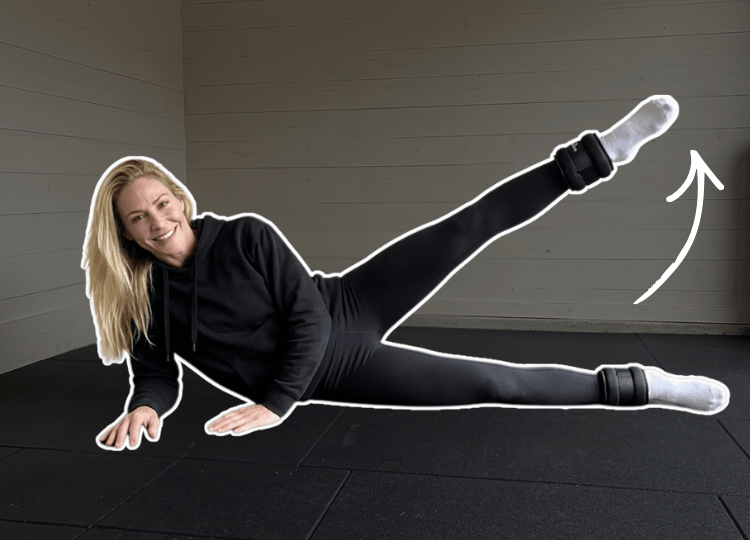
Side-Lying Leg Lift
Muscles worked: Gluteus medius, hip abductors, obliques
Lie on your side with your body in a straight line, legs stacked and fully extended. Keeping the foot flexed and the toes pointing forward, raise the top leg toward the ceiling. Pause briefly at the top, then lower with control. The body should remain in a straight line — resist the urge to roll forward or backward.
Sets and reps: 3 sets of 15 to 20 reps each side
Glute Bridge with Leg Extension
Muscles worked: Gluteus maximus, hamstrings, core, hip flexors
Lie on your back with knees bent and feet flat on the floor. Drive through the heels to lift the hips into a bridge position. From here, extend one leg straight out at knee height, hold for 2 seconds, then return the foot to the floor before lowering. The ankle weight adds resistance to the extension phase, increasing demand on the hip flexors and core.
Sets and reps: 3 sets of 10 reps each side
Superman
Muscles worked: Gluteus maximus, lower back erectors, hamstrings
Lie face down with arms extended overhead. Simultaneously lift the right arm and left leg off the floor, squeezing the glute of the working leg at the top. Hold briefly, then lower and repeat on the opposite side. The ankle weight increases the load on the glute and hamstring of the lifting leg, making this an effective posterior chain exercise that requires no equipment other than a mat.
Sets and reps: 3 sets of 12 reps each side
Lying Leg Raise
Muscles worked: Hip flexors, lower abdominals, quadriceps
Lie flat on your back with legs straight and hands placed lightly beneath the lower back for support. Keeping both legs together and straight, raise them toward the ceiling until they are perpendicular to the floor, then lower with control, stopping just before the feet touch the ground. The ankle weight adds significant load to this movement because the legs are the longest lever available in the human body.
Sets and reps: 3 sets of 10 to 12 reps
3 Ankle Weight Workouts
Workout 1: Glutes and Hips
Ideal for targeting the posterior chain and outer hip muscles. This workout can be done entirely on a mat.
Warm-up: 5 minutes of light movement, hip circles and lateral leg swings (2 sets of 15 each side).
| Exercise | Sets | Reps |
|---|---|---|
| Donkey Kick | 3 | 15 each side |
| Fire Hydrant | 3 | 12 each side |
| Donkey Kick Pulses | 3 | 10 + 10 pulses each side |
| Side-Lying Leg Lift | 3 | 20 each side |
| Clamshell | 3 | 15 each side |
| Glute Bridge with Leg Extension | 3 | 10 each side |
| Superman | 3 | 12 each side |
Cool-down: Hip flexor stretch, glute stretch, 3 to 5 minutes.
Workout 2: Core and Lower Body
This workout combines lower body conditioning with core activation, using a mix of standing and floor movements.
Warm-up: 5 minutes of light movement, front and rear leg swings, bodyweight squats.
| Exercise | Sets | Reps |
|---|---|---|
| Standing Front Leg Raise | 3 | 12 each side |
| Standing Rear Leg Raise | 3 | 12 each side |
| Reverse Lunge with Knee Drive | 3 | 10 each side |
| Squat with Rear Kickback | 3 | 10 each side |
| Lying Leg Raise | 3 | 10 to 12 |
| Glute Bridge with Leg Extension | 3 | 10 each side |
| Superman | 3 | 12 each side |
Cool-down: Hip flexor stretch, hamstring stretch, lower back stretch. 3 to 5 minutes.
Workout 3: Full-Body Barre-Style Session
This workout is structured around the high-rep, controlled movement style of barre training. It is well suited to anyone who enjoys that format, or wants a longer session focused on endurance and muscle tone rather than raw strength.
Warm-up: 5 minutes of light movement, arm circles, hip circles and lateral leg swings.
| Exercise | Sets | Reps |
|---|---|---|
| Standing Side Leg Raise | 3 | 15 each side |
| Standing Hip Abduction with Pulse | 3 | 10 + 3 pulses each side |
| Step-Up with Knee Drive | 3 | 10 each side |
| Donkey Kick Pulses | 3 | 10 + 10 pulses each side |
| Clamshell | 3 | 15 each side |
| Fire Hydrant | 3 | 12 each side |
| Side-Lying Leg Lift | 3 | 20 each side |
| Lateral Leg Swing | 2 | 15 each side (as a finisher/cool-down) |
Cool-down: Full hip and glute stretch sequence, 5 minutes.
Things to Keep in Mind
Do not use ankle weights for running or high-impact exercise
The lever arm effect that makes ankle weights effective for controlled movements also makes them potentially harmful during dynamic, high-velocity activities. Running with ankle weights alters gait mechanics and places excessive stress on the knee, hip and ankle joints. These are tools for controlled, low-impact work.
Start lighter than you think necessary
2 lbs at the ankle during a set of 15 donkey kick pulses is harder than it sounds. Ego-loading is one of the most common mistakes with ankle weights and leads to compensatory movement patterns that shift the work away from the target muscles.
Control the movement throughout
Ankle weight exercises respond well to slow, deliberate reps with a brief pause at peak contraction. Rushing through the reps allows momentum to do the work rather than the muscle.
Progress gradually
Once a given weight feels manageable across all sets and reps for 2 consecutive sessions, increase the load by 0.5 to 1 lb. Small increments over time produce consistent progress without compromising form.
Pair with compound lower body training
Ankle weight exercises are excellent accessory work but are most effective when part of a broader lower body programme that includes compound movements like squats, lunges and deadlifts. The 2 approaches complement each other well; compound movements build overall lower body strength, while ankle weight isolation work targets the glutes and hips in ways that heavier bilateral exercises cannot replicate.
Bottom Line
Ankle weights occupy a useful but specific space in a well-rounded training programme. They are not a substitute for progressive resistance training, but for glute and hip isolation work, rehabilitation movements, and barre-style sessions, they are a genuinely effective tool backed by solid research.
The 16 exercises above cover the full range of what ankle weights do well; from standing hip work that drives high gluteus medius activation to floor-based posterior chain exercises that can be done on a mat at home. The 3 workouts pull the best of these movements into structured sessions suitable for different goals and experience levels.
Related Articles