

There is a specific kind of frustration that comes with noticing your arms changing and not knowing quite what to do about it.
Not a dramatic change. Just softer, less defined, slightly less capable than they used to be. A bit harder to carry things for long periods. A bit less confidence in a sleeveless top.
This is not vanity… it is biology. And understanding the biology is the first step to doing something useful about it.
Why Arms Change After 50
From around age 30, the body begins losing muscle mass gradually. The rate of loss is slow at first, around 0.5 to 1% per year, but it accelerates significantly around menopause.
Research published in Frontiers in Endocrinology confirms that the decline in estradiol, the primary form of estrogen, directly affects skeletal muscle function by reducing muscle satellite cell activity, the cells responsible for muscle repair and growth. The result is that muscle breaks down more easily and rebuilds more slowly.
This is not just about aesthetics.
Muscle in the arms matters for carrying, lifting, pushing, pulling, reaching and everything that constitutes an independent, active daily life. University Hospitals research notes that muscle strength can decline by 1.5 to 5% per year from midlife onward, with the effects becoming clinically significant through the 60s and 70s. The arms are not exempt from this.
The good news is that this process is not irreversible. Research consistently shows that women who begin strength training in their 50s, 60s and beyond can build muscle and improve function within months. The exercises below are the most effective ones for doing exactly that.
What to Know Before You Start
- Progressive overload matters. The arms respond to challenge the same way they always have. If the weight never gets heavier over time, the muscle has no reason to grow. Start with a weight that is genuinely challenging for the final 2 to 3 reps of a set, and increase incrementally as it becomes easier.
- Heavier than you think. The instinct is to go light. In reality, research supports training with weights heavy enough to produce genuine fatigue within 8 to 12 reps. Weights that feel comfortable throughout produce minimal adaptation. A little discomfort in the final reps of a set is the signal that the stimulus is there.
- Slow the eccentric. The lowering phase of any exercise, when the muscle lengthens under load, is where a significant proportion of the muscle-building stimulus occurs. Lowering a dumbbell in 2 to 3 seconds rather than letting it drop doubles the quality of every rep without adding a single extra set.
- Frequency. 2 to 3 arm-focused sessions per week is sufficient for meaningful improvement. More is not necessarily better, because muscle is built during recovery, not during the session itself.
Best Arm Exercises for Women Over 50
Dumbbell Bicep Curl
Targets: Biceps brachii, brachialis, brachioradialis
The foundation of any arm programme and one of the most effective exercises for the front of the upper arm. Stand with a dumbbell in each hand, palms facing forward, elbows close to the sides. Curl both dumbbells toward the shoulders without swinging the body, pause briefly at the top, then lower with control over 2 to 3 seconds.
The lowering phase is where most people rush and where most of the adaptation is lost. If you can only manage the controlled descent with a lighter weight, use the lighter weight.
Sets and reps: 3 sets of 10 to 12 reps.
Hammer Curl
Targets: Brachialis, brachioradialis, biceps
Same movement as a standard curl but with a neutral grip, palms facing each other throughout. This grip reduces stress on the wrist and elbow joint while shifting more of the load to the brachialis, the muscle that sits beneath the biceps and contributes significantly to overall arm thickness and elbow strength.
For anyone who experiences wrist or elbow discomfort during standard curls, the hammer curl is the more joint-friendly alternative that does not compromise the training stimulus.
Sets and reps: 3 sets of 10 to 12 reps.
Overhead Tricep Extension
Targets: Triceps long head, triceps medial and lateral heads
The triceps make up roughly two thirds of the upper arm. They are the primary reason arms look toned or not, yet they are significantly undertrained compared to the biceps in most people’s routines.
The overhead position is the most important detail here. Holding a dumbbell with both hands and extending it overhead with arms close to the ears places the long head of the triceps, the largest of the 3 tricep heads, in a fully lengthened position under load. This is the loaded stretching principle applied to the triceps, and it is why overhead extensions produce more long head development than pushdowns or kickbacks.
Hold the dumbbell vertically with both hands, arms extended overhead. Bend the elbows to lower the dumbbell behind the head, keeping the upper arms still and close to the ears, then extend back to the start.
Sets and reps: 3 sets of 10 to 12 reps.
Tricep Kickback
Targets: Triceps, particularly the lateral head
Hinge forward at the hips to around 45 degrees, a dumbbell in each hand. Bring the upper arms parallel to the floor, elbows bent to 90 degrees. Extend both arms straight back by straightening the elbows fully, hold for 1 second, then return with control.
The key is keeping the upper arms completely still throughout. If they drop during the extension, the load shifts away from the tricep. The pause at full extension ensures the muscle contracts completely at the top, which is where the tricep is working hardest in this exercise.
For anyone with shoulder pain during overhead movements, kickbacks are the better tricep option because they do not require any overhead range of motion.
Sets and reps: 3 sets of 12 to 15 reps.
Push-Up (or Incline Push-Up)
Targets: Chest, triceps, shoulders, core
One of the most functional upper body exercises available, because it loads the arms in a way that directly mirrors real-world pushing tasks. From a full plank position, lower the chest to the floor by bending the elbows, keeping them at roughly 45 degrees from the body rather than flaring wide, then press back up.
If a full push-up is not yet accessible, an incline push-up from a bench, chair or countertop uses the same movement pattern with less load. The incline version is not a lesser exercise. It is the same exercise at an appropriate difficulty level, and most people progress to floor level within a few weeks of consistent practice.
The chest and triceps both benefit from the full range, which means lowering all the way to the floor or surface on every rep rather than stopping halfway.
Sets and reps: 3 sets of 8 to 15 reps, depending on difficulty level.
Shoulder Press
Targets: Deltoids, triceps, upper trapezius
Sit or stand with a dumbbell in each hand at shoulder height, palms facing forward. Press both dumbbells overhead until the arms are fully extended, then lower with control back to the start.
The shoulder press is one of the most important exercises on this list for functional independence. Reaching overhead, placing items on shelves, and any pushing motion involving height all depend on exactly the strength this exercise develops. Shoulder strength also supports the rotator cuff, the group of smaller muscles around the shoulder joint that become increasingly important for joint stability and injury prevention after 50.
Seated is a perfectly valid variation. Removing the balance demand allows full focus on the pressing movement and is preferable for anyone managing lower back issues.
Sets and reps: 3 sets of 10 to 12 reps.
Lateral Raise
Targets: Medial deltoid (side of the shoulder)
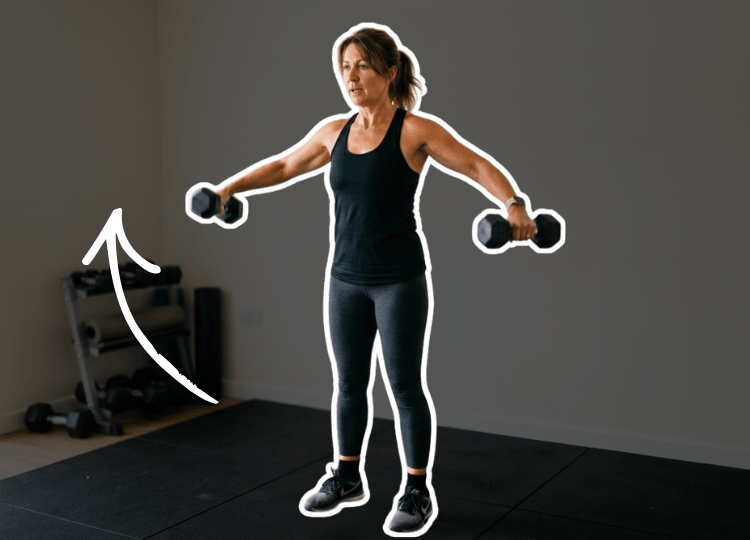
Stand with a dumbbell in each hand at the sides, a soft bend in the elbows. Raise both arms out to the sides to shoulder height, hold briefly, then lower with control. The movement should be smooth and controlled rather than swinging, and the arms should stop at shoulder height rather than above it.
The lateral raise specifically develops the medial head of the deltoid, which gives the shoulder its rounded, defined appearance. It also contributes to shoulder stability and is the exercise most responsible for that visible separation between the shoulder and the upper arm. Use lighter weights than you expect to need.
Alternatively, try lu raises with an extended range of motion for a more effective movement.
Sets and reps: 3 sets of 12 to 15 reps.
Dumbbell Row
Targets: Latissimus dorsi, rhomboids, biceps, rear deltoid
Place 1 knee and 1 hand on a bench for support, holding a dumbbell in the opposite hand. With the back flat and torso roughly parallel to the floor, pull the dumbbell up toward the hip by driving the elbow back. Lower with control. This is sometimes called a single-arm row.
The dumbbell row belongs in an arm programme for 2 reasons. First, the biceps are heavily involved as secondary movers, so it trains them through a functional pulling pattern in addition to isolated curl work.
Second, developing the back muscles around the shoulder is essential for joint health and posture after 50. Upper body pulling strength counteracts the forward rounding that desk work, driving and phone use all encourage, and that rounding puts the shoulder joint in a position where arm exercises become more likely to cause discomfort over time.
Sets and reps: 3 sets of 10 to 12 reps per side.
A Simple Weekly Structure
These exercises do not all need to be done in 1 session. A practical approach that covers all the bases:
- Session 1: Bicep curl, hammer curl, overhead tricep extension, shoulder press. This covers the front and back of the arm plus overhead function.
- Session 2: Push-up, tricep kickback, lateral raise, dumbbell row. This covers chest and triceps through a functional movement, side shoulder development and pulling strength.
2 sessions per week is enough to produce measurable improvement. 3 sessions per week, rotating through the exercises, will accelerate results. The rest between sessions is when the adaptation actually happens, so training arms every day is counterproductive.
Start each session with 2 to 3 minutes of light movement to warm the shoulder and elbow joints. Arm circles, band pull-aparts if available, or a set of light lateral raises through a comfortable range are all sufficient.
Bottom Line
The changes that happen to arms after 50 are real, driven by a combination of hormonal shifts and the accumulated effects of not specifically challenging those muscles. But they are not fixed. The research is consistent: women who train their arms with progressive resistance build muscle, improve definition and maintain the functional strength that keeps daily life easy and independent.
The exercises above cover every major muscle group in the arm and shoulder. They require only dumbbells and a bench or chair, and 2 sessions per week is enough to see results within 4 to 6 weeks.
The weight should feel challenging. The pace should be controlled. And the lowering phase should never be rushed.
Related Articles
Try This Simple Longevity Workout Routine