

Most people training for muscle growth have heard of progressive overload, periodisation, time under tension.
But there is a dimension of training that gets far less attention despite having a growing body of research behind it: where in the range of motion the load is applied.
The evidence is increasingly clear that muscles respond more to being trained at their longest, most stretched point than at their shortest.
Training the lengthened position produces more muscle growth, more durable flexibility gains, and adaptations at the structural level of the muscle fibre that mid-range training simply does not.
This principle has a name: loaded stretching.
It is not a replacement for conventional strength training. It is a smarter way of thinking about exercise selection and range of motion within the training you are already doing.
This guide explains what loaded stretching actually is, what the research says about why it works, and which exercises apply it most effectively.

Quick Summary
- Training a muscle at its longest point under load builds more muscle than training it at mid-range. That is the entire principle.
- Most people are already doing this without realising it. The Romanian deadlift, incline curl and deep squat are all loaded stretches.
- Loaded stretching is not a separate training method. It is a smarter way of choosing exercises and using the full range of motion you already have available.
What Is Loaded Stretching?
Loaded stretching means placing a muscle under external resistance while it is in a lengthened, stretched position. Instead of relaxing into a stretch, you are holding or moving through that position against a load.
The simplest way to picture it: the bottom of a Romanian deadlift. Your hamstrings are at their longest point, and you are holding a barbell. The muscle is not passively resting in that position. It is under tension from both the mechanical stretch itself and from the weight in your hands.
That combination is the key. Passive stretching applies tension through the stretch alone. Loaded stretching applies tension through the stretch and through external resistance simultaneously, creating a stimulus that is qualitatively different.
The concept overlaps with several terms you may have encountered: lengthened position training, lengthened partials, stretch-mediated hypertrophy, and full range of motion training. They are all describing variations of the same principle: that muscles respond differently when trained at longer lengths compared to shorter ones.
Lengthened muscles
The concept overlaps with several terms you may have encountered: lengthened position training, lengthened partials, stretch-mediated hypertrophy, and full range of motion training. They are all describing variations of the same principle: that muscles respond differently when trained at longer lengths compared to shorter ones.
Best Loaded Stretching Exercises To Try
These are exercises that naturally load the target muscle in a lengthened position. They are not novel movements, but understanding why they work provides the cue to use them correctly.
Romanian Deadlift (hamstrings and glutes)
The RDL loads the hamstrings and glutes maximally at the bottom of the movement where they are at their longest. This is the opposite of a leg press, which primarily loads those muscles in the shortened position.
To maximise the loaded stretch, lower slowly until you feel a strong stretch in the hamstrings, pause briefly, then drive back up. The pause at the bottom is where the loaded stretch stimulus is concentrated.
Jefferson Curl (posterior chain and spine)
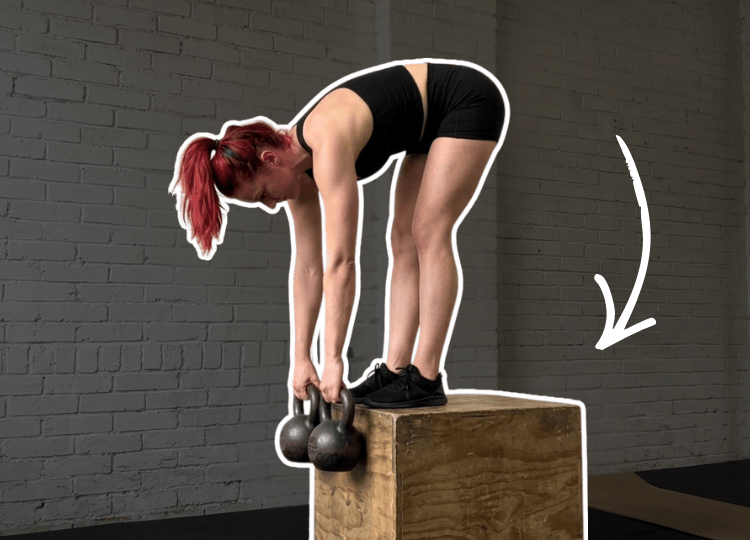
Stand on an elevated surface holding a light dumbbell or barbell, then slowly roll the spine into full flexion, vertebra by vertebra, reaching down past the feet. The erector spinae, hamstrings and all of the supporting spinal tissue are placed under loaded tension in a fully lengthened position.
This is the exercise most closely associated with loaded stretching in popular fitness culture, and for good reason. No other movement quite replicates the combination of segmental spinal mobility and posterior chain stretch it provides.
That said, it comes with a genuine caveat: loaded spinal flexion is one of the most debated movements in exercise science, with researchers including Professor Stuart McGill of the University of Waterloo noting that it places the intervertebral discs in a potentially vulnerable position under load.
The exercise has a legitimate place for those building toward it progressively with very light loads, but it is not appropriate for beginners, anyone with a history of disc injury, or anyone who attempts it with significant weight. Start with bodyweight on a low deficit. Build range and load extremely slowly over months, not weeks.
Incline Dumbbell Curl (biceps)
The incline position, where the arms hang behind the body, puts the biceps in a pre-stretched position before the movement even begins. This is one of the reasons the incline curl is considered more effective for bicep development than a standard standing curl: the biceps is loaded at a longer length throughout the early part of the movement.
Cable or Dumbbell Fly (chest)
Where a chest press loads the pectorals most at the shortened position near the top of the movement, a fly loads them maximally at the bottom where the arms are wide and the pecs are at their most stretched.
The cable version is particularly effective here because it maintains constant tension throughout that full arc, including the deep stretched position where dumbbell resistance drops off. For anyone whose chest responds poorly to pressing, adding flies and ensuring the arms travel fully wide at the bottom is the loaded stretch application for that muscle group.
Deficit Push-Up (chest, alternative)
If you train at home or without a cable machine, placing the hands on 2 elevated surfaces and lowering the chest below them extends the pec stretch further than a standard push-up. Same principle as the fly, different tool.
Overhead Triceps Extension (triceps)
With the arm raised overhead, the triceps long head, which crosses both the shoulder and elbow, is placed in a fully lengthened position under load. This is the main reason overhead triceps work is considered superior for long head development compared to pushdowns, where the triceps is in a relatively shortened position throughout.
Dumbbell Pullover (lats and long head of triceps)
Lying on a bench or the floor with a dumbbell held above the chest, lowering the weight behind the head places both the lats and the triceps long head under a significant loaded stretch simultaneously.
It is one of the few exercises that loads the lats in a lengthened overhead position rather than the shortened position typical of pulldowns and rows. Often overlooked in modern programming, it belongs in this category as much as any exercise here.
Deep Squat (quads)
Full depth squats, where the hip crease drops below the knee, place the quadriceps under load at a longer muscle length than a partial squat.
Research has consistently found greater quad hypertrophy from deeper squat variations compared to partial ones. The loaded stretch of the quads occurs at the bottom of the movement.
Seated Calf Raise (soleus)
The seated version loads the soleus in a dorsiflexed position, which is its most lengthened state. Standing calf raises, by contrast, mostly challenge the muscle through a shorter range. For ankle mobility and calf development, the seated version provides a loaded stretch the standing version does not.
Why the Lengthened Position Matters
There are 2 things happening when a muscle is trained at a long length that do not happen to the same degree when it is trained at mid-range or in a shortened position.
The first is mechanical tension. Research published in PMC explains that as a muscle lengthens, passive tension from the non-contractile elements of the tissue, tendons, fascia, and a protein called titin, increases significantly. Total muscular tension is actually highest when the muscle is in a stretched position.
Adding external load on top of that passive tension amplifies the mechanical signal even further. More tension at longer lengths sends a stronger anabolic signal through the mTOR pathway, the primary molecular route for muscle protein synthesis.
The second is structural adaptation. Training the lengthened position can produce something passive stretching alone cannot: sarcomerogenesis, which is the addition of new sarcomeres in series along the length of the muscle fibre.
This is sometimes called longitudinal hypertrophy. The muscle literally grows longer at the structural level, not just more tolerant of being stretched. This also has a knock-on effect for flexibility, because a muscle with more sarcomeres can reach a longer length before tension becomes prohibitive.
This is why strength training through a full range of motion has been shown in research to produce similar flexibility improvements to dedicated stretching programmes. The loaded range of motion is doing both jobs at once.
What the Research Says
The foundational work comes from animal studies, where weights attached to bird wings produced dramatic muscle growth from the stretched position alone. The protocols involved hours of loading per day, which does not translate directly to gym training, but the biological signal was clear.
Human research is more nuanced but largely points in the same direction. Multiple randomised controlled trials have found greater muscle growth from training at longer muscle lengths.
A study by Pedrosa and colleagues found roughly twice as much quad hypertrophy from deeper knee extensions compared to shallower ones. A 2025 study published in PeerJ, co-authored by Brad Schoenfeld’s lab, concluded that trainees seeking to maximise muscle size should prioritise the stretched position.
Key summary of the research
The animal research is dramatic but not directly applicable. The human research is younger and still developing, but consistently points toward greater muscle growth from the lengthened position. The practical takeaway is robust even if the full mechanism is still being worked out.
The Honest Caveat
The current research on lengthened position training is compelling but not settled. The studies are mostly short-term, and many involve untrained or recreationally trained participants. The mechanisms are still being debated: it is not entirely clear whether the additional growth comes from passive stretch tension specifically, from greater eccentric loading in the lengthened position, from a dose-response relationship with range of motion, or from some combination of all three.
What is consistently supported is that training through a greater range of motion and emphasising the lengthened position tends to produce more muscle growth than training through a partial range that avoids the stretched position.
The term stretch-mediated hypertrophy, while widely used, is something of a misnomer: the additional growth likely has multiple contributors, not a single mechanism. The practical take-away is robust even if the underlying science is still developing.
Things to Consider Before You Start
- Warm up first. The risk with any loaded stretching is applying tension to cold, unprepared tissue. Cold connective tissue is less compliant and more susceptible to strain. A proper warm-up, light cardio and dynamic movement through the relevant joints, is not optional here.
- Start lighter than you expect. The point of loaded stretching is the position and the tension in that position, not the weight. Going heavy in the lengthened position before your muscles and connective tissue are adapted to that stimulus is the most common route to injury. Build up progressively over several weeks.
- Do not force the range. Loaded stretching works by progressively adapting the muscle to longer lengths under tension. If you are forcing yourself into a range you do not yet have, the load will shift from the target muscle to the passive structures around the joint, including ligaments, which are not designed to handle that kind of stress. Pain during a loaded stretch is a signal to reduce the range or the load.
- Hypermobile individuals should be cautious. For people who already have excess joint laxity, adding loaded tension to already-stretched ligaments and joint capsules can increase instability. If you are naturally very flexible, the goal with loaded stretching is developing strength and control through your existing range, not extending it further.
- Do not abandon compound movements. Loaded stretching is an enhancement to, not a replacement for, traditional strength training. Squats, deadlifts, presses and pulls are still the foundation. The research suggests that prioritising full range of motion in these exercises and making deliberate choices about which exercises emphasise the lengthened position is a meaningful upgrade to how most people train.
Bottom Line
Loaded stretching is not a separate training method to bolt onto your programme. It is a more precise way of thinking about exercise selection and range of motion within what you are already doing.
For most people, the practical change is small: squat deeper, let the dumbbells travel further on a chest press, choose the incline curl over the standing curl, prioritise the RDL over the leg curl. These are not dramatic overhauls. They are deliberate choices about where in the movement the muscle gets challenged most.
The research is still developing, but the direction is consistent. Train muscles at their longest point under load, and they tend to grow more. That is the whole idea.
Related Articles
Wall Sit Time Chart By Age and Gender
Calisthenics for Beginners – Exercises, Tips and Things to Consider