

If you’ve been training your glutes consistently but still feel like something’s missing in terms of shape and definition, the lower glutes are probably the culprit.
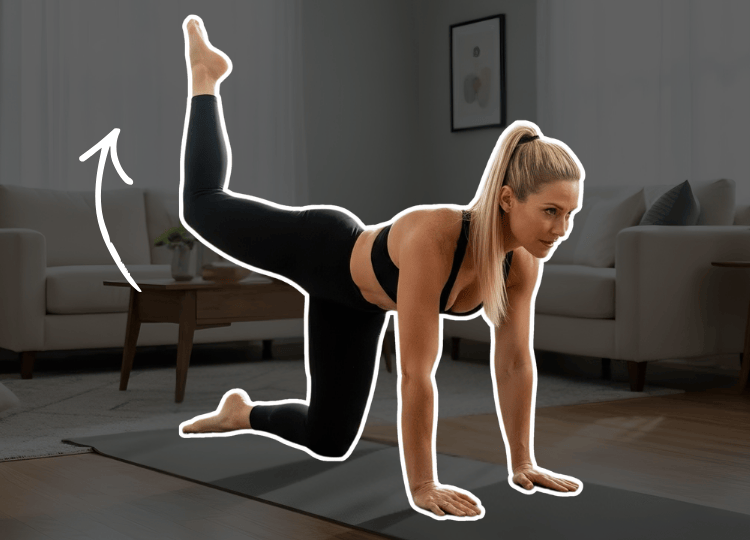
If you’re putting in the work on glute training but still not seeing the rounded, lifted shape you’re after, the lower glutes are likely the missing piece.
This often-neglected area, sometimes called the “underbutt”, can make a significant difference to how your glutes look and perform when trained correctly.
Anatomically speaking, there’s no single “underbutt” muscle, but we can absolutely target the muscle fibres in the lower glutes and upper hamstrings to strengthen and sculpt this specific area.
And with the right exercises, the difference is noticeable.
Beyond aesthetics, stronger lower glutes provide real functional benefits too, generating more lower body power, improving performance in sport and daily life, and playing a key role in stabilising the hips and spine.
In this guide, we cover the 7 most effective lower glute exercises, how to perform each one correctly, the mistakes to avoid, and how to structure it all into a workout that delivers results.
Upgrade your glute training and strength workouts with Alpha Progression.
Try for free.
ADVERTISEMENT
The importance of diet and fat loss
Developing a rounder derrière will involve building muscle in the glutes, but also reducing your body fat percentage. This means adopting a healthy diet alongside doing these exercises would be recommended.
Single Leg Romanian Deadlift
The single leg Romanian deadlift would make our list for pretty much any lower body workout. This unilateral movement helps to combat muscular imbalances and strengthen each side of your body separately.
Hinging at the hips, the single leg Romanian deadlift involves really squeezing your glutes and hamstrings to pull your body back to an upright position.
How to Perform – Stand on one leg with a slight bend in the knee. Hinge at the hips, extending the free leg back for balance. Keep your back straight and core engaged, then slowly return to standing.
Common Mistake to Avoid – Rounding the back or swinging the lifted leg.
Donkey Kicks
Donkey kicks are a popular glute exercise and they lend themselves well for both bodyweight and resistance-based workouts.
Donkey kicks involve a upward (or backward) kick from a quadruped position.
One of the benefits of using donkey kicks to activate the lower glutes is that the movement is very easy to modify and adapt. From a straight leg variation to using different gym weights to provide resistance, it means the donkey kick can keep your glute workouts new and exciting.
To make the most of donkey kicks, we’d recommend really focusing on squeezing the glutes during the movement and slowly lowering your leg back down to keep the muscles under tension for longer.
How to Perform – Start on all fours with a flat back. Lift one leg with the knee bent, aiming the heel upwards. Lower the leg without touching the floor, maintaining controlled movements.
Common Mistake to Avoid – Arching the back or using momentum instead of muscle strength.
Deficit Reverse Lunge
Lunges are a great lower body exercise, but most of us will naturally lunge forward. The biomechanics of this mean the quads are the leading muscle involved in the movement. If, however, you lunge backwards, the glutes and hamstrings become the leading muscles involved.
So, when it comes to sculpting your glutes, include reverse lunges.
Deficit reverse lunges simply increase the range of motion at the hips and allow you to keep muscles under tension for longer. The angle created by the deficit also means it’s the fibres in the lower glutes that are activated.
We recently published a whole guide on the deficit reverse lunge so check that out to learn more on how to do this movement properly.
How to Perform – Stand on an elevated platform. Step back into a lunge, keeping the front knee over the ankle and the chest up. Push through the front heel to return to the start.
Common Mistake to Avoid – Leaning forward or not stepping back far enough, causing strain on the knees.
Frog Squats
Frog squats involve descending into a wide, deep squat with the toes pointed well out, closer to a ballet-style stance than a standard squat.
The glutes are recruited at the top of the movement as you drive the hips up and through, while the quads do much of the work through the lower range. It’s worth noting that the glute involvement here is more of an isometric/accessory nature, which means frog squats work best as a complementary movement within a broader glute workout rather than a primary lower glute builder.
That said, the deep squat position also makes this a useful drill for improving hip mobility and flexibility, a genuine secondary benefit.
How to Perform – Stand with feet significantly wider than shoulder width and toes pointing well out at roughly 45–60 degrees. Keeping your chest up and back neutral, descend into a deep squat. Drive through the heels to return to standing, squeezing the glutes firmly at the top of the movement.
Common Mistake to Avoid – Allowing the heels to lift, the knees to cave inward, or only squatting to a shallow depth. You should also avoid leaning heavily forward with the torso, the chest should stay as upright as possible throughout.
Glute Kickbacks
Glute kickbacks are a great way to train your glutes and hamstrings, and involve pulling one leg behind you. This can be done as a bodyweight movement, but using resistance bands or a cable machine (check out our guide on cable glute kickbacks) allows you to overload the muscle with additional resistance.
Like frog squats, you can incorporate smaller “pulsing” repetitions, as well as slow eccentric repetitions to really focus on sculpting the lower glutes.
It’s worth clarifying how glute kickbacks differ from donkey kicks, which are also listed in this guide. The key distinction is leg position: donkey kicks are performed with the knee bent at roughly 90 degrees, driving the heel toward the ceiling. Glute kickbacks, by contrast, use a straighter leg, extending it back and upward in a more sweeping arc. Both movements activate the glutes effectively, but the straight-leg kickback places slightly more emphasis on the lower glute and hamstring tie-in, while the bent-knee variation offers a stronger peak contraction at the top.
How to Perform – On all fours, extend one leg back and upward, keeping hips stable. Lower the leg in a controlled manner, focusing on glute engagement.
Common Mistake to Avoid – Overarching the back or swinging the leg without control.
Step Ups
Step-ups may look straightforward, but research consistently shows they’re among the most effective exercises for gluteus maximus activation, outperforming many gym staples when it comes to peak glute recruitment.
If you only have access to a bench or a sturdy box, this movement alone can be a serious glute builder. It also trains the glutes unilaterally, helping to address any strength imbalances between sides.
When it comes to unilateral exercises like step ups, you’ve got a decision to make… do you do alternating legs or do a single set on each leg separately. Both options are fine, but if the goal is building muscle, we’d recommend doing a single set on each leg separately, as you can keep the muscles in that leg under tension during the whole set.
(Our guide on step up alternatives offers a list of exercises that offer similar outcomes).
How to Perform – Face a bench, stepping up with one foot. Push through the heel to lift your body, keeping the torso upright. Step down with control.
Common Mistake to Avoid – Relying too much on the back foot or leaning forward, which reduces glute activation.
B Stance Hip Thrust
B stance hip thrusts involve adopting a “staggered” stance during hip thrusts. Think of this like a single leg variation where the other leg is used to support the movement (it’s also sometimes called a kickstand hip thrust, which is a good way to think about the exercise).
The reason we tend to use b stance hip thrusts instead of regular hip thrusts is simply to benefit from unilateral training and ensuring we’re including plenty of movements that help address potential muscular imbalances. We don’t want one side overcompensating for the other side.
B stance hip thrusts also mean you aren’t loading as much weight, which is useful if you’re training at home.
You can of course, however, opt for a regular hip thrust and it will have the same outcome.
For any sort of hip thrust, a little trick to tailor the movement towards your lower glutes, is to place your feet/foot further away on the floor from your glutes. This will activate the hamstrings and lower glutes more than if you placed your feet closer to your glutes.
How to Perform – Sit with your back against a bench, one foot flat, the other toe on the ground. Thrust hips upward, engaging glutes at the top. Lower hips with control.
Common Mistake to Avoid – Overextending the back or pushing mainly from the toes, which can reduce glute focus and strain the back.
FAQs
What is the “Underbutt”?
As mentioned in the intro, there is no “underbutt” muscle… when people refer to the underbutt (or “glute ham tie-in”), it’s really just the lower glutes they’re talking about.
By developing the lower glutes (and dropping excess fat), you can change the appearance of your glutes, developing a more rounded and lifted appearance.
The upper hamstrings will also play a part in this.
How to Target and Train Your Underbutt
When it comes to targeting and training your underbutt, we’re basically talking about glute exercises and workouts. Getting stronger glutes will largely play a defining role.
As highlighted in this article, there are certain exercises and variations, that help to put more emphasis on the muscle fibres in the lower glutes, compared to just doing generic leg workouts.
Although there is a place for high rep, sculpting style workouts, to build muscle, you’ll want to include some sort of progressive overload training into your workouts. This means using additional resistance (e.g. dumbbells, bands, cables, barbells, kettlebells), to force the muscles to work harder and grow.
Although you can build meaningful muscle with bodyweight exercises, particularly as a beginner, adding external resistance makes it easier to progressively overload the muscles over time, which is the key driver of long-term growth. If you’re training at home without equipment, focus on increasing reps, slowing down the tempo, or adding pauses to keep making progress.
(Check out of guide on lifting weights for women if you want help getting started).
Importance of Training the Underbutt
The underbutt, or lower glutes, helps to provide stability and support to the spine and hips. Weak glutes can often be the root cause for back ache and poor posture.
Training the glutes and your underbutt goes beyond just the aesthetic reasons and can help improve functional movement too.
It’s important, however, not to overtrain the glutes and ignore other parts of your body. We’d recommend following a workout split like the PPL (push, pull, legs) to ensure you are following a balanced routine that avoids creating muscular imbalances.
Lower Glute/Underbutt Workout
The 7 exercises listed are all you need to create an effective lower glute/underbutt workout.
We’d recommend selecting 4 or 5 of these exercises and doing 3 or 4 sets of between 8-12 repetitions for each exercise. This means selecting a weight whereby 8-12 repetitions feels challenging yet achievable. You may want to do an introductory workout where you test different weights to give you an idea of what weights are best suited to your current strength.
Over the weeks, you can rotate the exercises to keep the workout fresh.
Doing 3 sets of between 8-12 repetitions will focus on hypertrophy and developing muscle. If you want to focus more on sculpting, you may want to increase the repetitions and select a lighter weight.
| Workout | Exercise | Sets | Reps |
|---|---|---|---|
| A | Single Leg Romanian Deadlift | 3-4 | 8-12 |
| A | Deficit Reverse Lunge | 3-4 | 8-12 |
| A | Frog Squats | 3-4 | 8-12 |
| A | Glute Kickbacks | 3-4 | 8-12 |
| B | Donkey Kicks | 3-4 | 8-12 |
| B | Step Ups | 3-4 | 8-12 |
| B | B Stance Hip Thrust | 3-4 | 8-12 |
| B | Glute Kickbacks | 3-4 | 8-12 |
Bottom Line
If you’re looking to target your lower glutes, try these exercises in your next workout. Remember to focus on really squeezing the glutes during the exercises and maintain proper form throughout.
Over time, try and increase the weight you’re lifting to keep progressing.
For aesthetic and visual transformations, you’ll need to consider your diet and overall fat composition too.
Related Articles
4 Week Glute Workout Plan with PDF