

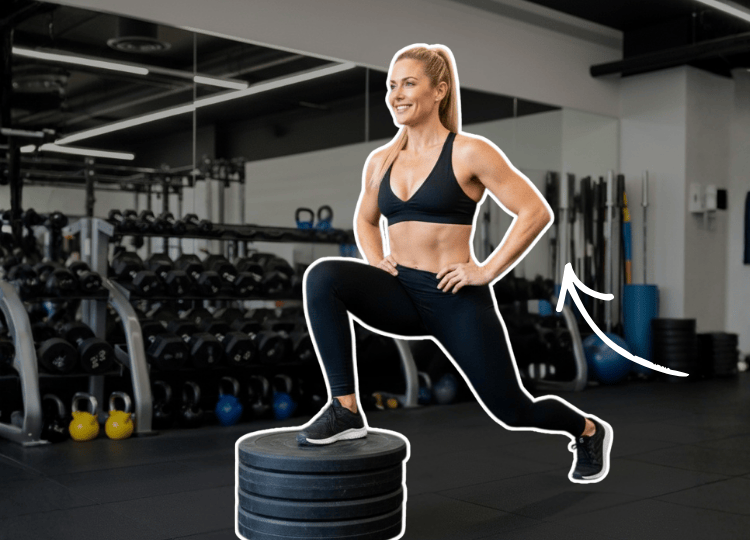
If you had to pick one exercise that ticks almost every box for lower body training, glute activation, hamstring development, hip mobility, unilateral strength, knee friendliness, the deficit reverse lunge would be a strong contender.
The movement sits in a sweet spot that’s surprisingly hard to find: it loads the glutes and hamstrings through a greater range of motion than a standard lunge, causes virtually no impact stress on the leading knee, and builds the kind of single leg strength that carries over to sport, running, and everyday movement.
Whether you’re training for performance, aesthetics, or joint longevity, this exercise deserves a place in your programme.
This guide covers everything you need to know, including how to perform it correctly, muscles worked, benefits, how to load it, and how it compares to a standard reverse lunge.
Getting Started…
If you’ve never done any sort of reverse lunge before, we’d recommend getting comfortable with a standard reverse lunge first, before adding a deficit.
How to do a Deficit Reverse Lunge
To do deficit reverse lunges:
- Stand with your feet shoulder width apart on a raised platform. To make the movement more challenging, you can add resistance, such as holding a pair of dumbbells/kettlebells or even holding a weighted barbell on your upper back.
- Shift your weight onto your left leg and lift your right foot off the platform and place it behind you and lunge down. Keep your left foot flat on the raised platform for the whole movement. Lean forward slightly as you place your right foot behind you to maintain balance.
- Drive through your left leg to create the power to return your right foot to the platform.
- Repeat this on the other side.
Coach’s Tip – Don’t get distracted by the trailing leg… it’s the front leg that should be generating the power for the movement. To help ensure you’re focusing on the front leg, we’d recommend only placing your toes on the ground with your back leg, to remind you it is just there for stability.
Creating a Deficit
By deficit, we mean, the movement goes beyond just doing it on a flat surface, i.e., your knee goes lower than the lowest point of the raised platform (which would be the floor if you did it on a flat surface). One or two barbell plates is often a popular choice, or a step bench.
Deficit Reverse Lunge Muscles Worked
Gluteus Maximus
The glutes are the primary target and the main reason most people include this exercise in their programme. Research comparing lunges to back squats found significantly greater gluteus maximus activation during lunges, with no significant difference in quad activation between the two exercises – meaning if glute development is the goal, lunges have a meaningful edge.
The deficit amplifies this further by increasing hip flexion at the bottom of the movement, requiring more hip extension to return to the starting position and keeping the glutes under load for longer.
Hamstrings
The hamstrings work alongside the glutes throughout the movement, particularly during the drive back to the starting position. Because the exercise is initiated by stepping backward rather than forward, the glutes and hamstrings fire first – before the quads get involved.
This makes the deficit reverse lunge genuinely posterior-chain dominant in a way that forward lunges aren’t.
Quadriceps
The quads of the front leg are engaged throughout, working to control the descent and stabilise the knee during the movement.
The degree of quad involvement can be adjusted by stride length – a shorter step back increases knee flexion and quad demand, while a longer step back reduces it and shifts more emphasis onto the glutes and hamstrings.
Gluteus Medius and Hip Stabilisers
The gluteus medius on the working leg is continuously active as a stabiliser, keeping the pelvis level and preventing the knee from caving inward during the movement.
Research on lunge variations consistently shows meaningful gluteus medius activation, particularly during the descent phase… making this a useful secondary benefit for anyone working on hip stability.
Core
The core works throughout every rep to maintain an upright torso and prevent rotation. This demand increases when holding dumbbells at the sides rather than a barbell on the back, since the load is further from the centre of gravity.
Forward Vs Reverse Lunges
As a general training principle, lunges work the lower body, but forward lunges put more emphasis on the quads, whilst reverse lunges put more emphasis on the glutes and hamstrings. A deficit lunge will simply increase this focus, depending on whether you go forwards or backwards.
Deficit Reverse Lunge Benefits
Gentle on the Knee Joint
The deficit reverse lunge has an unusual quality for a challenging lower body exercise – it’s genuinely knee-friendly.
The reason comes down to mechanics: the leading leg remains planted on the platform for the entire duration of each rep, which means it never has to absorb impact forces or decelerate a moving body.
This is what makes forward lunges so problematic for people with knee issues – and what the reverse variation eliminates entirely. The result is an exercise that can load the quads, glutes and hamstrings effectively while placing far less anterior stress on the patella than squats or forward lunges.
Glutes and Hamstrings Fire First
In a forward lunge, the quads and hip flexors initiate the movement as the body steps forward. In a reverse lunge, the glutes and hamstrings fire first as the body steps back – a meaningful difference for anyone whose primary goal is posterior chain development.
Combine this with the additional hip flexion created by the deficit, and the result is a movement that challenges the glutes through a greater range of motion than almost any other lunge variation.
Target Lower Glutes
Although lunging forward and lunging backwards may seem like “basically” the same movement… the biomechanics are very different.
For a reverse lunge, the glutes and hamstrings are getting engaged first, and they lead the movement (as opposed to the quads for a forward lunge). If you want to focus on your glutes and hamstrings, this difference in the direct you’re lunging is definitely worth considering.
The deficit also means the range of motion at the hips is greater… which firstly, means your glutes have to work harder, but it also changes the angle at which your glutes are contracting, engaging more muscle fibres at the bottom of the gluteus maximus. In other words, it’s a very effective way at developing your lower glutes.
Remember to lean your torso forward slightly too… as this helps put more emphasis on your glutes during the movement.
The recommendation to lean slightly forward during the movement isn’t just a balance cue – it has research support. Studies have found that a forward trunk lean during lunges significantly increases gluteus maximus and biceps femoris activation compared to an upright position.
Incorporating a deliberate but controlled forward lean as you step back is one of the simplest ways to increase the glute stimulus of each rep.
Unilateral Training
Training each leg separately forces the body to address any strength or stability imbalances that bilateral exercises can mask.
It also requires the core and hip stabilisers to work harder throughout, builds practical balance and coordination, and reduces spinal loading compared to heavy bilateral squats – making it a sensible option for those managing lower back issues.
Easy to Increase Load
The deficit reverse lunge makes it easy to progressively overload the muscles. If you have access to a wide range of dumbbells, like in a gym, you can simply grab heavier dumbbells between each set to keep the muscles working harder.
You can also add weight in so many ways… whether you prefer a barbell, kettlebells, dumbbells, or bands… it can fit around whatever equipment you have available.
Add Variety to a Glute Workout
Most glute exercises involve hinging at the hips, and you may find after a few months, you’re losing a bit of motivation to do the same glute exercises week in, week out. If so, adding in a new movement like the deficit reverse lunge can be a welcome addition… and help engage the glutes in a different way.
Selecting Your Weights and Deciding Sets
If the aim of the game is to strength and build muscle in the glutes, we’d recommend holding dumbbells. This will likely be the best way to add resistance so your legs take the weight.
If you’re using deficit reverse lunges for a more general workout, then you may want to consider holding a light barbell overhead to engage the core and shoulders during the movement too. This approach might mean that it’s your core or shoulders that weaken first though, so like we mentioned, if the focus is on glutes, then holding dumbbells in each hand is probably your best bet.
Your overall goals may also influence if you want to do alternating legs or a set of each leg separately. Although both are completely fine, they are suited to different goals. Alternating legs is better for testing your balance and stability, but you’ll lose tension as you swap sides. Doing each leg separately is better for muscle development as you can keep the same leg under tension for the whole set.
On platform height: most coaching sources recommend a raised surface of 2 to 6 inches for the deficit. One or two standard barbell plates stacked together is a common and practical choice.
Starting at the lower end of this range and progressing upward as hip mobility and control improve is the sensible approach – going too high too soon tends to result in the lower back compensating rather than the hips and glutes working through the full range.
When Should You Do Deficit Reverse Lunges?
This really depends on your existing workout plan, but we’d do them after any big lifts, such as weighted squats, so you don’t tire your muscles before these compound movements. Or you could use them as a warm-up by not using any weight and just activating the glutes. Equally, they can work well in a HIIT style workout too.
Deficit Reverse Lunge Vs Reverse Lunge
The deficit reverse lunge is a direct progression from the standard reverse lunge, sharing the same movement pattern and biomechanics but requiring greater range of motion at the hips due to the raised platform.
The standard reverse lunge is the right starting point for anyone new to this style of training – it builds the coordination, balance, and posterior chain strength needed to get the most from the deficit variation. Once you can perform 3 sets of 12 to 15 reps per side with good control and full range, adding a deficit is a natural next step.
It’s also worth knowing where the deficit reverse lunge sits in the broader lunge family. Forward lunges put more emphasis on the quads, while reverse lunges shift the focus to the glutes and hamstrings. A deficit amplifies whichever direction you choose – but the reverse variation’s combination of posterior chain priority and reduced knee stress makes it the more versatile and widely applicable option for most training goals.
Bottom Line
The deficit reverse lunge is one of the most well-rounded lower body exercises available… genuinely effective for glute and hamstring development, kind to the knee joint, progressive, and adaptable to a wide range of training goals and equipment setups.
It’s also, as the title of this article suggests, one of the gym’s most underused movements.
Start with a standard reverse lunge if you’re new to the pattern, then introduce the deficit once your form is solid and your hip mobility allows for the increased range of motion.
Done consistently, it has a way of quietly becoming one of the most valuable exercises in your training week.
Related Articles
Best Leg Press Foot Placement for Glutes, Quads, Hamstrings and Calves
Lateral Side Squats – How to Perform, Benefits and Muscles Worked