

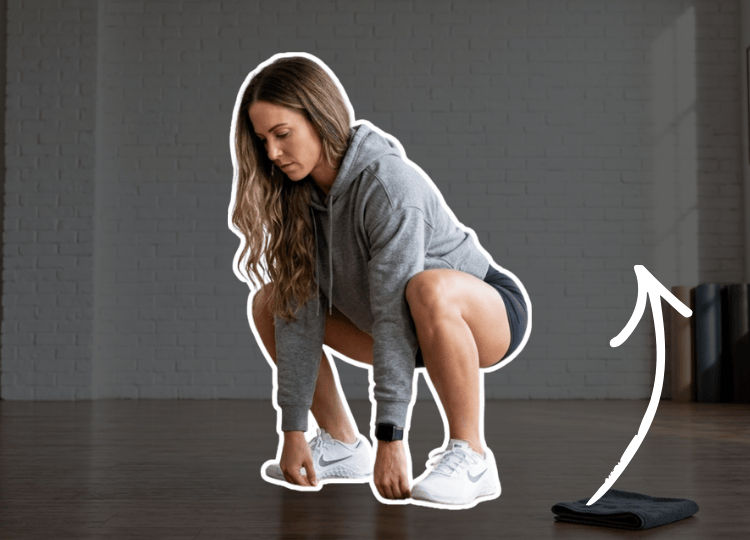
There is a movement that every child does naturally and that most adults have forgotten how to do. Drop into a deep squat, place your hands flat on the floor in front of you, then straighten the legs and fold forward, shifting the load from the hips to the hamstrings.
Then reverse it. Back into the squat. Hands on the floor. Straighten. Fold. Repeat.
That is the gorilla squat.
And if it sounds simple, it is, right up until you try it and discover that your ankles have no range, your hamstrings are locked, and your hips do not want to open.
At which point it becomes one of the most honest assessments of lower body mobility you will ever do, and one of the most effective exercises for improving it.
What Is a Gorilla Squat?
A gorilla squat is a dynamic mobility exercise that moves continuously between 2 positions: a deep squat with hands on the floor, and a standing forward fold with legs as straight as possible.
The transition between the 2 is the exercise. Not just sitting in a deep squat (that is more of an Asian squat or resting squat), and not just a forward fold. The gorilla squat combines both into a flowing movement that loads the lower body through a full and demanding range of motion.
It gets its name from the motion itself, which resembles the way a gorilla moves between crouching and standing while supporting its weight with its knuckles or hands on the ground.
Different from the gorilla walk
It is worth distinguishing it from the gorilla walk, which is a separate animal flow movement involving lateral locomotion on hands and feet. The gorilla squat is a stationary, vertical movement used primarily as a warm-up or mobility drill.
How to Perform Gorilla Squats
- Stand with feet shoulder-width apart, toes turned out slightly.
- Drop into a deep squat, letting the hips sink below the knees, and place both hands flat on the floor in front of you.
- From there, push the hips up toward the ceiling, straightening the legs as much as possible while keeping the hands on the floor.
- Pause briefly in the forward fold, feeling the stretch through the hamstrings.
- Lower the hips back down into the deep squat position and repeat.
Aim for slow, controlled reps, 2 to 3 seconds in each position, rather than bouncing between the two.
Muscles Worked
Gorilla squats load the lower body through two distinct positions. The deep squat challenges the quads, glutes and hip adductors (inner thighs), while the forward fold places the hamstrings under a loaded stretch with the legs approaching full extension.
Across both phases, the ankles are required to dorsiflex, the calves are stretched, and the core works to stabilise the torso throughout the transition.
Gorilla Squats Benefits
Targets the Three Main Squat Limiters at Once
Most people who struggle to squat deep are held back by one or more of three things: ankle dorsiflexion, hip flexion range, and adductor tightness.
The gorilla squat is unusual in that it loads all three within a single movement. Rather than needing separate drills for each limitation, you get a single exercise that addresses the whole chain.
Research from the Journal of Human Kinetics confirmed that ankle dorsiflexion and hip flexion range of motion are the two most significant predictors of squat depth, and the adductors play a major supporting role in achieving the bottom position without the knees caving or the spine rounding.
Builds Mobility You Can Actually Use
Static stretching trains passive range… length you can achieve when relaxed and not under load.
Gorilla squats train active range, repeatedly loading the end positions through controlled movement. The difference matters. When you actively load a stretched position, the nervous system learns to allow range of motion that it can also control.
That is the kind of mobility that transfers to squats, deadlifts and everything else you do in the gym. Passive holds produce passive flexibility. The gorilla squat produces something more useful.
Doubles as a Movement Screen
Where the movement breaks down tells you exactly what is limiting your lifting. Heels that lift point to restricted ankle dorsiflexion. Knees that cave inward indicate tight adductors. Legs that refuse to straighten in the fold signal hamstring restriction.
Run through a set before a lower body session and you will know in about 30 seconds which part of your lower body needs the most attention. Most people spend months guessing at this.
Prepares Every Major Lower Body Pattern
The deep squat, the hip hinge, and the hamstring stretch are all present within a single gorilla squat rep. Those three patterns cover the demands of squats, deadlifts, Romanian deadlifts, lunges and leg press. Performing a set or two before a lower body session is not just a general warm-up.
It is specific preparation for precisely the ranges of motion the session will require.
Undoes the Damage of Sitting
Prolonged sitting shortens the hip flexors, compresses the hip joint, tightens the adductors and steadily reduces ankle mobility. Left unaddressed, those adaptations accumulate and eventually show up as pain, poor movement patterns, or plateaus in the gym.
Gorilla squats directly counter all four. Even a single set of slow reps before training will produce a noticeable difference in how the hips move for the session that follows.
Break Up Sitting
Gorilla squats are a simple way to reset your body during long stretches of sitting. A few controlled reps can loosen things up, get your hips moving again, and stop that stiff, sluggish feeling from creeping in.
Doing Gorilla Squats with Weights
Once the bodyweight version is comfortable and you can move through both positions with reasonable range and control, adding load shifts the gorilla squat from a mobility drill into something closer to a strength exercise.
The key is choosing a loading position that supports rather than disrupts the movement.
Goblet-style hold (recommended starting point)
Hold a single dumbbell or kettlebell at chest height with both hands, in the same position as a goblet squat. This front-loaded position naturally encourages the chest to stay up in the squat phase and creates a useful counterbalance that actually makes the deep squat position easier to reach and hold.
The weight shifts your centre of gravity forward slightly, which helps the hips settle deeper between the feet.
The transition to the forward fold becomes harder because you are now managing a load while the torso drops, which increases demand on the core and the hip hinge.
Start with a light weight (8 to 12kg) and prioritise control over load.
Plate hold
Holding a weight plate flat with both arms extended in front of the body is a slightly more advanced variation. The extended arms increase the lever and the core demand in both positions. It reinforces the deep squat by keeping the arms in front rather than at the chest.
Bottom position loading
For those primarily using gorilla squats as a loaded stretching tool, simply pausing in the deep squat for a longer hold (5 to 10 seconds per rep) with a goblet weight amplifies the loaded stretch stimulus on the glutes, adductors and hip flexors.
This approach is closer to loaded stretching in intent than mobility drilling, and it works well later in a session as a cool-down finisher.
For any weighted variation, the set and rep range shifts slightly: 5 to 8 reps with deliberate pauses in both positions rather than 6 to 10 reps moving more freely. The weight should never compromise the range of motion.
Adding Weight
For any weighted variation, the set and rep range shifts slightly: 5 to 8 reps with deliberate pauses in both positions rather than 6 to 10 reps moving more freely. The weight should never compromise the range of motion. If adding load causes the heels to lift or the knees to collapse inward, the weight is too heavy.
Variations
- Static deep squat hold. Sometimes called the Asian squat or resting squat, this is simply sitting in the bottom position of the gorilla squat and holding. 30 to 90 seconds of passive holding in this position improves hip and ankle mobility in its own right. It can be used as a progression before adding the forward fold phase, or alongside gorilla squats as additional hip opening work.
- Slow tempo gorilla squat. Move through each phase on a 3 to 4 second count in both directions. This increases time under tension in the stretched positions and is more demanding than the standard version despite feeling less athletic.
- Supported gorilla squat. For anyone who cannot keep their heels flat or who loses balance in the squat position, holding a doorframe, a squat rack post or a TRX strap provides stability. This allows the movement to be performed with better range and control while the mobility develops. Using support is not a modification to be embarrassed about. It is simply training within your current range while building toward the unassisted version.
Common Mistakes
Letting the heels rise
This is usually an ankle mobility problem rather than a technique problem, and forcing depth with lifted heels shifts load into the lower back. Work within the range the ankles allow and address ankle mobility separately with calf stretches and ankle dorsiflexion drills.
Rushing the transition
The bounce between squat and fold removes the loading benefit of each position. The exercise is not a cardio drill. Slow it down.
Not going low enough in the squat
The hips should drop well below the knees in the squat phase. A half-squat with hands on the floor is not a gorilla squat; it is just a bent-over reach. The deep squat is the point.
Not straightening the legs in the fold
Many people move the hips up but keep the knees heavily bent, which removes the hamstring stretch entirely. Work progressively toward straighter legs even if you cannot get there fully.
How to Use Them
Gorilla squats work best as a warm-up for any lower body session, 1 to 2 sets of 8 to 10 reps before squats, deadlifts or leg work of any kind. They can also serve as a daily mobility drill on non-training days for anyone working to address tight hips, stiff hamstrings or restricted ankle range.
They do not replace strength work. The bodyweight version produces minimal muscle damage or hypertrophic stimulus on its own. Their value is in preparing joints and tissues to move well under load, and in the mobility improvements that compound over time with consistent practice.
If your lower body lifting has been limited by stiffness rather than strength, 2 to 3 weeks of daily gorilla squats before your sessions will likely tell you more about where your mobility is lacking than months of occasional static stretching ever did.
Frog Squat Pulses
A similar variation of gorilla squats are frog squts – popular in HIIT and circuit training routines.
Bottom Line
The gorilla squat is one of those exercises that looks deceptively simple but does a better job of exposing and improving lower body mobility than most things people spend time on. It challenges ankle dorsiflexion, hip opening, adductor length and hamstring flexibility simultaneously, in a movement that also transfers directly to every major lower body exercise.
Add them weighted and they become a genuine strength and loaded stretching tool as well. Start bodyweight, go slowly, and do not skip the pauses. The time spent in each position is where the adaptation actually happens.
Related Articles
Balance Pad Exercises You Can Try At Home