

The deadlift is one of the most effective exercises available for building posterior chain strength, and resistance bands make it accessible to almost anyone, regardless of whether they have access to a gym or a set of weights.
Resistance band deadlifts follow the same fundamental hip hinge pattern as a barbell deadlift but use the elastic tension of a band rather than plates for resistance. The result is a movement that feels different from free weight deadlifts in a specific and useful way: the band provides minimal resistance at the bottom of the lift and maximum resistance at the top, which challenges the muscles hardest at lockout rather than at the floor.
This makes them a practical training tool in their own right, not simply a substitute for a barbell.
This guide covers how to perform resistance band deadlifts correctly, the muscles they work, the benefits of including them in your training, key variations to try, and what to look for when buying bands.

Quick Summary
- Resistance band deadlifts follow the same hip hinge pattern as a barbell deadlift but provide increasing tension toward the top of the lift, challenging the glutes and posterior chain hardest at lockout.
- A practical option for home training, travel or those new to the deadlift who want to build technique before adding free weight load.
- Resistance band deadlifts are best treated as a complement to free weight training rather than a direct replacement, as bands do not replicate the same level of muscle activation as a barbell in all conditions.
How to Do Resistance Band Deadlifts
- Stand with feet shoulder-width apart, toes pointing forward.
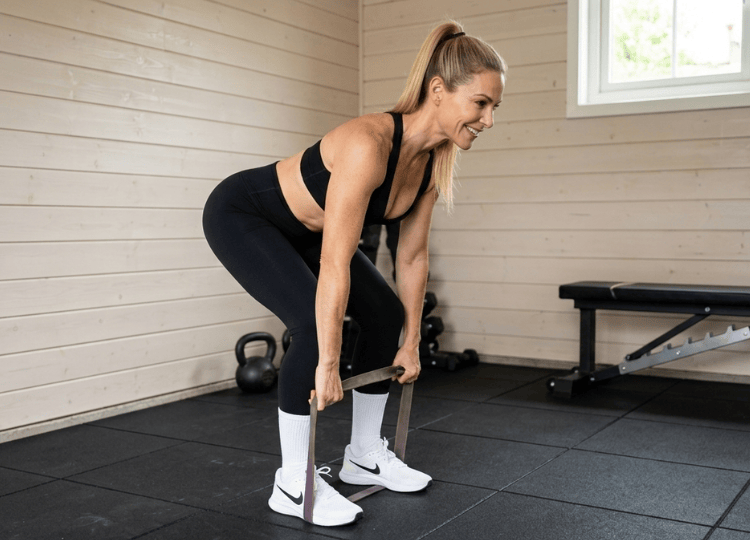
- Place the resistance band under the balls of both feet and hold the band at roughly shoulder-width apart, gripping either the handles or the band itself.
- Hinge at the hips and bend the knees until the torso is roughly parallel to the floor. The back should be flat, the chest tall and the core braced.
- Drive through the legs and hips to stand upright, keeping the band close to the body throughout.
- Hold for a moment at the top, squeezing the glutes, then hinge back down with control.
- Repeat for the desired number of reps.
The lower you grip the band on the way down, the more resistance will be applied. Experiment with your grip position over the first few sessions to find the right level of challenge.
Coach’s Tip – Technique is everything in any deadlift variation. Keep the back flat and the chest up throughout the entire movement, and think about pushing the floor away rather than pulling the band up. If the lower back rounds at any point, reduce the range of motion until hip mobility and hamstring flexibility improve.
Warm-up
Before any deadlift session, spend 5 minutes warming up with glute bridges, hip circles and dorsal raises to activate the posterior chain and improve hip range of motion before loading.
Muscles Worked
- Glutes – the primary driver of hip extension at the top of the lift, where band tension is highest
- Hamstrings – work alongside the glutes to extend the hip and stabilise the knee throughout the movement
- Erector spinae – the muscles running along the spine that maintain a neutral back position under load
- Quads – drive knee extension from the bottom position to initiate the lift
- Lats – stabilise the torso and keep the band close to the body during the pull
- Core – braces the spine throughout the movement to protect the lower back under load
- Trapezius – keeps the shoulders retracted and the upper back tight during the lift
- Forearms and grip – engaged throughout to hold the band under tension
Benefits of Resistance Band Deadlifts
Accessible and portable
A resistance band weighs almost nothing and takes up minimal space, making band deadlifts one of the most practical strength exercises available for home training or travel. No barbell, no plates and no gym membership are required.
Challenges the lockout specifically
Unlike a barbell deadlift, where resistance is constant throughout the lift, a resistance band provides increasing tension as it is stretched. This means the muscles are challenged hardest at the top of the movement, specifically the glutes and erector spinae at lockout, in a way that free weights do not replicate.
A 2024 study published in Physical Therapy Rehabilitation Science found that resistance band groups showed significantly higher muscle activity than conventional deadlifts during the mid and end phases of the lift, particularly in the trunk, core and lower extremity muscles.
Beginner-friendly technique tool
Resistance bands are regularly used in deadlift learning progressions because the lower resistance at the bottom of the lift makes it easier to establish and maintain good form before adding significant load. For those new to the hip hinge pattern, starting with a band rather than a barbell is a lower-risk way to build movement quality and confidence.
Safer for those returning from injury
The adjustable nature of band resistance makes it straightforward to reduce load instantly mid-session if needed, something that requires changing plates with a barbell. Research has noted the value of resistance bands in deadlift rehabilitation for those with lower back concerns, as the reduced demand at the start position avoids the high initial force requirement of a barbell lift from the floor.
Develops stability
The elastic nature of a resistance band introduces slight instability during the pull that a barbell does not. This engages the stabilising muscles of the trunk and shoulders more actively and can improve overall movement quality over time.
Things to Consider
It is worth being clear that resistance bands are not a direct equivalent to barbell deadlifts for building maximum strength or muscle mass. Studies comparing the two modalities have found that conventional resistance training equipment produces higher levels of muscle activation in the prime movers in some conditions.
Resistance band deadlifts are a valuable training tool, particularly for beginners, travellers and those without gym access, but those whose primary goal is maximum strength development should treat them as a complement to free weight training rather than a full replacement.
Variations
Romanian Deadlift with Resistance Band
The Romanian deadlift keeps the legs straighter than the conventional deadlift and emphasises the hamstrings and glutes through a longer range of hip hinge motion. Stand on the band, hold it at hip height and hinge forward from the hips with a slight bend in the knees, lowering the band toward the floor until a stretch is felt through the hamstrings. Drive the hips forward to return to standing.
Single Leg Deadlift with Resistance Band
The single leg variation trains each side independently, challenges balance and exposes any strength imbalances between left and right. Stand on the band with one foot, hold it in the opposite hand and hinge forward on the standing leg, extending the free leg behind as a counterbalance. This is a more demanding variation and is best approached once the conventional band deadlift feels comfortable.
B-Stance Deadlift with Resistance Band
The b-stance places one foot slightly behind the other as a kickstand for balance while the front leg does the majority of the work. It is a useful stepping stone between bilateral and single leg deadlifts for those working on unilateral strength and stability.
Sumo Deadlift with Resistance Band
The sumo stance places the feet wider than shoulder-width with the toes turned outward. This shifts more of the emphasis onto the inner thighs, glutes and quads compared to the conventional stance. Stand on the band with a wide stance, grip the band between the legs and hinge and lift as normal.
Things to Consider
- Form always comes before resistance. The most common mistake in band deadlifts is using a band that is too heavy before the hip hinge pattern is established. Start with a lighter band, focus on keeping the back flat and the chest tall, and progress resistance gradually.
- The band should stay close to the body. Allowing the band to drift forward during the pull shifts load onto the lower back rather than the posterior chain. Think about keeping the band running along the shins and thighs throughout the movement, just as you would with a barbell.
- Wear shoes. Standing on a resistance band in bare feet is uncomfortable and can cause the band to slip. Training shoes provide a more stable and comfortable base.
- Progressive overload is more limited than with free weights. Resistance bands do not allow the same precise, incremental overload as adding plates to a barbell. As strength improves, you will need to move to heavier bands, adjust your grip position, or combine multiple bands to continue making progress.
Buying Resistance Bands for Deadlifts
Not all resistance bands are suitable for deadlifts. Light therapy bands used for rehabilitation exercises will not provide enough resistance for a meaningful deadlift session for most people.
- Go heavy duty. Look for looped resistance bands rather than light therapy bands. These are typically made from thicker latex and come in a range of resistances, from light to extra heavy. Most people will need at least a medium or heavy band for deadlifts.
- Buy a set. Most reputable brands sell bands in sets of three to five with varying levels of resistance. This gives you the flexibility to adjust load between exercises and to progress over time without buying new bands repeatedly.
- Consider handles. Plain looped bands can be uncomfortable to grip during deadlifts. Some people find bands with built-in handles easier to hold, particularly for higher rep sets. Alternatively, a pair of lifting straps can be looped through a plain band to provide a more secure grip.
Banded Deadlifts vs Resistance Band Deadlifts
These two terms are often used interchangeably but they describe different exercises.
A resistance band deadlift uses the band as the sole source of resistance, replacing the barbell entirely. It is the exercise described throughout this guide.
A banded deadlift uses a resistance band attached to a loaded barbell to add variable resistance on top of the free weight load. This is a more advanced powerlifting technique used to increase resistance at lockout and is a different exercise altogether. If you are just getting started with band deadlifts, the resistance band deadlift described in this guide is the one to focus on.
Bottom Line
Resistance band deadlifts are a practical and effective exercise for building posterior chain strength, improving hip hinge mechanics and training the deadlift pattern without a barbell or gym access. The variable resistance they provide, with tension increasing toward the top of the lift, makes them a genuinely useful training tool rather than just a convenient substitute for free weights.
They are particularly well suited to beginners learning the deadlift movement, those training at home or travelling, and anyone returning from a lower back injury who needs to reduce load while maintaining movement quality. For those chasing maximum strength, they work best alongside rather than instead of free weight training.
Start with a medium resistance band, focus on technique before adding load, and explore the variations above to keep sessions varied and progressive.
Related Articles:
Kneeling Squats Exercise Guide