

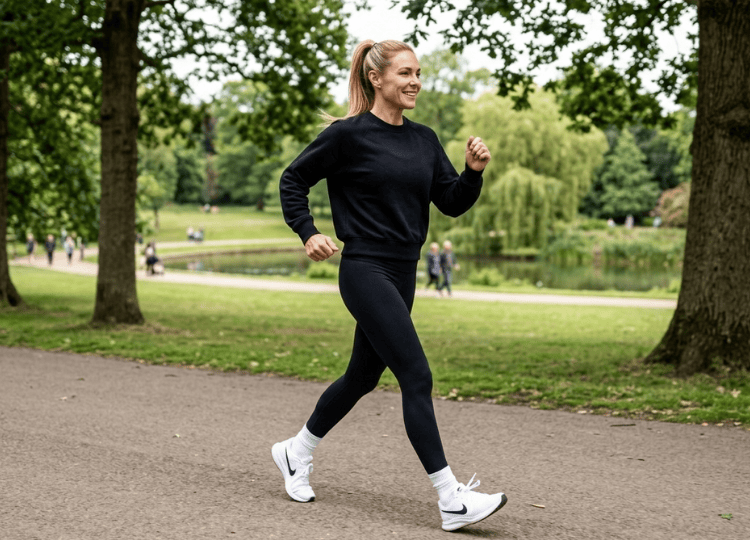
Walking is one of the most well-evidenced forms of exercise available.
Power walking takes that foundation and adds enough intensity to produce meaningful cardiovascular, metabolic and longevity benefits that a casual stroll simply cannot match.
A Vanderbilt University study of nearly 85,000 adults found that fast walking for as little as 15 minutes per day was associated with a nearly 20% reduction in all-cause mortality. A PMC review of the evidence found that adults who walk at a brisk pace have a 38% to 53% lower risk of cardiovascular mortality compared to slow walkers, and that every 1km per hour increase in walking pace is associated with a 13% reduced risk of stroke.
The NHS uses a simple test to define the threshold: if you can talk but not sing while walking, you are at the right intensity.
Power walking sits in Zone 2, the aerobic heart rate zone where the body is working hard enough to drive cardiovascular adaptation but not so hard that it becomes unsustainable.
This guide covers everything you need to get started, including technique, how to measure effort, a time guide by age, how to progress over time, and how power walking fits into broader health and fitness goals.

Quick Summary
- Power walking sits between a casual stroll and a jog in terms of intensity, and research consistently links brisk walking to reduced risk of cardiovascular disease, stroke and early death, even in relatively small doses.
- Technique matters: arms should drive at 90 degrees, steps should be short and quick rather than long and reaching, and effort should sit at a level where you can speak a few words but not hold a full conversation.
- Rucking, walking with a weighted backpack, is the most natural progression from power walking and research shows it can burn up to three times more calories than unweighted walking while remaining considerably lower impact than running.
What is Power Walking?
Power walking is faster than a casual stroll but slower than a jog. It typically sits between 5 and 8km per hour depending on the individual, but pace is less important than effort. The defining characteristic is intent: arms are actively driving at roughly 90 degrees, steps are quicker and more purposeful, and the cardiovascular system is noticeably working.
Unlike jogging, both feet never leave the ground simultaneously in power walking. This makes it considerably lower impact on the joints while still delivering a meaningful aerobic stimulus.
How to Measure Your Effort
The most practical way to gauge intensity during a power walk is the talk test. You should be able to speak a few words but not hold a full conversation comfortably. If you can chat freely, pick up the pace. If you cannot speak at all, slow down slightly.
For those who use a heart rate monitor, aim for 60 to 75% of maximum heart rate. A rough estimate of maximum heart rate is 220 minus your age.
A rating of perceived exertion of 5 to 7 out of 10 is the right target zone for most people during a power walk. Effort should feel purposeful and slightly challenging, but sustainable for the full duration of the session.
Try Nordic Walking
If you enjoy power walking and want to add an upper body element, Nordic walking is a natural next step. By adding poles to the movement, Nordic walking engages the arms, shoulders and core more actively than a standard power walk and research suggests it burns up to 46% more calories than walking without poles. Take a look at our beginner’s guide to Nordic walking to find out more.
Power Walking Speed Chart by Age
The table below shows approximate times to walk 1km across three levels, based on research data on average and brisk walking speeds by age group. Use it to gauge where you currently sit and what to aim for.
Power walking is generally defined as a speed of 7 to 9km per hour, though for most people over 50 or those new to exercise, a brisk pace of 5 to 6km per hour already qualifies as moderate to vigorous intensity and delivers meaningful health benefits.
| Age Group | Moderate Walk | Power Walk | Fast Power Walk |
|---|---|---|---|
| 20 to 30 | 13 to 15 min/km | 10 to 12 min/km | 8 to 9 min/km |
| 31 to 40 | 14 to 15 min/km | 11 to 12 min/km | 9 to 10 min/km |
| 41 to 50 | 14 to 16 min/km | 11 to 13 min/km | 9 to 11 min/km |
| 51 to 60 | 15 to 17 min/km | 12 to 14 min/km | 10 to 12 min/km |
| 61 to 70 | 16 to 18 min/km | 13 to 15 min/km | 11 to 13 min/km |
| 71 and over | 17 to 20 min/km | 14 to 17 min/km | 12 to 14 min/km |
A moderate walk is a comfortable, conversational pace. A power walk should feel purposeful, with arms driving and breathing noticeably elevated. A fast power walk sits at the upper limit of walking before it transitions into a jog.
These are approximate ranges based on population data. Individual factors including height, leg length and fitness level all affect pace, so use the table as a guide rather than a fixed standard.
Power Walking Technique
- Posture. Stand tall with the head up, shoulders back and relaxed, and core gently braced. Avoid leaning forward at the waist or allowing the shoulders to round, both of which reduce efficiency and increase fatigue.
- Arms. Bend the arms to roughly 90 degrees at the elbow and drive them forward and back from the shoulder in a controlled, compact swing. The arms should not cross the midline of the body. Active arm drive increases pace and cardiovascular demand simultaneously.
- Stride. Take shorter, quicker steps rather than longer strides. Reaching the foot far ahead of the body creates a braking effect that slows you down and stresses the knee. Focus on pushing off from the back foot to propel forward.
- Heel to toe. The heel should contact the ground first, followed by a smooth roll through to the toes, which drive the next step. Flat-footed contact or toe-first striking both indicate technique issues worth addressing before building volume.
- Breathing. Breathe steadily and rhythmically throughout. If breathing becomes laboured to the point of gasping, reduce the pace slightly.
Benefits of Power Walking
Cardiovascular Health
Power walking consistently improves cardiovascular fitness when done regularly. Research published in PMC found that brisk walking reduces the risk of high blood pressure, high cholesterol, type 2 diabetes and coronary heart disease.
The Vanderbilt study found that fast walking reduced cardiovascular mortality specifically, with researchers suggesting the mechanism involves improved cardiac efficiency, lower blood pressure and reduced obesity-related cardiovascular risk.
Longevity
The evidence linking walking pace to longevity is among the most compelling in exercise research. A UK Biobank analysis of 363,000 participants found that slow walkers had a significantly higher risk of stroke than average pace walkers.
Mental Wellbeing
Research consistently links regular walking to reduced stress, lower anxiety and reduced risk of depression. A PMC review found that walking improves mental wellbeing through multiple mechanisms, including the effects of moderate aerobic exercise on mood regulation and the additional benefits of outdoor exposure on cortisol levels and psychological recovery from stress.
Weight Management
Power walking burns meaningfully more calories than a casual walk. Research from the American Council on Exercise estimates that a 160lb person burns approximately 119 calories in 30 minutes of brisk walking at 3mph and around 181 calories at a power walking pace of 4mph. Over time and with consistency, this adds up significantly.
Joint Health
Power walking is considerably lower impact than jogging or running, making it accessible to a wider range of people including those with joint sensitivities, those returning from injury and older adults.
Bone Health
Walking is a weight-bearing activity, which means it places mechanical load on the bones and stimulates bone remodelling. This is particularly relevant after the age of 50 when bone density begins to decline more rapidly.
How to Progress
Power walking rewards consistency and gradual progression. Once the goal column in the time table above feels comfortable, there are several ways to increase the challenge without switching to running.
- Increase pace. Walking faster is the most direct way to increase the cardiovascular demand. Aim to reduce your time for a fixed route by a few seconds each week rather than trying to make large jumps in speed.
- Add hills. Walking uphill significantly increases the effort level and calorie burn without increasing impact on the joints. Incorporating hilly routes or treadmill incline into sessions is one of the most effective ways to progress power walking without changing the fundamental movement.
- Interval walking. Alternating between periods of maximum effort walking and a slower recovery pace brings power walking closer to a structured HIIT workout. A simple protocol is two minutes at maximum effort followed by one minute at an easy pace, repeated for the duration of the session.
- Change your route. Varying the terrain, gradient and environment keeps sessions mentally engaging and challenges the body in different ways. Trails and uneven surfaces add a proprioceptive and stability element that flat pavement does not.
Taking It Further With Rucking
Once power walking feels comfortable and consistent, rucking is the most natural and evidence-backed progression.
Rucking is simply walking with a weighted backpack. It has military origins but has become increasingly popular as a civilian fitness tool, in part due to its compelling research profile. Research found that rucking can burn up to three times more calories than unweighted walking, putting it broadly on par with jogging while remaining considerably lower impact on the joints. A Journal of Strength and Conditioning Research study found that healthy men saw significant improvements in VO2 max after a ten-week rucking programme.
Rucking also adds meaningful strength demand to a walking session. The load requires the core, glutes and postural muscles to work continuously to stabilise against the pack weight, which builds functional strength alongside cardiovascular fitness. Research on older adults found that walking with weights improved leg strength and functional mobility, making it particularly relevant for those over 50 concerned with maintaining independence.
Getting started with rucking
Start with a regular backpack loaded to roughly 10% of your bodyweight, which is approximately 7 to 8kg for most adults. Begin with 15 to 20 minute sessions at your normal power walking pace and build duration before increasing load. Progress weight by no more than 10% per week and pay attention to how the neck, shoulders and lower back respond.
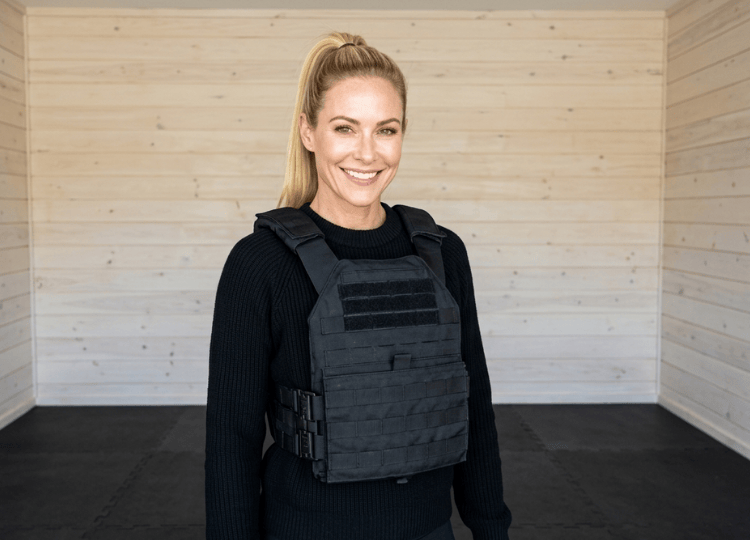
A weighted vest is a practical alternative to a backpack for those who find pack-based rucking uncomfortable, as it distributes the load more evenly across the torso.
Things to Consider
- Footwear matters. A sturdy pair of walking shoes with good cushioning and a supportive sole reduces fatigue and the risk of foot and ankle issues. For walking on varied terrain, shoes with additional ankle support are worth investing in.
- Start conservatively. The most common mistake with any new exercise routine is doing too much too quickly. Begin at the beginner column of the time guide above and build gradually over several weeks before increasing session length or frequency.
- Warm up and cool down. A few minutes of gentle walking before picking up the pace and a short stretch of the calves, hamstrings and hip flexors after the session reduces injury risk and improves recovery.
- Consistency beats intensity. Four moderate power walking sessions per week, every week, will produce far greater health benefits than occasional intense efforts. Building the habit is the priority, especially in the first few months.
Bottom Line
Power walking is one of the most accessible, evidence-backed and sustainable forms of exercise available. The research on its benefits for cardiovascular health, longevity, mental wellbeing and weight management is extensive and consistent, and the barrier to entry is as low as putting on a pair of walking shoes and stepping outside.
Start with the beginner targets in the time guide, focus on technique and effort level rather than pace, and build volume gradually over weeks and months. As fitness improves, adding hills, intervals and eventually rucking provides a natural and well-evidenced progression pathway that can keep power walking genuinely challenging for years.
Related Articles: