

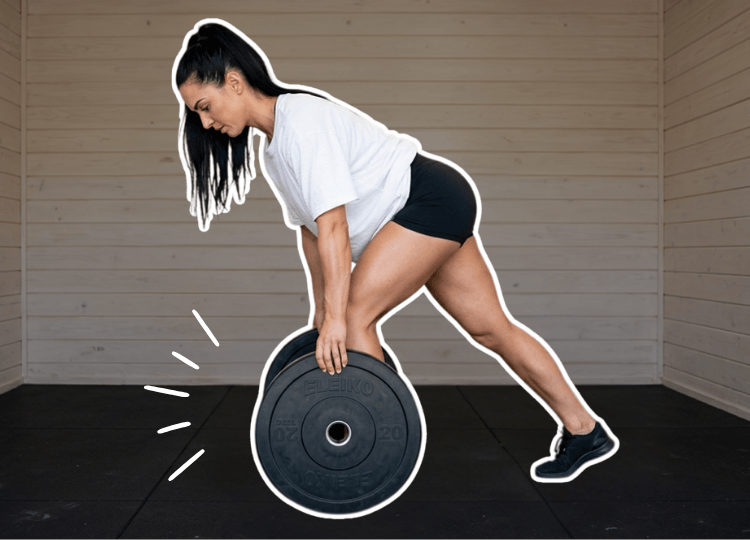
Plate pinches are one of the most direct and accessible ways to train grip strength. The exercise is exactly what it sounds like: pinching a weight plate between the fingers and thumb and holding it under load.
No specialist equipment, no complex setup. Just a weight plate and the grip to hold it.
What makes plate pinches specifically valuable is the type of grip they train.
There are three distinct grip types: crush grip, support grip and pinch grip. Most training, from deadlifts to pull-ups, primarily develops crush and support grip.
Pinch grip, the strength generated between the fingers and thumb rather than the full hand, is rarely trained directly and is often the weakest link.
Plate pinches address this gap directly.

Quick Summary
- Plate pinches train pinch grip specifically, the strength between the fingers and thumb, which is rarely developed through standard training and is consistently the weakest grip type in most lifters.
- Grip strength is one of the most well-evidenced markers of long-term health, with research linking low grip strength to a 67% higher risk of early death from all causes.
- Progress by building hold duration to 60 seconds before moving up in plate weight, with the 20kg plate held for 30 seconds per side being a widely recognised benchmark to work toward.
What Are Plate Pinches?
A plate pinch is an isometric grip strength exercise performed by holding a weight plate between the fingers on one side and the thumb on the other, with no part of the palm in contact with the plate. The load is held for a set duration, training the fingers, thumb, hand and forearm muscles under sustained tension.
Unlike crush grip exercises such as hand gripper training, plate pinches place the majority of the demand on the tendons and muscles of the fingers and thumb rather than the forearm flexors.
This makes them a targeted and specific tool for developing pinch strength, which translates to any activity that requires gripping flat or thin objects.
How to Do Plate Pinches
- Stand a weight plate on its edge on the floor beside you.
- Squat down and grip the plate with your fingers on the outer face and your thumb on the inner face, keeping the palm open and not in contact with the plate.
- Stand upright and hold the plate by your side, arm straight, keeping the shoulder back and the core braced.
- Hold for the desired duration, or walk forward, then lower the plate to the floor with control.
- Repeat on the other side.
Start with 3 to 4 sets of 20 to 30 second holds per side. Build toward 60 second holds before increasing the weight or adding a second plate.
Coach’s Tip – Drive the thumb actively into the plate throughout the hold rather than relying on passive friction. This engages the thumb flexors more effectively and significantly improves how long you can hold the position. Keep the wrist neutral and avoid letting it bend inward under load.
Muscles Worked
- Flexor digitorum profundus – the deep finger flexor that runs along each finger, primarily responsible for maintaining the pinch position under load
- Flexor pollicis longus – the thumb flexor muscle, the single most important muscle in the plate pinch and often the first to fatigue
- Flexor carpi radialis and flexor carpi ulnaris – the forearm flexors that stabilise the wrist throughout the hold
- Thenar muscles – the group of muscles at the base of the thumb responsible for thumb opposition and grip precision
- Hypothenar muscles – the muscles at the base of the little finger that assist with grip stability and finger positioning
- Forearm extensors – work isometrically to stabilise the wrist against the load throughout the hold
Benefits of Plate Pinches
Directly trains the most neglected grip type
Most people who train regularly have reasonably well-developed crush grip from deadlifts, rows and pull-ups. Pinch grip is almost never trained directly in standard programming. Because pinch grip relies primarily on finger and thumb strength rather than forearm bulk, it requires specific training to develop and does not improve significantly as a by-product of other exercises. Plate pinches address this directly.
Improves performance across a wide range of lifts
A stronger grip means a longer time before the hands become the limiting factor in exercises like deadlifts, Romanian deadlifts, rows and pull-up variations. Research from the Journal of Strength and Conditioning Research found that hand grip strength is a significant predictor of overall muscular strength and endurance across multiple movement patterns.
Spending dedicated time on grip work, including plate pinches, translates into more reps and heavier loads on the exercises that matter most.
Builds grip strength linked to longevity
The research linking grip strength to long-term health outcomes is among the most compelling in exercise science. The PURE study found grip strength predicted mortality more strongly than blood pressure.
A meta-analysis of 42 studies found those with low grip strength had a 67% higher risk of early death from all causes. Grip strength is now widely considered a biomarker of overall musculoskeletal health, reflecting muscle mass, neuromuscular function and metabolic health simultaneously. Training it directly is one of the most evidence-backed investments you can make in long-term health and longevity.
Supports injury prevention in the hands and wrists
Strengthening the tendons, muscles and connective tissue of the fingers and hands through progressive loading reduces the risk of overuse injuries such as tendonitis and strains, particularly for those who use their hands extensively at work or in sport.
Plate pinches apply a controlled, progressive tensile load to the finger flexor tendons, which supports their long-term resilience.
Simple and accessible
Plate pinches require nothing beyond a weight plate, which is available in every gym and increasingly common in home training setups. There is no specialist equipment, no complex setup and no technique barrier. The exercise is immediately accessible to anyone at any training level.
Variations
Two-Plate Pinch (Smooth Sides Out)
Instead of a single plate, stack two thinner plates together with the smooth sides facing outward. This removes the raised edges from the equation and significantly increases the difficulty, as there is less surface texture to grip.
This is a common progression in grip sport and a reliable way to increase the challenge without moving to a heavier single plate.
Plate Pinch Walk
Rather than holding in a static position, hold the plate in a pinch grip and walk for a set distance, typically 20 to 30 metres. The movement adds a dynamic challenge that demands sustained grip endurance over a longer period and introduces subtle instability from the walking motion. This variation also adds a core stability element similar to a suitcase carry.
Thumbless Plate Pinch
Grip the plate using only the fingers, with the thumb removed from the equation entirely. This forces the finger flexors to work in isolation and is significantly harder than the standard version. It is best treated as an advanced variation once single-plate holds of 60 seconds are well established.
Double Overhead Plate Pinch
Hold a plate in a pinch grip in each hand simultaneously. This doubles the grip demand and requires the core to work harder to keep the torso stable under the bilateral load. Measure sessions by total hold time rather than weight, as maintaining the pinch in both hands simultaneously is considerably more demanding than single-hand holds.
Plate Pinch Row
Attach a resistance band or cable to a plate and perform a rowing movement while maintaining the pinch grip throughout. This combines back and arm strengthening with grip endurance in a single exercise and is a useful variation for those who want to integrate grip work into their pulling sessions rather than treating it as a standalone drill.
Things to Consider
- Measure by time, not reps. Plate pinches are an isometric exercise and should be programmed by hold duration rather than repetitions. Start with 20 to 30 second holds and build progressively toward 60 seconds before increasing the load.
- Use chalk if available. Pinch grip is entirely reliant on friction between the fingers, thumb and plate surface. Any perspiration on the hands significantly reduces performance. Chalk removes this variable and allows a truer test of grip strength rather than skin friction. This is particularly relevant for heavier holds.
- Progress load gradually. Grip tendons and connective tissue adapt more slowly than the muscles themselves. Moving up in weight too quickly before the supporting structures have adapted is one of the most common causes of finger and thumb overuse injuries. A conservative approach to load progression is well worth it.
- Train grip at the end of sessions. Performing plate pinches before compound lifts will pre-fatigue the hands and compromise performance on deadlifts, rows and pull-ups. Grip work is best placed at the end of a training session once the primary lifts are complete.
- Two to three sessions per week is sufficient. Grip training requires recovery like any other muscle group. Training it daily, particularly when first introducing plate pinches, increases the risk of tendon irritation in the fingers. Two to three sessions per week with at least one rest day between sessions is the appropriate starting frequency.
How to Progress with Plate Pinches
Plate pinches progress differently from most strength exercises. Rather than adding small increments of weight each session, progression follows a simple two-step sequence: build the hold duration first, then increase the plate weight.
Step 1: Build the hold duration
Start with a plate weight that is genuinely challenging to hold for 20 to 30 seconds. Once you can hold that weight comfortably for 60 seconds per side across 3 sets, you are ready to move up in weight.
Step 2: Progress through plate sizes
The natural progression for most people follows the standard plate sizes available in most gyms:
| Level | Plate Weight | What to Expect |
|---|---|---|
| Beginner | 5kg / 10lb | A practical starting point for most people new to grip training |
| Intermediate | 10kg / 25lb | A meaningful step up that requires dedicated grip work to reach |
| Advanced | 15kg / 35lb | Above average pinch grip strength for most gym-goers |
| Elite | 20kg / 45lb | A widely recognised benchmark in grip training circles |
The 20kg plate pinch held for 30 seconds per side is a commonly cited marker of serious pinch grip strength. Most people will take several months of consistent training to reach it, which makes it a useful long-term goal to work toward.
A Simple 8 Week Starting Protocol
| Week | Sets | Hold Duration |
|---|---|---|
| 1 to 2 | 3 | 20 to 30 seconds |
| 3 to 4 | 3 | 30 to 45 seconds |
| 5 to 6 | 4 | 45 to 60 seconds |
| 7 to 8 | 4 | 60 seconds |
Once 60 second holds feel well controlled at a given plate weight, move up to the next size and start the duration progression again from 20 to 30 seconds.
For those who want to develop grip strength more systematically, pairing plate pinches with farmer’s carries and dead hangs covers all three grip types, crush, support and pinch, and provides comprehensive grip development without significant additional session time.
Bottom Line
Plate pinches are one of the most direct and underused grip training exercises available. They specifically target pinch grip, the strength between the fingers and thumb, which is rarely developed through standard training and is consistently the weakest grip type in most lifters.
The research on grip strength and long-term health is compelling enough that training it should be a priority for almost everyone, not just those chasing heavier deadlifts. Plate pinches are a simple, accessible and progressive way to do exactly that.
Start with a single plate, hold for 20 to 30 seconds per side, and build gradually. The returns, both in the gym and beyond it, are well worth the effort.
Related Articles
Strength Training Program for Over 50s