
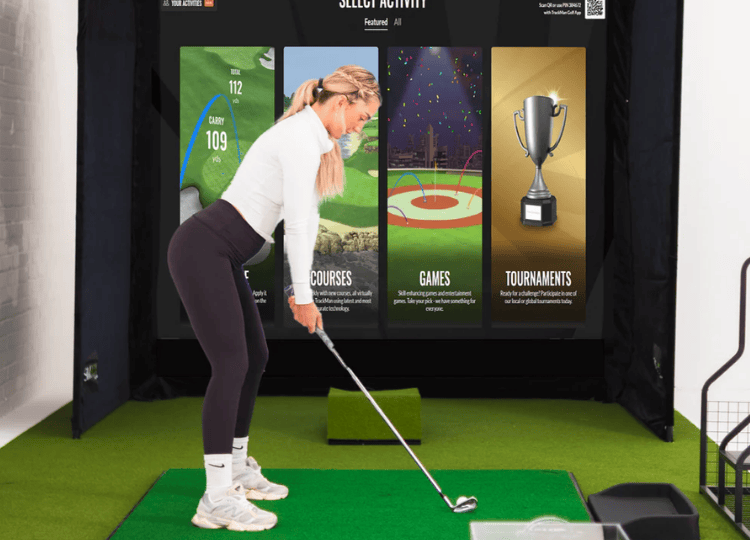
You’ve got a treadmill you barely touch, dumbbells collecting dust, and that nagging guilt every time you walk past your neglected home gym. Sound familiar? What if your workout space could actually make you excited to use it – and help you play better golf at the same time?
Golf simulators are quietly becoming the must-have feature in modern home fitness setups. Here’s why this trend is taking off and how you can get in on it.
Why Golf Simulators Are Having a Moment
The numbers tell an interesting story. According to the National Golf Foundation, the number of Americans participating in simulator golf has grown 73% since 2019. That’s not a small bump – that’s a fundamental shift in how people experience the game.
What’s driving this surge? A perfect storm of factors. Green grass golf participation topped 28 million in 2024, marking a seventh consecutive annual increase. More golfers means more people looking for ways to practice year-round, regardless of weather or busy schedules.
Meanwhile, the technology has become dramatically more accessible. Launch monitors that once cost as much as a car now fit in your pocket and connect to your phone. There has never been a better time to shop for a golf simulator, with choices at every price point and innovations making indoor simulator golf both fun and effective for game improvement.
The Home Gym Revolution Meets Golf
The home fitness market has exploded in recent years. The global home gym equipment market is estimated to be valued at USD 12.4 billion in 2025 and is projected to reach USD 19.6 billion by 2035. People aren’t just buying treadmills anymore, and they’re creating entire wellness spaces.
Key factors driving the home golf simulator trend:
- In 2023, 51% of US exercisers indicated a significant preference for at-home workouts
- Year-round practice regardless of weather conditions
- No travel time to driving ranges or courses
- Privacy to practice without feeling self-conscious
- COVID-19 fuelled a surge in domestic simulator installations as players turned en masse toward indoor options
Combining Golf and Fitness in One Space
The smartest home setups integrate both functions. With careful planning, you can create a multi-purpose cohesive space that offers the best of both worlds, dividing the space using partitions, furniture, or smart layouts to separate the home gym from the golf simulator setup.
Professional golfer Charley Hull recently showed off her personal setup, which demonstrates this combination perfectly. Hull’s gym features a variety of standard fitness equipment and even a dedicated cardio area, plus a special corner for practice chipping.
The space is designed with both fitness and golf training in mind, offering an all-encompassing workout experience. When planning your own space, specialists like Golfbays can help you navigate the technical requirements and find equipment that fits both your budget and available room dimensions. A well-equipped simulator can transform your practice and take your game to the next level.
The Fitness Benefits You Didn’t Expect
Here’s something that might surprise you: golf simulators actually provide a solid workout. Using a golf simulator for just an hour can burn up to 300-500 calories, making it a great cardiovascular exercise. That’s comparable to a brisk walk or a moderate cycling session – except you’re actually having fun doing it.
Golfers who use simulators often report reduced stiffness and increased mobility over time. These benefits make golf simulators particularly appealing for active adults over 50 looking to stay sharp on the course. It’s low-impact exercise that builds flexibility, balance, and coordination, all of which matter more as we age. This makes simulators a practical choice for enhancing overall wellness.
Modern golf simulators aren’t just for golf anymore. In 2025, simulators now support games like soccer, baseball, and even cricket, with seamless switching between modes offering endless entertainment options. This multi-sport capability transforms your investment into something the whole family can enjoy.
What You Need to Get Started
Setting up a home golf simulator requires some planning. Here’s a quick breakdown:
| Setup Level | Price Range | Best For |
| Entry-level | £800 – £1,500 | Beginners, limited space |
| Mid-range | £4,000 – £12,000 | Serious amateurs, dedicated rooms |
| Premium | £15,000+ | Low handicappers, full immersion |
Space requirements: You’ll need enough ceiling height to swing your longest club without contact – most experts recommend at least 9-10 feet, with 10 feet of width and 12-15 feet of depth minimum.
Core components: Every setup needs a launch monitor, an impact screen or net, a hitting mat, and either a projector or monitor for displaying your shots.
The Technology Keeps Getting Better
Artificial intelligence is set to become a major player in the golf simulator industry, with AI-powered simulators providing instant analysis of your swing and personalized training programs tailored to your specific needs. Around 62% of new simulator models launched in 2023 featured AI swing analysis and integrated VR capabilities, showing a strong shift toward immersive and data-rich user experiences.
Common Mistakes to Avoid
Before you start shopping, learn from others’ expensive lessons:
- Underestimating ceiling height – Take your driver into your intended space and take full swings slowly before purchasing anything
- Skimping on impact screens – Cheap screens wear out fast and can be dangerous if a ball breaks through
- Ignoring acoustics – Ball impacts are loud; your family will remind you of this at 6 AM
FAQs
How much space do I need for a home golf simulator?
At minimum, you need 10 feet of width, 12-15 feet of depth, and 9-10 feet of ceiling height. More space is always better for comfort and full swings with longer clubs.
Can golf simulators actually improve my game?
Yes – modern launch monitors provide accurate data on ball speed, spin rate, and club path. This feedback allows for targeted practice that translates to real course improvement.
How accurate are home golf simulators?
Premium launch monitors achieve accuracy within 1-2% of actual shot performance. Lower-cost options may have wider variance, particularly with spin and carry distance calculations.
Can I use a golf simulator if I’m a complete beginner?
Absolutely. Many simulators include instruction modes designed for new players. The privacy of home practice often helps beginners feel more comfortable while learning.
Key Takeaways
- Golf simulator participation has grown 73% since 2019, driven by better technology and increased interest in home fitness
- A one-hour simulator session burns 300-500 calories while improving flexibility and coordination
- Multi-sport functionality means one investment serves the whole family
- Ceiling height is the most critical and commonly miscalculated factor in space planning