

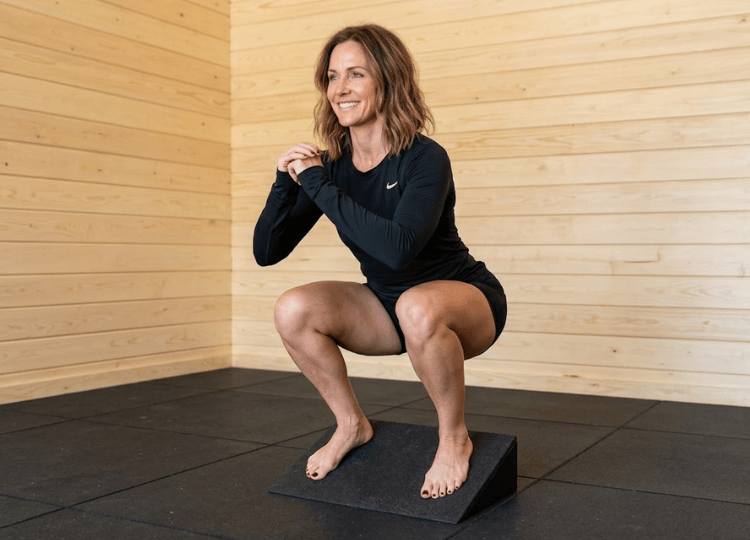
The slant board is one of the most underrated pieces of equipment in strength training and rehabilitation, and one of the most affordable.
It is an angled platform that elevates the heels during squats and lower body exercises, allowing the knees to travel further forward and the torso to stay more upright than flat ground permits.
In practice, this means deeper squats with better form, more targeted quad and knee strengthening, and improved ankle mobility over time.
For anyone who has ever struggled to squat to depth without the heels rising, or who has been told by a physio to do decline squats for knee pain, this is the tool those recommendations are built around.
Research consistently shows that squatting on a slant board produces significantly greater quad activation than squatting on flat ground, making it one of the most evidence-backed tools for both knee health and leg strength.
This guide covers 8 decline slant board exercises with step by step instructions and coaching tips, the key benefits, and everything you need to get started.

Quick Summary
- A slant board elevates the heels during squats and lower body exercises, producing significantly greater quad activation than flat ground squatting and making deep squatting accessible for those with limited ankle mobility.
- Widely used in physical therapy for patellar tendinopathy, Achilles tendinopathy and plantar fasciitis rehabilitation, as well as a practical strength and mobility tool for home training.
- The board can be used in two orientations: heels elevated for squats and strength exercises, and reversed with toes elevated for calf and Achilles stretching.
What is a Decline Slant Board?
A slant board is a flat, non-slip platform set at an angle, typically between 20 and 35 degrees, with the toes lower than the heels. This inclined position reduces the demand on ankle dorsiflexion, which allows the torso to remain more upright during squats and lunges and enables the knees to travel further forward over the toes without the heels lifting.
Most slant boards offer two to three adjustable angles to suit different exercises and ability levels. A lower angle is appropriate for stretching and rehabilitation work. A higher angle increases the challenge and range of motion for strength exercises.
The board can also be used in reverse, with the toes elevated and the heels lower, which is the correct orientation for calf stretches and Achilles stretching. In this position the board provides a passive, sustained stretch through the calf and Achilles complex without any additional effort required.
Who is the Slant Board For?
The slant board is useful for a wide range of people and training goals.
Those with limited ankle mobility who struggle to reach full squat depth without the heels rising will find the slant board allows immediate improvement in depth and form. It is also well suited to anyone specifically targeting quad development, since the elevated heel position increases rectus femoris and VMO activation beyond what flat ground squatting allows.
In rehabilitation settings it is used extensively for tendinopathy management and for retraining movement patterns following knee and lower leg injuries.
One important caveat worth noting: the slant board should not be the only squatting surface you train on. The goal is to use it as a tool to build strength and range of motion while continuing to work on ankle mobility separately, with the longer term aim of being able to squat well on flat ground too.
A Longevity Training Staple
If you are building a workout routine focused on long-term health and independence, the slant board deserves a place in it, as the combination of quad strength, knee resilience and ankle mobility it develops are among the most important physical qualities for staying active as you age.
Slant Board Exercises
1. Slant Board Squat
The slant board squat is the most important exercise in this guide and the primary reason most people purchase a slant board. The elevated heel position allows a more upright torso, deeper knee flexion and significantly greater quad activation than a standard flat-footed squat.
How to do it:
- Stand on the slant board with feet hip to shoulder-width apart and toes pointing forward or slightly outward.
- Brace the core and keep the chest tall throughout the movement.
- Lower into a squat, allowing the knees to travel forward over the toes in a controlled descent.
- Aim for full depth, thighs parallel to the floor or below, before driving through the legs to return to standing.
- Perform 3 to 4 sets of 8 to 12 reps.
Coach’s Tip – Focus on a slow, controlled descent of 3 to 4 seconds rather than dropping quickly. Controlled eccentrics increase time under tension in the quads and are particularly effective for both hypertrophy and tendon strengthening. Begin with bodyweight and progress to a goblet hold or barbell once depth and control are well established.
2. Slant Board Split Squat
The split squat on a slant board places the front foot on the board, which increases the range of motion at the knee and dramatically increases the quad demand on the front leg. It is one of the most effective unilateral quad exercises available.
How to do it:
- Place the front foot on the slant board with the rear foot on the floor behind you.
- Lower the rear knee toward the floor, keeping the front shin as vertical as possible and the torso upright.
- Drive through the front foot to return to the starting position.
- Complete all reps on one side before switching.
- Perform 3 sets of 8 to 10 reps per side.
Coach’s Tip – The closer the rear foot, the greater the knee flexion demand. Start with a moderate stance and adjust based on what is comfortable. A slight forward lean of the torso is fine but avoid excessive leaning which shifts the load toward the hip rather than the quad.
3. Eccentric Slant Board Squat
The eccentric slant board squat, also known as the decline squat, is one of the most well-researched exercises for patellar tendinopathy rehabilitation. Research has consistently found that slow eccentric loading through full range of motion on a decline surface reduces pain and promotes tendon remodelling. It is also a highly effective general quad strengthening exercise for those without tendon issues.
How to do it:
- Stand on the slant board with feet hip-width apart.
- Lower into a squat over 6 to 10 seconds, keeping the torso upright and the knees tracking over the toes.
- At the bottom, use both hands to assist standing if needed, then remove the assistance and repeat the slow descent.
- The focus is entirely on the lowering phase.
- Perform 3 sets of 8 to 15 reps.
Coach’s Tip – This exercise is uncomfortable in a productive way. A burning sensation through the quads and around the knee is normal and expected. Sharp or acute pain is not. Start with bodyweight and progress to a light load across the chest once the movement feels well controlled.
Train the Outer Quads Too
While the slant board is particularly effective for targeting the VMO and inner quad, pairing it with lateral movements and exercises like leg press ensures the outer quads get equal attention for balanced leg development.
4. Goblet Squat on Slant Board
Adding a kettlebell or dumbbell in the goblet position to a slant board squat increases the load on the quads, challenges the core and allows a natural counterbalance that helps achieve greater depth. It is one of the most practical loaded progressions from the bodyweight version.
How to do it:
- Hold a kettlebell or dumbbell at chest height with both hands.
- Stand on the slant board with feet shoulder-width apart.
- Lower into a deep squat, using the weight as a counterbalance to maintain an upright torso.
- Drive through the legs to stand and squeeze the quads at the top.
- Perform 3 to 4 sets of 8 to 12 reps.
Coach’s Tip – Allow the elbows to track inside the knees at the bottom of the squat. This naturally deepens the hip position and improves the quality of the movement. Start with a lighter weight than you would use for a regular goblet squat on flat ground.
5. Single Leg Calf Raise
The slant board provides a greater range of motion for calf raises than a standard step because the starting position allows a deeper stretch of the calf and Achilles tendon. For this exercise the board is used in reverse, with the toes pointing down the slope and the heels elevated, which allows a deeper stretch at the bottom and a fuller contraction at the top. This makes it particularly effective for calf hypertrophy and for Achilles tendon rehabilitation.
How to do it:
- Stand on the slant board in reverse with one foot, toes pointing down the slope and the heel elevated.
- Hold a wall or support lightly for balance.
- Lower the heel toward the floor as far as comfortable to feel a deep stretch through the calf.
- Drive up onto the toes as high as possible, squeezing the calf at the top.
- Perform 3 sets of 12 to 15 reps per side.
Coach’s Tip – The lowering phase is the most important part of this exercise for both strength and tendon health. Lower slowly over 3 seconds rather than dropping quickly between reps.
6. Jefferson Curl
The Jefferson curl is a loaded spinal flexion exercise that trains the hamstrings, erector spinae and calves through a long range of motion. Performed on a slant board, the elevated position increases the range available to the hamstrings. It is a mobility and strength exercise in one and works best with a very light load.
How to do it:
- Stand on the slant board holding a light dumbbell or weight plate in both hands.
- Slowly roll the spine forward from the head down, allowing the weight to lower toward the floor vertebra by vertebra.
- Hold briefly at the bottom, feeling the stretch through the entire posterior chain.
- Reverse the movement by stacking the spine back up from the base.
- Perform 2 to 3 sets of 5 to 8 reps with a very light weight.
Coach’s Tip – This exercise is specifically about range and control, not load. Start with no weight at all until the movement pattern feels natural. Increase load only very gradually over many weeks. If there is existing lower back pain, consult a physiotherapist before including this exercise.
Ready for a Challenge? Try Skater Squats
Once slant board squats feel comfortable, the skater squat is a demanding single-leg progression that can be performed on the board to significantly increase the difficulty and unilateral quad demand.
7. Calf Stretch
The slant board used in reverse, with the toes elevated and the heels lower, is one of the most effective passive calf and Achilles stretches available. The incline provides a consistent and adjustable stretch without requiring active effort.
How to do it:
- Stand on the slant board in reverse with both feet, toes pointing up the slope and heels on the lower end.
- Keep the legs straight and hold the position for 30 to 60 seconds, feeling the stretch through the calves and Achilles tendons.
- For a deeper stretch, lean gently forward while keeping the heels down.
- For a stretch focused more on the soleus and lower Achilles, soften the knees slightly.
Coach’s Tip – Use a wall or support for balance, especially at steeper angles. This is an excellent exercise to perform before and after training sessions or as a standalone mobility drill throughout the day.
8. Hamstring Stretch
The slant board increases the available range of motion for a standing hamstring stretch compared to flat ground, making it a useful addition to any lower body mobility routine.
How to do it:
- Stand on the slant board with both feet flat, legs straight.
- Slowly hinge forward from the hips, reaching the hands toward the toes.
- Hold for 30 to 60 seconds, breathing steadily and allowing the hamstrings to relax into the stretch with each exhale.
Coach’s Tip – Keep the back flat for the first part of the hinge to target the hamstrings directly. Allowing the spine to round as you reach further increases the stretch into the lower back and posterior chain.
Benefits of the Slant Board
Increases Quad Activation
A PMC study found that the muscle activity of the rectus femoris was significantly higher during slant board squats compared to flat surface squats at knee joint angles of 45, 60 and 90 degrees. This makes the slant board one of the most evidence-backed tools for maximising quad development, particularly for the rectus femoris and VMO which are among the most difficult quad muscles to load effectively with conventional exercises.
Improves Squat Depth and Technique
By elevating the heels, the slant board reduces the ankle dorsiflexion demands, making it easier to stay upright and maintain tension on the quads while achieving a deep squat. For those with limited ankle mobility, this allows immediate access to full depth squatting that would otherwise require years of mobility work to achieve on flat ground.
Supports Knee Rehabilitation
The slant board is the primary tool used in decline squat protocols for patellar tendinopathy, one of the most common overuse injuries in sport. The eccentric loading it enables has been consistently shown in research to reduce pain and promote tendon remodelling. It is also used in Achilles tendinopathy and plantar fasciitis rehabilitation programmes for the same reasons.
Improves Ankle Mobility Over Time
Consistent use of the slant board for squats and stretches gently loads and lengthens the calf and Achilles complex through a greater range of motion than flat ground training, which contributes to improved dorsiflexion over time. This has downstream benefits for movement quality across squatting, running and everyday activities.
Reduces Lower Back Stress During Squatting
By shifting the emphasis onto the knees and quads, the slant board reduces strain on the lower back and allows deeper knee flexion. The more upright torso position it encourages reduces the compressive and shear forces on the lumbar spine that a forward-leaning squat creates.
Accessible and Compact
A slant board requires minimal space, costs considerably less than most gym equipment and can be used at home with no additional equipment for several of the exercises above. It is a practical investment for anyone who trains primarily at home.
Things to Consider
- Start at a lower angle. Most slant boards offer multiple incline options. Beginning at a lower angle allows the body to adapt to the heel-elevated position before progressing to a steeper incline that demands more from the quads and knees.
- Do not neglect flat ground squatting. The slant board is a tool, not a replacement for developing full ankle mobility and the ability to squat well on flat ground. Use it alongside flat ground squatting rather than instead of it.
- Progress load gradually. The increased knee flexion and quad demand of slant board exercises places greater stress on the patellar tendon than flat ground squatting. Building volume and load gradually over several weeks gives the tendons time to adapt.
- Use support where needed. Several exercises, particularly the single leg calf raise and split squat, benefit from light wall or chair support while the movement is being learned. There is no benefit to performing these unsupported before balance and strength are established.
Bottom Line
The slant board is a simple, evidence-backed tool that delivers meaningful benefits for quad development, squat technique, ankle mobility and lower body rehabilitation.
The research is clear: heel elevation during squats produces significantly greater quad activation than flat ground squatting, particularly in the rectus femoris and VMO, while simultaneously making deep squatting more accessible for those with limited ankle mobility.
The eight exercises above range from beginner-friendly stretches to challenging loaded movements and cover the full range of what the slant board can deliver.
Start with bodyweight versions of the squat and split squat, build the eccentric capacity of the quads gradually, and progress load only once depth and control are well established.
Related Articles:
Wall Sit Time Chart By Age and Gender