

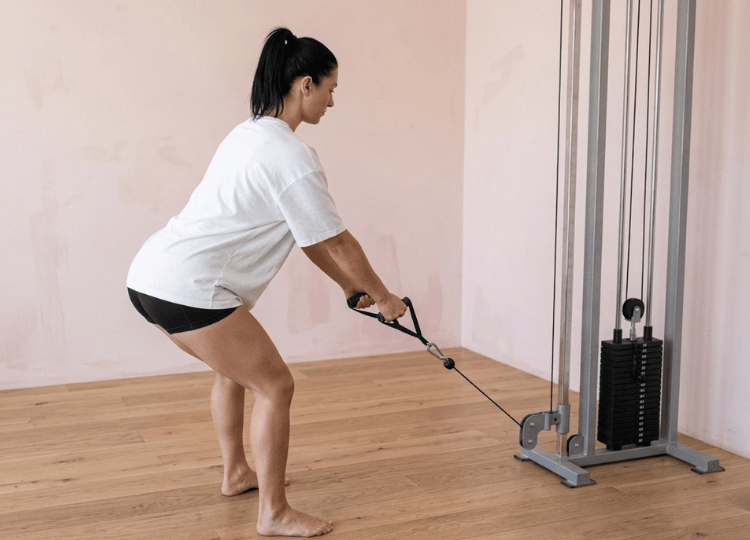
The Romanian deadlift is one of the most effective posterior chain exercises available.
It targets the hamstrings and glutes through a long range of motion, builds the kind of hip hinge strength that carries over to almost every other lower body movement, and is accessible enough to be included in most training programmes regardless of experience level.
The cable variation takes that same movement pattern and changes one fundamental thing: where the resistance comes from.
Instead of a barbell or dumbbells loading the movement from above via gravity, a cable pulley loads it from in front and below, maintaining tension throughout the entire range of motion rather than only during the most mechanically demanding portion.
That difference is small in appearance but meaningful in practice. It changes how the hamstrings are loaded, reduces the stress on the lower back, and makes the cable RDL a genuinely distinct exercise rather than just a substitution for the barbell version.
This guide on the cable Romanian deadlift covers everything you need to know, including how to perform the cable RDL, the muscles it works, the key benefits, how it compares to similar exercises, and what to consider before adding it to your programme.

Quick Summary
- The cable RDL follows the same hip hinge pattern as a barbell RDL but uses a low cable pulley to maintain constant tension throughout the full range of motion, including at the top where free weight variations unload.
- This makes it a strong accessory movement for hamstring and glute hypertrophy, with the added benefit of reduced lower back stress compared to barbell alternatives.
- It is not a replacement for barbell RDL work if strength is the primary goal, but works well alongside it during higher volume training phases.
What is a Cable Romanian Deadlift?
The cable Romanian deadlift is a hip hinge exercise performed using a cable machine with the pulley set to its lowest position. You hold the cable attachment, hinge forward at the hips with a slight bend in the knees, lower the handle toward the floor while maintaining a neutral spine, and then drive the hips forward to return to standing.
The mechanics closely mirror a barbell or dumbbell RDL, but the cable creates a horizontal pulling force rather than a purely vertical one. This means the glutes and hamstrings are under load at the top of the movement as well as the bottom, which is not the case with free weight variations where the load reduces as you approach the standing position.
It can be performed with a straight bar attachment, a rope attachment, or single-handed with a D-ring handle for a unilateral variation.
How to Perform the Cable Romanian Deadlift
To do the Cable Romanian Deadlift:
- Set the cable pulley to the lowest position and attach a straight bar or rope handle. Stand facing the machine with your feet hip-width apart, approximately one to two steps back from the pulley.
- Hinge forward slightly to grip the handle, then stand tall with the cable under light tension before beginning the movement.
- With a soft bend in the knees, brace your core and begin to hinge at the hips, pushing them back as you lower the handle toward the floor. Keep your back flat and your chest up throughout.
- Lower until you feel a deep stretch through the hamstrings, typically when the torso reaches roughly parallel to the floor, or as far as your flexibility comfortably allows.
- Drive the hips forward to return to the standing position, squeezing the glutes at the top.
- Keep the cable taut throughout the entire movement, including at the top, rather than letting it go slack.
Coach’s Tip
The most common mistake is allowing the lower back to round as fatigue sets in, which shifts the load away from the hamstrings and onto the spine. Before each rep, think about lengthening the spine and pushing the chest forward rather than simply dropping the torso down. If rounding is happening consistently, the weight is too heavy or the range of motion is exceeding your current hamstring flexibility.
Muscles Worked
- Hamstrings – the primary target, loaded eccentrically during the descent and concentrically during the drive back up, with the cable maintaining tension throughout the full range of motion.
- Gluteus Maximus – drives hip extension on the return to standing and is particularly active at the top of the movement where free weight variations typically unload.
- Erector Spinae – work isometrically throughout to maintain a neutral spine during the hinge, though the horizontal cable pull reduces the compressive spinal load compared to a barbell.
- Core and Obliques – brace continuously to stabilise the trunk and resist the forward pull of the cable throughout the movement.
- Adductors – assist with hip extension during the concentric phase and contribute to overall hip stability.
- Trapezius and Rhomboids – work to keep the shoulders packed and prevent the upper back from rounding as the torso hinges forward.
Cable Romanian Deadlift Benefits
Constant Tension Throughout the Range of Motion
This is the defining advantage of the cable RDL over its free weight alternatives. With a barbell or dumbbells, the resistance curve follows gravity, meaning load varies depending on where the weight is in space relative to your body.
At the top of a barbell RDL, when you are standing upright, the mechanical demand drops considerably.
The cable eliminates this by maintaining consistent tension regardless of body position. Research on resistance training consistently shows that greater time under tension and consistent loading through the full range of motion produces superior hypertrophy outcomes, making the cable RDL a strong option for those prioritising hamstring and glute development.
Reduced Lower Back Stress
The horizontal nature of the cable pull reduces the compressive load on the lumbar spine compared to a barbell RDL, where the entire weight of the bar is acting directly downward through the spine.
For those with a history of lower back discomfort or those in higher volume training phases looking to manage spinal fatigue, the cable RDL allows meaningful posterior chain loading with less lower back stress. This is one of its clearest practical advantages over the barbell version.
Improved Mind-Muscle Connection
The constant tension from the cable makes it easier to feel the hamstrings and glutes working throughout the movement, particularly at the top of each rep. This is useful for those who struggle to feel their posterior chain engaging during free weight hip hinge movements.
Research suggests that a stronger mind-muscle connection during training, particularly for the glutes, is associated with greater muscle activation per rep, which has practical implications for hypertrophy over time.
Accessible for a Range of Fitness Levels
The cable RDL is more forgiving to learn than the barbell version for most people. The lighter loads typically used with a cable machine, and the ability to increase weight in small increments, make it a practical starting point for those who are newer to hip hinge training.
The absence of a heavy barbell also removes some of the setup complexity and reduces the intimidation factor that can make barbell deadlifting feel unapproachable early in a training journey.
Unilateral Variation is Straightforward
Switching to a single-arm or single-leg cable RDL is a natural progression that is more practical on a cable machine than with a barbell.
The unilateral variation builds single-leg strength and stability, addresses imbalances between sides, and increases the core demand considerably. This versatility makes the cable machine a particularly flexible tool for RDL training across different goals.
A b-stance RDL is another popular choice for unilateral training, as well as single leg Romanian deadlifts using dumbbells.
Cable RDL vs Similar Exercises
Cable RDL vs Barbell RDL
The barbell RDL remains the gold standard for building posterior chain strength, particularly for those focused on progressive overload and maximum load. It allows considerably more weight to be moved than a cable variation and has decades of research supporting its effectiveness for hamstring and glute development.
For powerlifters, strength athletes and those whose primary goal is moving heavy weight, the barbell RDL is the better tool.
Where the cable RDL has a genuine edge is in hypertrophy-focused training, managing lower back fatigue during high volume phases, and for those with lower back sensitivities who want to continue training the hip hinge pattern without aggravating the spine.
The constant tension advantage is real and meaningful for muscle development, but it comes at the cost of the loading potential that the barbell offers.
The honest answer for most lifters is that both have a place in a well-rounded programme, with the barbell RDL as the primary movement and the cable variation serving as a useful accessory.
Cable RDL vs Dumbbell RDL
The dumbbell RDL shares the same gravity-dependent resistance curve limitation as the barbell version, meaning the load reduces at the top of the movement. The cable addresses this limitation.
Dumbbells have a practical advantage in accessibility since not everyone has access to a cable machine, and they are a useful option for home training.
For those who do have access to both, the cable version is the stronger hypertrophy tool due to the constant tension it provides.
Cable RDL vs Cable Pull-Through
The cable pull-through is a closely related exercise that also uses a low cable pulley and trains hip extension, but the movement pattern is slightly different. In the pull-through, the cable passes between the legs and the movement is more of a hip thrust pattern than a hinge.
The cable RDL demands greater hamstring flexibility, loads the hamstrings more directly, and requires more trunk stability. The pull-through tends to emphasise the glutes slightly more and is generally easier to learn, making it a useful starting point before progressing to the cable RDL.
Things to Consider
Progressive overload is limited compared to free weights
Most cable machines have weight stacks that cap out at a level well below what an experienced lifter could handle in a barbell RDL.
For those who are already strong in the hip hinge pattern, the cable RDL may eventually become too light to provide a sufficient strength stimulus, at which point it functions better as an accessory movement than a primary one.
Foot position relative to the pulley matters
Standing too close to the machine reduces the range of motion and limits how well the cable loads the bottom of the movement. Standing too far away makes it harder to maintain tension at the top.
Experimenting with distance from the pulley to find the position that keeps the cable taut throughout the full range is worth the time investment when first learning the exercise.
It is not a direct substitute for barbell work if strength is the goal
The cable RDL is an excellent hypertrophy and accessory tool, but it should not be treated as a like-for-like replacement for the barbell RDL in a strength-focused programme. The loading limitations mean it cannot replicate the strength stimulus of a heavy barbell hip hinge, and those training specifically for strength or athletic performance should keep the barbell variation as their primary movement.
Attachment choice affects the feel
A straight bar attachment keeps both hands in a fixed position and feels most similar to a barbell RDL. A rope attachment allows the hands to move more freely and can feel more natural for some people.
A D-ring handle opens up unilateral variations. It is worth trying different attachments when first incorporating the exercise to find what feels most comfortable and allows the best technique.
Bottom Line
The cable Romanian deadlift is a genuinely effective posterior chain exercise that earns its place as an accessory movement in most lower body programmes. The constant tension it provides throughout the full range of motion is a real advantage for hamstring and glute hypertrophy, and the reduced lower back stress makes it a practical option during high volume training phases or for those managing spinal fatigue.
It is not a replacement for the barbell RDL if maximal strength is the goal, and experienced lifters will eventually outgrow the loading capacity of most cable stacks. But as a complement to heavier free weight work, a hypertrophy-focused accessory exercise, or a more accessible entry point into hip hinge training, it is a versatile and underrated option that is worth including consistently.
Related Articles
Benefits of Deficit Reverse Lunges