
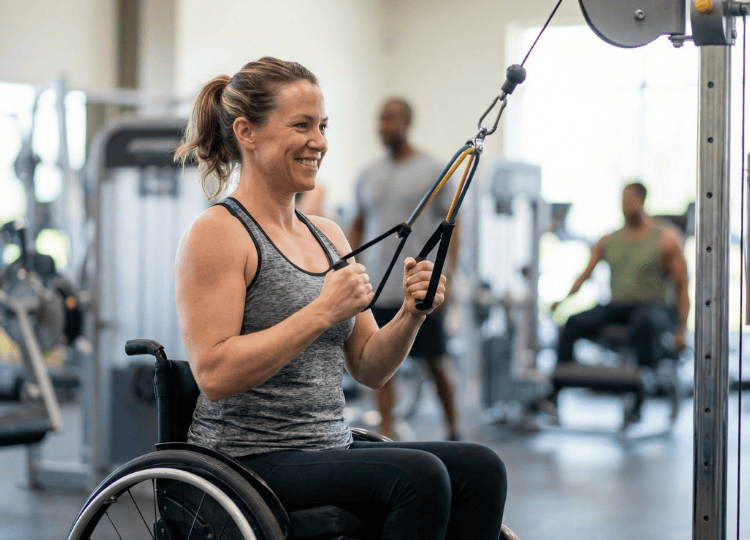
For a long time, fitness culture has quietly assumed one thing: that exercise looks the same for everyone. Standing movements, running, jumping, and bodyweight drills have dominated gyms, workout plans, and social media feeds. But strength training does not belong to one body type or mobility level. Adaptive fitness is reshaping what exercise looks like, and for wheelchair users, strength training is not just possible, it is powerful.
Adaptive fitness focuses on meeting people where they are, not forcing them into rigid movement standards. When done thoughtfully, strength training can improve independence, confidence, long term health, and quality of life for wheelchair users. It is not about “overcoming” disability. It is about building capacity, resilience, and agency within each individual’s unique abilities.
Why Strength Training Matters for Wheelchair Users
Strength training plays a critical role in physical health for wheelchair users, often even more so than for the general population. Daily life places high demands on the upper body. Propelling a wheelchair, transferring between surfaces, reaching overhead, and maintaining posture all rely heavily on shoulder, arm, and core strength.
Without targeted training, this repetitive load can increase the risk of overuse injuries, particularly in the shoulders, elbows, and wrists. Strength training helps balance these demands by strengthening stabilising muscles, improving joint integrity, and reducing strain during everyday movement.
Beyond injury prevention, strength training supports bone density, metabolic health, and cardiovascular function. For individuals with limited lower body loading, resistance training becomes an especially important tool in maintaining musculoskeletal health over time.
There is also the psychological benefit. Building strength is empowering. Seeing measurable progress in the gym or at home reinforces a sense of control over one’s body, which can positively impact mental wellbeing and self confidence.
What Adaptive Strength Training Looks Like
Adaptive strength training is not a watered down version of “real” training. It is smart training, adjusted for mechanics, mobility, and access. The core principles remain the same: progressive overload, consistency, and good technique.
Workouts can be performed seated in a wheelchair, on a bench, or on the floor depending on the individual. Many upper body exercises translate naturally to a seated position, including presses, rows, curls, triceps work, and shoulder raises.
Core training is also highly adaptable. Anti rotation exercises, controlled leans, resisted twists, and isometric holds can all be performed seated or supported, targeting the muscles responsible for trunk stability and posture.
For wheelchair users with partial or full lower body function, adaptive leg training may include resistance bands, assisted movements, or machine based exercises that provide external support.
The key is not the exercise selection itself, but how it is applied. Range of motion, grip options, load placement, and tempo can all be adjusted to suit the individual.
Equipment Considerations for Inclusive Training
One of the biggest barriers to adaptive fitness is not ability, but access. Many gyms are not designed with wheelchair users in mind. However, with the right equipment, strength training becomes far more accessible.
Resistance bands are one of the most versatile tools available. They are affordable, portable, and easy to anchor to racks, doors, or wheelchairs. Bands allow for smooth resistance throughout a movement and reduce joint stress, making them ideal for both beginners and advanced users.
Dumbbells are another excellent option, particularly when paired with adjustable benches or wheelchair friendly spaces. Lighter dumbbells allow for precise loading and unilateral work, which can help address imbalances.
Cable machines are often ideal for wheelchair users when space allows. They offer adjustable heights, consistent resistance, and a wide range of movement patterns. Many cable exercises can be performed without transferring out of the chair.
Grip adaptations are also important. Straps, cuffs, or adaptive handles can help individuals with limited hand function maintain control and train safely.
Perhaps most importantly, gyms should provide open floor space, movable benches, and staff who understand how to adjust setups without making assumptions.
The Role of Coaching and Education
Adaptive fitness thrives when coaches prioritise listening over prescribing. Every wheelchair user has a different relationship with their body, their injury or condition, and their goals. Effective programming starts with understanding these factors rather than applying generic templates.
Education also plays a role for the wider fitness community. Trainers do not need to be medical experts, but they do need to be curious, respectful, and willing to adapt. Inclusive fitness environments are built through collaboration, not perfection.
Online resources and adaptive fitness communities are growing rapidly, offering workout ideas, peer support, and representation that has historically been lacking. Seeing other wheelchair users train confidently sends a powerful message: strength belongs to everyone.
Shifting the Narrative Around Fitness
One of the most meaningful aspects of adaptive strength training is how it challenges outdated narratives. Fitness is not about aesthetics or comparison. It is about function, health, and self expression.
For wheelchair users, strength training can support independence, reduce pain, improve endurance, and enhance participation in daily life. But it also does something deeper. It reframes the body not as something broken, but as something capable.
Inclusive fitness benefits everyone. When gyms become more accessible, programming becomes more flexible, and coaches become more thoughtful, the entire industry improves.
Adaptive fitness is not a niche category. It is a reminder of what fitness should have been all along: adaptable, empowering, and human.