

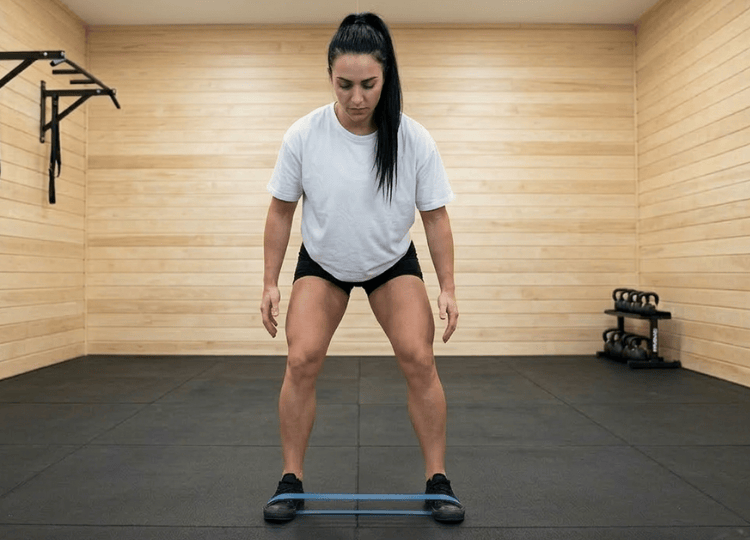
Although banded lateral walks look relatively simple, this low-impact exercise is one of the most effective ways to strengthen the hip abductors and gluteus medius specifically.
By stepping side to side against the resistance of a band, the exercise directly targets the outer hip muscles responsible for hip stability and lateral movement.
These muscles are consistently undertrained in most programmes, which tend to focus on forward and backward movements like squats, lunges and deadlifts. The lateral plane is often neglected entirely.
Banded lateral walks are also great for beginners and you can adapt the exercise to suit your current level of fitness and strength.
But, it’s an exercise we often see performed incorrectly, and there are some key mistakes to avoid.
This guide provides a clear overview of the banded lateral walk, including how to perform it, the benefits, and muscles worked.

Quick Summary
- Use banded lateral walks to strengthen the hip abductors, primarily the gluteus medius.
- Focus on small steps and keep the band taut as you step from side to side.
- The lower you place the band on your body, the harder the abductors need to work.
- Don’t forget to strengthen your hip adductors too.
What is the Banded Lateral Walk (Side Step) Exercise?
The banded lateral walk (also sometimes referred to as a “banded side step”) is a resistance exercise designed to strengthen the hip abductors and glutes.
It involves stepping side to side, with a resistance band placed around either your thighs, ankles or feet. The band creates tension and means your glutes and lower body muscles need to actively push against this tension to move.
The exercise is also very versatile and can be performed at home or in the gym.
Where Should I Place the Band?
You can place the band above your knees, below your knees, around your ankles, or even around your feet. The lower the band, the more challenging the exercise. Research suggests placing the band around your feet leads to the greatest activation of the glutes.
Equipment Needed
The only equipment you need for banded lateral walks is a resistance band of some kind.
The thicker the band, the harder the exercise becomes (because more resistance is applied to the movement).
Resistance bands come in a range of shapes and sizes, and any band will do, but we find those described as “glute bands” tend to be smaller and lend themselves well for exercises like clamshells and other banded hip abduction exercises like lateral walk side steps.
How to Perform Banded Lateral Walks
To do a banded lateral walk:
- Place a resistance band around your thighs, ankles or feet. The lower the band, the more challenging the exercise.
- Stand with your feet hip-width apart.
- Slightly bend your knees and hinge forward at the hips so you are in a quarter squat position.
- Keep your back straight, chest up and core engaged throughout.
- Take a step to the right with your right foot, then follow with your left foot. Ensure the band stays taut and tension is maintained throughout the movement.
- Repeat for the desired number of steps or distance, then switch directions.
Coach’s Tip – It is really important that your knees do not cave inward during this exercise. This suggests you are internally rotating at the hips and not actively engaging the glutes. Take small steps and focus all your energy on keeping the band taut by pushing against it. A slight forward lean in the torso, as if you are in an athletic stance, has been shown in research to increase gluteus medius and maximus activation compared to standing fully upright.
Banded Lateral Walk Muscles Worked
- Gluteus medius – the primary target of the banded lateral walk, responsible for hip abduction and pelvic stability throughout each step
- Gluteus minimus – assists the gluteus medius in hip abduction and helps keep the hips stable as you move laterally
- Gluteus maximus – contributes to the movement, particularly the upper fibres that assist with hip abduction and external rotation
- Tensor fasciae latae (TFL) – assists with hip abduction, though good technique with the band placed low minimises over-reliance on this muscle
- Quadriceps – engaged to maintain the quarter squat position throughout the movement
- Hamstrings – assist in stabilising the hip and knee during the lateral stepping pattern
- Core and obliques – activated throughout to keep the torso stable and prevent lateral trunk sway
Benefits
Gluteus Medius Activation
Banded lateral walks are one of the most direct exercises for activating and strengthening the gluteus medius, the outer hip muscle responsible for stabilising the pelvis during walking, running and lateral movement.
Research from PMC found that lateral band walks produce meaningful gluteus medius activation of 30 to 50% of maximal voluntary isometric contraction in the stance limb, making it one of the higher-activation exercises available for this muscle group.
Improved Balance and Stability
By strengthening the hip abductors and gluteus medius and minimus, banded lateral walks improve balance and overall hip stability. This is particularly relevant for older adults, as hip stability plays a direct role in fall prevention and the quality of everyday movement.
Better Athletic Performance
Strong hip abductors support better performance in any sport or physical activity that involves lateral movement, acceleration or change of direction.
Sports like tennis, basketball and football all require rapid lateral movements, and weak hip abductors are one of the most common contributors to reduced performance and injury risk in these activities.
Injury Prevention
Weak hip abductors and gluteus medius muscles are directly associated with increased risk of knee pain, IT band syndrome, patellofemoral pain and hip impingement.
Research consistently shows that hip abductor weakness alters lower limb mechanics, placing compensatory stress on the knees and lower back. Including banded lateral walks in a regular routine is a practical and accessible way to address this.
Improved Posture
Strong glutes and hip abductors help align the hips and pelvis, which has a positive knock-on effect on posture throughout the entire lower body and lower back. Weakness in these muscles is one of the most common contributors to hip drop during walking and running, which over time contributes to lower back pain and movement inefficiency.
Versatile and Accessible
Banded lateral walks require nothing beyond a resistance band and can be performed anywhere. They work equally well as a warm-up activation exercise before lower body training, as a standalone strengthening drill, or as part of a rehabilitation programme.
Common Mistakes to Avoid
Losing Tension in the Band
The band should remain taut throughout the entire movement. Taking steps that are too large allows the band to go slack, which reduces the demand on the glutes significantly. Keep steps small and controlled and maintain tension at all times.
Standing Upright
Performing the exercise fully upright reduces gluteal engagement. Maintaining a slight bend in the knees and hinging at the hips into a quarter squat naturally activates the glutes and improves the quality of every step.
Research supports a moderate hip and knee flexion of around 30 degrees as the most biomechanically effective position for targeting the gluteus medius.
Rushing the Movement
Performing the exercise quickly and with little control shifts the work to momentum rather than the target muscles. Slow, deliberate steps with a pause at full extension produce significantly better glute activation than fast, shallow ones.
Inward Knees
If the knees cave inward during the movement, it is a sign the glutes are not engaging properly. Performing the exercise in front of a mirror when first learning it is a useful way to check that the knees are tracking in line with the toes throughout.
Lateral Trunk Sway
Leaning to one side as you step reduces the demand on the hip abductors by mechanically offloading the stance limb. Keep the trunk facing forward and avoid any tilting or swaying of the torso during the movement.
Banded Lateral Walk Variations
Monster Walk
The monster walk replaces the side-to-side stepping pattern with a forward and backward walking movement, keeping the band around the ankles throughout.
It trains the hip abductors in a forward movement pattern that more closely mimics the demands of running and change of direction. Research comparing monster walks and lateral band walks found comparable gluteus medius activation, making them a useful complement to each other rather than a direct substitute.
Banded Squat Walk
Add a full squat between each lateral step to increase the intensity and further engage the glutes, quads and hamstrings. After each step, lower into a squat before stepping again. This variation increases the overall demand of the session and works well for those who find the standard lateral walk insufficiently challenging.
Forward and Backward Banded Walk
Instead of stepping laterally, walk forward for a set number of steps and then backward, maintaining the quarter squat position throughout. This variation trains the hip abductors in a sagittal plane pattern and is particularly useful for those looking to improve hip stability for running or walking.
Bodyweight Lateral Walk
For those new to strength training, starting without a band is a practical first step. Although there is no band to push against, focusing on squeezing the glutes and driving the hip outward during each step promotes good technique and builds the movement pattern before resistance is introduced.
Focus on Technique
Whatever variation you’re doing, focus on good technique and form to avoid the risk of injury.
Bottom Line
Banded lateral walks are a beginner-friendly and highly accessible exercise for strengthening the hip abductors, an area that is consistently neglected in most lower body training programmes. The research supports their effectiveness, with EMG data showing meaningful gluteus medius activation, particularly when the band is placed at the ankles or feet and the exercise is performed in a semi-squat position.
Focus on small, controlled steps that keep the band taut throughout the movement, avoid letting the knees cave inward, and use the quarter squat position to maximise glute engagement. Two to three sessions per week is sufficient for meaningful strength improvements over time.
If you currently have hip or knee pain, speak to a physiotherapist before starting.
Related Articles