
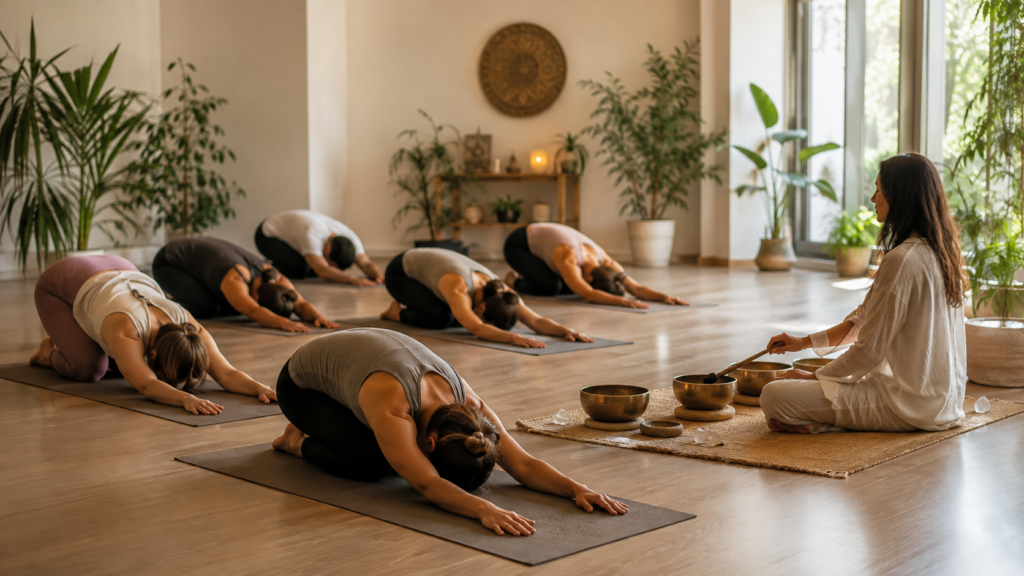
Walk into a yoga studio on a Tuesday evening and you’ll notice something that wasn’t there five years ago. The mats are still in rows, the lighting is still dimmed, but tucked into the corner near the teacher’s mat sits a collection of metal bowls, a small gong, maybe a set of chimes. Roughly halfway through class — often right as the room settles into hip openers or the final stretch before savasana — the teacher stops cueing and starts playing.
This isn’t a niche experiment anymore. Studios in cities from Portland to Berlin have quietly restructured their schedules around it, adding “sound-integrated flow” or “vinyasa + sound bath” to timetables that used to list only power, hot, and restorative. Some studios report those hybrid classes filling faster than anything else on the board. Something in the way people want to practice has shifted, and the studios paying attention are following it.
The Shift Behind the Trend
The easy explanation is that wellness culture loves a new format. The more accurate explanation has to do with what people are actually walking into class carrying.
Most yoga students arrive overstimulated. Not tired in the muscular sense — tired in the attentional sense. They’ve spent the day switching between screens, absorbing notifications, holding half-finished thoughts. Traditional yoga asks them to quiet that down through breath and physical effort alone, and for a lot of people that no longer works. The mind keeps running its background processes while the body moves through the shapes.
Studio owners noticed this before anyone published research about it. Teachers were seeing students who could hold a difficult balance for a full minute but couldn’t lie still for three. Savasana became the hardest pose in the room. Sound baths entered the picture as a practical fix: give the mind something to follow that isn’t a thought, and it stops chasing the day.
There’s also a business reality here. Boutique fitness got crowded. Studios competing on heated rooms and playlist quality hit a ceiling. Sound offers a genuine point of difference that doesn’t require new infrastructure — no build-out, no equipment leases, just instruments and a teacher who knows how to use them.
What Sound Actually Adds to Movement
The pairing works because sound and movement operate on the body through different doors.
Physical practice engages the body from the outside in — you place a limb, engage a muscle, and the nervous system responds to what you’ve done. Sound works the other way. Sustained, low-frequency tones reach the auditory system directly and may encourage a calmer breathing rhythm and a greater sense of relaxation for some people. Researchers continue to study their effects on measures such as heart rate variability, and current evidence remains limited. You don’t have to *try* to receive a sound bath. That’s precisely what makes it effective at the end of a class where you’ve already spent an hour trying.
One proposed explanation is that slow, continuous tones may support relaxation by complementing slow breathing and mindful attention. While some studies suggest benefits for stress reduction, the exact physiological mechanisms are still being investigated. Breathing lengthens on its own. Muscles that were still holding tension after stretching finally released, because the release wasn’t a muscular problem to begin with.
Teachers who’ve integrated sound describe a specific sequencing logic. Movement first, to discharge physical restlessness and create genuine fatigue. Sound second, to catch the body in that open, post-effort state when it’s most receptive. Reverse the order and the effect thins out considerably. The movement earns the stillness; the sound deepens it.
Frequency matters too, and this is where instrument quality becomes a real variable rather than an aesthetic one. A well-made bowl produces overlapping overtones that shift and beat against each other as they fade, which is what creates the sensation of sound moving through the body rather than simply arriving at the ears. A poorly made one produces a flat tone that stops being interesting after four seconds — and in a room of forty people lying still, four seconds is nothing.
Why Students Are Choosing It Over Standard Classes
Ask attendees why they book the sound-integrated class instead of the regular flow and the answers rarely mention chakras or energy. They’re more pragmatic than that.
The most common response is some version of *I actually stop thinking*. For people who’ve tried meditation apps and abandoned them, a sound bath removes the performance element. There’s no instruction to follow, nothing to get right, no internal scorekeeping about whether you’re doing it correctly. You lie there and the sound does the work. That passivity is the appeal, especially for high-achieving students who turn everything else into a project.
The second answer is about aftereffects. Students describe leaving these classes with a kind of settled clarity that lasts into the evening — noticeably different from the pleasant exhaustion of a hard vinyasa. Whether that’s the nervous system reset or simply the novelty of ninety uninterrupted minutes without a phone is an open question. Most people don’t care about the mechanism.
There’s a social dimension as well. Sound baths are communal in a way that individual practice isn’t. Forty people experiencing the same acoustic environment at the same moment creates a shared quality of attention that students mention unprompted. In an era where most restorative activity happens alone and through headphones, that shared quality has become unexpectedly scarce.
How Studios Are Actually Doing It
The practical implementation is less mystical than the marketing suggests.
Most studios start small — one instrument, used for five minutes at the close of an existing class. Teachers experiment with placement, learning that a bowl played near the head of the room reaches everyone differently than one carried between the rows. The good ones learn restraint fast. The most common beginner mistake is playing too much; sound baths work through space and decay, not density.
Instrument selection tends to be the biggest investment decision. Machine-pressed bowls are cheap and consistent, but they produce a single clean tone with little harmonic complexity. Hand-hammered pieces are irregular by nature, and that irregularity is the point — the slight asymmetries generate the layered, wavering overtones that make longer sessions engaging rather than monotonous. Studios building a serious sound program usually end up sourcing handmade singing bowls from Kathmandu, where the metalworking tradition has produced this exact acoustic character for generations. It’s worth taking time to understand what separates authentic sound healing instruments from decorative reproductions before committing to a set, since a mismatched collection is difficult to work with and expensive to replace.
Range matters more than quantity. Three well-chosen bowls covering low, middle, and high registers give a teacher far more to work with than a dozen instruments clustered in the same pitch range. Many studios pair traditional Nepali metalwork with a single gong or a set of chimes for punctuation, and stop there.
Training is the piece studios most often underestimate. Playing a bowl is easy. Structuring forty minutes of sound so it builds, holds, and resolves is a genuine skill, closer to composition than to instrument technique. Studios that treat it as a bolt-on tend to produce sessions students describe as pleasant but forgettable.
Where This Is Heading
Sound is no longer confined to the yoga room. Physical therapy clinics are testing it for pain management protocols. Corporate wellness programs have started booking sessions the way they once booked chair massage. A handful of hotels now run evening sound sessions as an amenity, and sleep-focused programming built around low-frequency tones is expanding well outside the wellness category.
What that spread suggests is that the yoga studio isn’t the destination for this trend — it’s the entry point. Studios were simply the first environment with the right conditions: dim rooms, floor space, and an audience already willing to lie down for an hour.
The more interesting question is what happens to yoga itself. For most of its modern Western history, the practice has drifted toward the physical — harder sequences, hotter rooms, measurable progress. Sound pulls in the opposite direction, toward experience that can’t be tracked or optimized. Studios adding it aren’t just diversifying their schedule; they’re quietly signaling that the fitness-first era of yoga has reached its limit, and that what people want now is somewhere to put down the effort entirely.