

Resistance bands are one of the most underestimated pieces of fitness equipment available. They are inexpensive, take up almost no space and can be used anywhere, but they are often dismissed as a beginner’s substitute for real weights rather than a genuinely effective training tool in their own right.
The research suggests otherwise. A PMC meta-analysis comparing elastic resistance training with conventional resistance training found no significant difference in strength gains between the two methods for either upper or lower body.
A separate review found that elastic resistance training produces similar electromyographic muscle activation to free weights, with the added benefit of reduced joint stress throughout the movement.
What makes bands particularly effective is their resistance curve. Unlike free weights, where tension drops at the top of many movements, bands maintain constant tension throughout the full range of motion. This means the muscles are under load even in positions where dumbbells or barbells would otherwise provide little challenge.
The 8 exercises below cover the full body, require no anchoring equipment beyond your own feet or a door frame, and are well suited to anyone getting started with resistance band training or looking to supplement an existing routine.

Quick Summary
- Resistance bands are a highly effective and often overlooked training tool, shown to build strength just as effectively as free weights while placing less stress on the joints.
- Their unique resistance curve keeps muscles under constant tension, making them particularly valuable for both beginners and those supplementing existing routines.
- Exercises include; banded squats, resistance band Romanian deadlifts, seated rows, chest presses, face pulls, glute bridges, bicep curls, and lateral raises.
Types of Resistance Bands
Before getting started it is worth understanding the main types of bands available, as different exercises suit different band styles.
- Loop bands – These are a continuous circle of elastic, typically shorter in length, and sit around the thighs or ankles. They are best suited to lower body exercises like banded squats, glute bridges and lateral walks.
- Long resistance bands – These are a single length of flat elastic that can be stood on, anchored to a door or wrapped around a fixed point. They are the most versatile option and work well for rows, presses, curls and deadlifts.
- Tube bands with handles – These have a handle at each end and work similarly to long bands but are often more comfortable to grip for upper body exercises.
Most people benefit from having two or three bands of different resistances. Lower body exercises generally require heavier resistance than upper body isolation movements.
8 Resistance Band Exercises
Banded Squat
The banded squat adds resistance to one of the most fundamental lower body movements. Placing the band above the knees rather than underfoot adds an abduction challenge that activates the gluteus medius alongside the quads and glutes, improving hip stability and knee tracking simultaneously.
How to do it:
- Place a loop band just above both knees.
- Stand with feet shoulder-width apart and toes turned slightly outward.
- Brace the core and lower into a squat, actively pressing the knees outward against the band throughout the movement.
- Drive through the heels to return to standing and squeeze the glutes at the top.
- Perform 3 sets of 12 to 15 reps.
Coach’s Tip: The most common mistake is allowing the knees to cave inward as fatigue sets in. Focus on pushing the knees out against the band on every rep. If this is difficult, reduce the resistance of the band before increasing squat depth.
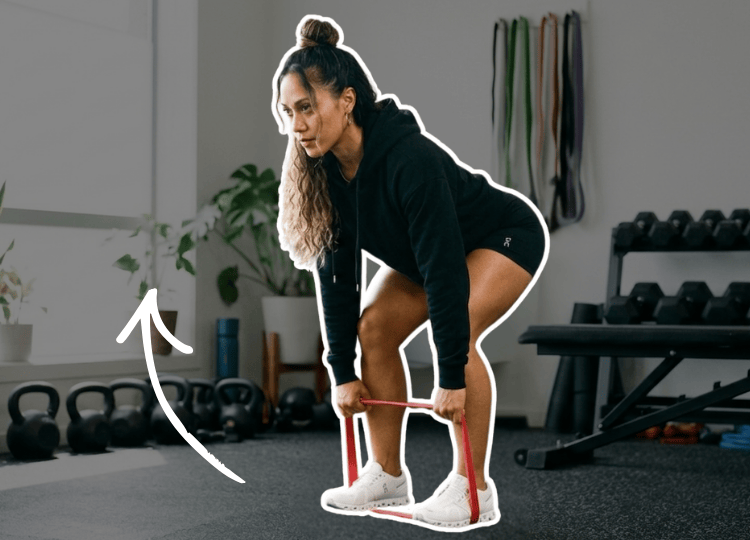
Resistance Band Romanian Deadlift
The banded Romanian deadlift trains the posterior chain through a hip hinge pattern, targeting the hamstrings, glutes and lower back. The band provides increasing resistance as the hips drive forward at the top of the movement, which is precisely where free weight tension drops off (similar to cable RDLs).
How to do it:
- Stand on the centre of a long band with feet hip-width apart, holding the ends in each hand.
- With a soft bend in the knees, hinge at the hips and lower the hands toward the floor, keeping them close to the legs and the back flat.
- Feel the stretch through the hamstrings, then drive the hips forward to return to standing.
- Squeeze the glutes at the top of each rep.
- Perform 3 sets of 10 to 12 reps.
Coach’s Tip: The movement comes from the hips, not the lower back. Think about pushing the hips backward on the way down rather than bending forward. If the back rounds, shorten the range of motion until hamstring flexibility improves.
Seated Resistance Band Row
The seated row targets the muscles of the mid and upper back, including the lats, rhomboids and rear deltoids. These muscles support posture and are often underdeveloped in those who spend long periods sitting. A band is exceptionally well suited to this movement because tension increases as the elbows pull back, matching the natural strength curve of the rowing pattern.
How to do it:
- Sit on the floor with legs extended and loop the band around the soles of both feet.
- Hold one end of the band in each hand with arms extended.
- Row the hands toward the lower ribcage, leading with the elbows and squeezing the shoulder blades together at the end of the movement.
- Extend the arms back with control and repeat.
- Perform 3 sets of 12 reps.
Coach’s Tip: Avoid rounding the lower back to generate momentum. Keep the torso upright throughout and let the arms do the work. If the band goes slack before the elbows reach full extension, wrap it around the feet an extra time to shorten the available length.
Resistance Band Chest Press
The band chest press targets the pectorals, anterior deltoids and triceps in a horizontal pressing pattern. Anchoring the band behind the body and pressing forward replicates the cable chest press movement pattern and keeps constant tension on the chest throughout the range of motion.
How to do it:
- Anchor a long band behind you at roughly chest height, either through a door anchor or looped around a fixed point.
- Hold one end in each hand at chest height with elbows bent at roughly 90 degrees.
- Press both hands forward until the arms are fully extended, keeping a slight bend in the elbows at the end.
- Return with control, feeling the stretch through the chest.
- Perform 3 sets of 12 reps.
Coach’s Tip: Stand far enough from the anchor point that there is meaningful tension in the band even at the start position before pressing. If the band is slack at the beginning, step further forward to increase the challenge throughout the full range.
Face Pull
The face pull targets the rear deltoids, trapezius and rotator cuff muscles, making it one of the most valuable exercises for shoulder health and upper back posture. It is particularly beneficial for those who sit at a desk or who do a significant amount of pressing work, as it strengthens the muscles responsible for pulling the shoulders back and open.
How to do it:
- Anchor the band at roughly face height in front of you.
- Hold one end in each hand with palms facing down and arms extended.
- Pull the band toward your face, leading with the elbows high and wide, until the hands are level with the ears.
- At the end of the movement, externally rotate the shoulders so the forearms point toward the ceiling.
- Return with control and repeat.
- Perform 3 sets of 15 reps.
Coach’s Tip: Keep the elbows high throughout the pull. If the elbows drop, the movement shifts from the rear deltoids toward the biceps and loses much of its value for shoulder health. Use a lighter band than you think necessary for this one.
Glute Bridge with Band
The banded glute bridge adds abduction resistance to the standard glute bridge, combining hip extension with the outward knee drive to challenge the gluteus maximus and gluteus medius simultaneously. It is one of the most effective glute activation exercises available and requires no equipment beyond a loop band.
How to do it:
- Lie on your back with knees bent and feet flat on the floor, hip-width apart.
- Place a loop band just above both knees.
- Drive the hips upward by squeezing the glutes, pressing the knees outward against the band throughout the movement.
- Hold for a moment at the top, then lower with control.
- Perform 3 sets of 15 reps.
Coach’s Tip: Focus on squeezing the glutes at the top rather than simply lifting the hips as high as possible. The glute contraction is what makes the exercise effective. Pressing the knees outward against the band throughout, not just at the top, ensures the hip abductors are engaged consistently.
Resistance Band Bicep Curl
The bicep curl with a resistance band produces consistent tension throughout the full range of the curl, including at the top position where a dumbbell becomes nearly weightless at full flexion. This makes it one of the cases where band training has a genuine mechanical advantage over free weights.
How to do it:
- Stand on the centre of a long band with feet hip-width apart.
- Hold one end in each hand with palms facing forward and elbows at the sides.
- Curl both hands toward the shoulders, keeping the elbows fixed and close to the body.
- Lower with control, resisting the pull of the band on the way down.
- Perform 3 sets of 12 reps.
Coach’s Tip: Keep the elbows pinned to the sides throughout the movement. Allowing them to drift forward turns the curl into a front raise and reduces the bicep stimulus. The lowering phase is where bands provide the most unique benefit over free weights, so control the descent rather than letting the band snap the arms back down.
Resistance Band Lateral Raise
The lateral raise isolates the medial deltoid, building shoulder width and strength. Bands work particularly well for this movement because the resistance increases as the arms rise, matching the point at which the deltoid is most mechanically active.
How to do it:
- Stand on the centre of a long band with feet hip-width apart.
- Hold one end in each hand with arms at the sides and palms facing the body.
- Raise both arms out to the sides until they reach shoulder height, keeping a soft bend in the elbows throughout.
- Lower with control and repeat.
- Perform 3 sets of 12 to 15 reps.
Coach’s Tip: Start with a lighter band than you think is necessary. The lateral raise is a small movement targeting a relatively small muscle, and the temptation to use too much resistance leads to shrugging and swinging which shifts the load onto the trapezius instead. The movement should feel like a controlled, deliberate arc rather than a lift.
Benefits of Resistance Band Training
Comparable strength gains to free weights
A PMC meta-analysis found no significant difference in strength gains between elastic resistance training and conventional weight training for either the upper or lower body. For those without access to a gym or a full set of dumbbells, this is a meaningful finding.
Constant tension throughout the range of motion
Unlike free weights, which lose tension at certain positions in a movement, bands maintain resistance throughout the full range. This increases time under tension and muscle activation, particularly in positions where free weights provide minimal challenge.
Joint-friendly loading
Bands reduce compressive and shear forces on the joints compared to heavy free weight loading. This makes them a particularly practical option for those returning from injury, those with existing joint sensitivities, or older adults looking for a lower-impact training method.
Portable and affordable
A set of three bands covering light, medium and heavy resistance costs a fraction of a dumbbell set and fits in a bag. They are one of the most practical tools available for anyone who travels regularly or trains at home.
Things to Consider
- Match the band resistance to the exercise. Lower body movements like squats and deadlifts generally require a heavier band than upper body isolation exercises like lateral raises or curls. Having two or three bands of different resistances allows for appropriate loading across all exercises.
- Check bands regularly for wear. Resistance bands degrade over time, particularly if exposed to sunlight, sweat or sharp surfaces. Inspect bands before each session and replace any that show cracks, thinning or discolouration.
- Progressive overload still applies. To continue making progress with band training, resistance needs to increase over time. This can be done by moving to a heavier band, shortening the band to increase tension, or adding reps and sets before progressing to a heavier resistance.
- Anchor points need to be secure. For exercises that require anchoring the band to a fixed point, ensure the anchor is solid before adding tension. Door anchors are practical but should be checked that the door is closed firmly and the anchor is correctly positioned before each exercise.
Bottom Line
Resistance bands are a genuinely effective training tool that the research supports as comparable to free weights for building strength, with the added advantage of constant tension throughout the range of motion and reduced joint loading.
They work particularly well for pulling movements, hip hinge patterns and shoulder health exercises, and are one of the most practical and affordable options available for home training.
The 8 exercises above cover the full body and can be completed in a single session or split across the week. Start with a lighter band than feels necessary, focus on controlled movements, and progress to heavier resistance as each exercise becomes well controlled across all sets and reps.
Related Articles
Tabata Training Workouts – Everything You Need to Know