

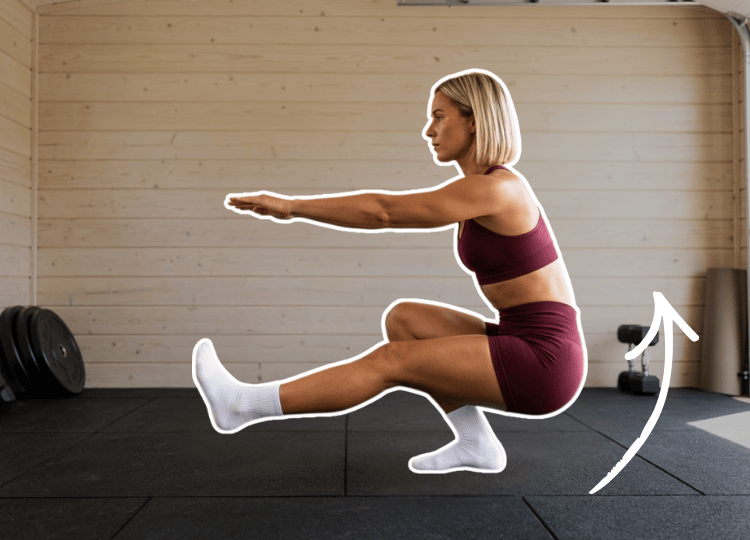
Most single-leg exercises give you something to fall back on. A reverse lunge has the back foot. A split squat has both feet on the floor. Even a skater squat keeps the trailing leg close to the ground as a counterbalance. The pistol squat gives you none of that. It is just you, one leg, and a full depth squat, with the other leg extended straight out in front throughout the entire movement.
That is what makes it one of the most demanding bodyweight exercises available, and one of the most rewarding to work toward.
It requires strength, balance, ankle mobility, hip flexibility and genuine body awareness all at once.
This guide is designed for those who are starting from scratch. It covers what the pistol squat is, how to perform it, the muscles it works, the key benefits, what to work on before you attempt it, and a clear progression pathway for getting there from whatever level you are at right now.

Quick Summary
- The pistol squat is one of the most demanding bodyweight exercises available, requiring strength, balance, ankle mobility and hip flexibility all at once, making it a genuine benchmark of single-leg fitness.
- Most beginners should expect to spend several weeks to months working through progressions such as the box pistol squat, assisted variation and eccentric only method before achieving a clean first rep.
- Ankle mobility is the most common limiting factor, not strength, so addressing dorsiflexion early in the process will unlock progress faster than simply attempting more pistol squats.
What is a Pistol Squat?
The pistol squat is a single-leg squat where the non-working leg is held straight out in front of the body, roughly parallel to the floor, throughout the entire movement. The working leg performs a full squat, descending until the hamstring rests on the calf at the bottom, before driving back up to standing.
It is worth distinguishing the pistol squat from a standard single-leg squat. Both involve squatting on one leg, but in a standard single-leg squat there is no requirement for what the non-working leg does. In the pistol squat, the extended front leg is a defining part of the movement. It acts as a counterbalance, adds to the overall difficulty, and increases the demand on hip flexor strength and hamstring flexibility.
The movement has roots in gymnastics and calisthenics and has become a benchmark exercise in functional fitness and bodyweight training for the combination of physical qualities it requires.
Skater Squat
If you are working toward the pistol squat, the skater squat is a great stepping stone to build single-leg strength and balance along the way.
How Long Does it Take to Learn?
This is one of the first questions most beginners ask, and it is worth answering honestly.
It depends significantly on your current starting point. If you already have solid single-leg strength, good ankle mobility and decent balance, learning the movement pattern may take just a few weeks of focused practice. If you are starting from a lower base, research and practical coaching experience suggest that most beginners need somewhere between four and eight months of consistent work to achieve a clean first pistol squat.
The good news is that the journey toward it is productive in its own right. Every progression you work through builds real strength, mobility and balance, regardless of whether you have hit the full movement yet. Treating it as a long-term skill to develop rather than a trick to attempt once gives you a much better chance of getting there.
What You Need Before You Start
The pistol squat has several physical prerequisites. Attempting the full movement before these are in place tends to result in poor technique, compensatory patterns and frustration. It is worth honestly assessing each of these areas first.
- Ankle mobility – you need sufficient dorsiflexion to keep the heel flat on the floor through a deep single-leg squat. This is the most common limiting factor for beginners. A simple test: can you perform a deep two-legged squat with your heels flat and your torso relatively upright? If not, ankle mobility is worth addressing before progressing to single-leg work.
- Single-leg balance – stand on one leg with the other extended forward, roughly parallel to the floor, and hold for 15 seconds. If this is very challenging, balance work should come before loaded single-leg squatting.
- Hamstring flexibility – the non-working leg needs to stay extended throughout the movement. Tight hamstrings will pull it down and make the exercise significantly harder. Regular hamstring stretching is a useful investment early in the process.
- Basic single-leg strength – a good indicator is the ability to perform 10 controlled reverse lunges on each leg with bodyweight before progressing to the pistol squat.
How to Perform the Pistol Squat
To do the Pistol Squat:
- Stand tall with your feet hip-width apart. Extend your arms straight out in front of you at shoulder height to help with balance throughout the movement.
- Shift your weight onto your right foot and lift your left leg off the ground, extending it forward so it is roughly parallel to the floor.
- Begin to hinge at the hip and bend the right knee, lowering your body slowly toward the ground. Keep the left leg extended throughout the descent.
- Continue lowering until the right hamstring rests on the right calf at the bottom of the movement. Keep your heel flat on the floor and your chest as upright as possible.
- From the bottom position, drive through the right heel to push back up to standing, keeping the left leg extended throughout.
- Return to the starting position and complete all reps on one side before switching legs.
Coach’s Tip: The two most common sticking points are the bottom position and the initial drive out of it. If you find yourself collapsing forward or losing balance at the bottom, ankle mobility is usually the limiting factor rather than strength.
Muscles Worked
- Quadriceps – the primary mover, working hard to control the descent and drive the body back up from the bottom of the squat on a single leg.
- Gluteus Maximus – extends the hip during the ascent and stabilises the pelvis throughout the movement.
- Gluteus Medius – keeps the pelvis level and prevents the knee from caving inward throughout the movement.
- Hamstrings – support the knee joint and assist with controlling the eccentric lowering phase.
- Hip Flexors – work actively to hold the non-working leg extended out in front throughout the entire movement.
- Calves – maintain ankle stability and keep the heel grounded through the full range of motion.
- Core – braces throughout to maintain an upright torso and resist the rotational demand created by the single-leg loading.
Benefits of Pistol Squats
Builds Serious Unilateral Lower Body Strength
The pistol squat places the full load of the body through a single leg for a complete range of motion squat. This is a significant strength demand, and one that bilateral squatting cannot replicate.
Because the dominant side cannot compensate for the weaker one as it can in two-legged movements, the pistol squat is one of the most effective tools available for building balanced strength across both legs.
Identifies and Corrects Muscle Imbalances
Most people have meaningful strength and mobility differences between their left and right sides that bilateral training can mask. The pistol squat exposes these immediately. If one side struggles significantly more than the other with depth, balance or control, that is useful information.
Addressing those imbalances through regular single-leg training reduces the compensatory movement patterns that often contribute to injury over time.
Improves Hip, Knee and Ankle Mobility
Getting to the bottom of a pistol squat and returning from it requires meaningful range of motion at the ankle, knee and hip simultaneously. Working consistently through the progressions and toward the full movement is an effective way to improve mobility across all three joints.
It is also one of the most revealing mobility assessments available, since sticking points at each joint become immediately apparent.
Develops Balance and Proprioception
Performing a full squat on one leg while managing the extended leg as a counterbalance requires a high level of body awareness and coordination.
Regular practice genuinely improves balance and proprioception, qualities that have direct relevance to athletic performance and to the functional movement that supports independence and injury resilience as you age.
Requires No Equipment
The pistol squat is a bodyweight exercise, which means it requires nothing beyond a flat surface. This makes it one of the most accessible high-demand lower body exercises available for home training and travel. When greater resistance is needed, it can be loaded by holding a weight at the chest in a goblet position.
Pistol Squat Progressions for Beginners
Working through these progressions in order is the most reliable path to the full pistol squat. There is no fixed timeline for moving between steps. The signal to progress is consistency and control at your current level, not a set number of sessions.
Step 1: Box Pistol Squat
Stand in front of a box or chair and squat down onto it on one leg, with the other leg extended forward. Push through the heel to stand back up. Start with a higher surface and gradually reduce the height as control improves. This is the most accessible starting point and builds the single-leg strength and movement pattern the full exercise requires.
Step 2: Assisted Pistol Squat
Hold a TRX strap, resistance band anchored to a fixed point, or a sturdy upright with one hand to reduce the balance and strength demand while continuing to learn the movement pattern. Use as little assistance as possible and work toward relying on it less with each session.
Step 3: Eccentric Only
Lower slowly into the bottom position on one leg over three to five seconds, then use both legs to stand back up. This builds the strength and motor pattern needed for the full movement without requiring the ability to drive back up unilaterally from depth yet. It is particularly effective for developing quad strength through the full range of motion.
Step 4: Elevated Pistol Squat
Stand on a low box or step so the non-working leg can dip below the surface level, making it easier to maintain the extended leg position without the floor getting in the way. This builds full range of motion control while reducing the ankle mobility demand slightly compared to the floor version.
Step 5: Full Pistol Squat
Once the elevated version feels controlled and consistent, the floor version is the natural next step. Expect the first few reps to feel unsteady. Keeping the arms extended forward, the heel flat and the descent slow and controlled gives you the best chance of a clean first rep.
Things to Consider
Heel lifting off the floor is the most common technical error and is almost always an ankle mobility issue rather than a strength problem. If the heel rises before reaching depth, prioritise ankle dorsiflexion work before continuing to push the depth of the movement itself.
Knee cave, where the working knee collapses inward during the descent or ascent, typically points to insufficient glute medius strength or activation. Banded clamshells, lateral band walks and single-leg glute bridges are all useful supplementary exercises for addressing this.
Excessive forward lean is normal to a degree in the pistol squat, but significant rounding of the lower back should be addressed. Hip flexor and thoracic mobility work can help here, as can practising the eccentric progression with a focus on keeping the chest up.
Knee discomfort is worth taking seriously. The pistol squat places significant demand on the knee joint through a deep range of motion. For those with existing knee issues or a history of patellofemoral pain, it is worth consulting a physiotherapist or qualified trainer before including the exercise.
Bottom Line
The pistol squat is one of the most complete single-leg exercises available. It builds unilateral lower body strength through a full range of motion, develops balance and proprioception, improves mobility at the ankle, knee and hip, and requires nothing beyond bodyweight to perform.
For most beginners, the full movement is months rather than weeks away, and that is completely normal. The progressions outlined above give you a clear pathway to work through, each of which builds real strength and mobility in its own right. Focus on the step in front of you rather than the end goal, and the full pistol squat tends to arrive sooner than expected.
Related Articles