

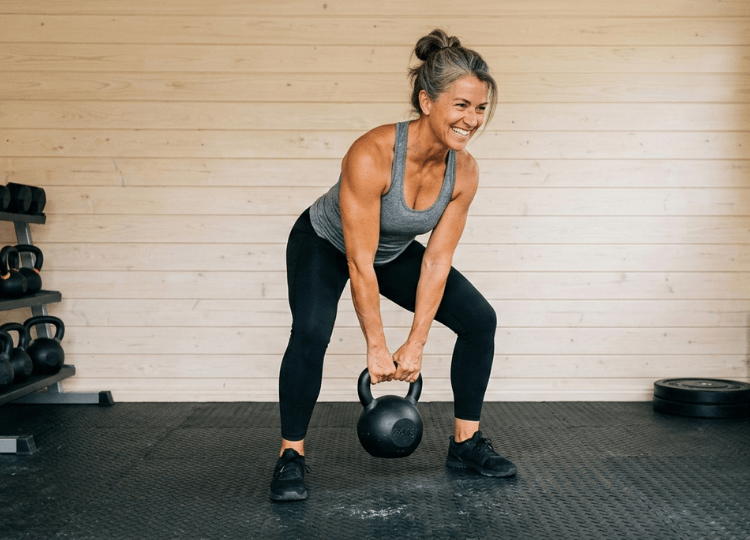
The research on kettlebell training for older adults is compelling.
A 2024 study found that adults aged 60 to 80 who trained with kettlebells twice weekly saw increases in muscle mass, grip strength and leg strength after just six months, with markers of inflammation decreasing after twelve. A separate trial found meaningful improvements in cardiovascular capacity, hip strength and the ability to get up from the floor after just three months.
What makes kettlebells particularly well suited to over 50s is what they develop in a single session. Strength, balance, coordination, grip and cardiovascular fitness all at once, in a way that most gym machines simply cannot replicate.
This guide gives you a practical 3-day weekly plan, clear guidance on where to start with weight, and a full breakdown of every exercise in the programme.
Looking to take your training further?
Our guide to the best fitness apps for over 50s covers the top tools for following structured programmes, tracking progress and staying consistent.
What Weight Should You Start With?
Starting too heavy is the most common mistake in kettlebell training and one that tends to result in poor form and unnecessary injury risk. The goal in the early weeks is to learn the movement patterns, not to challenge your limits.
As a general starting point:
Women over 50: 6 to 10kg for most exercises. The halo and windmill may require something lighter, around 4 to 6kg, while goblet squats and deadlifts can often be heavier once technique is established.
Men over 50: 10 to 16kg for most exercises. As with women, rotational and overhead movements typically require a lighter weight than lower body and hinge exercises.
These are starting points rather than fixed rules. If a weight feels too light after the first session, move up. If any exercise feels unstable or uncomfortable, move down. Form always takes priority over load.
The 3 Day Weekly Plan
The programme is structured across three days, each with a clear focus. Rest at least one day between each session.
Day 1: Upper Body Day 2: Lower Body Day 3: Core and Mobility
Each session includes four exercises. Perform 3 sets of 10 to 12 reps for strength exercises, or the prescribed duration for holds and carries. Rest 60 to 90 seconds between sets.
Day 1: Upper Body
This session targets the pushing and pulling muscles of the upper body, including the shoulders, back, chest and arms. Upper body strength is directly relevant to functional tasks like lifting, carrying and reaching overhead.
Warm-up: 5 minutes of light movement, arm circles, shoulder rolls and band pull-aparts or light lateral raises.
| Exercise | Sets | Reps |
|---|---|---|
| Kettlebell Swing | 3 | 12 |
| Kettlebell Shoulder Press | 3 | 10 each side |
| Kettlebell Bent Over Row | 3 | 10 each side |
| Kettlebell Halo | 3 | 8 each direction |
Cool-down: Chest opener stretch, doorframe shoulder stretch, 2 to 3 minutes.
Day 2: Lower Body
This session targets the quads, glutes, hamstrings and calves. Lower body strength is perhaps the most directly relevant category for functional independence, from walking and stair climbing to getting up from a seated position.
Warm-up: 5 to 10 minutes of light movement, bodyweight squats, hip circles and leg swings.
| Exercise | Sets | Reps |
|---|---|---|
| Goblet Squat | 3 | 10 to 12 |
| Kettlebell Romanian Deadlift | 3 | 10 |
| Single Leg Deadlift | 3 | 8 each side |
| Kettlebell Swing | 3 | 12 |
Cool-down: Hip flexor stretch, hamstring stretch, quad stretch. 3 to 5 minutes.
Day 3: Core and Mobility
This session develops functional core strength and improves mobility at the hips, thoracic spine and shoulders. The exercises here may look less demanding than the strength days but they are among the most valuable in the programme for long-term movement quality and injury resilience.
Warm-up: 5 minutes of gentle movement, cat-cow, hip circles and thoracic rotations.
| Exercise | Sets | Reps or Duration |
|---|---|---|
| Turkish Get-Up | 3 | 3 to 5 each side |
| Kettlebell Windmill | 3 | 6 each side |
| Kettlebell Halo | 3 | 8 each direction |
| Russian Twist | 3 | 12 each side |
Cool-down: Full body stretch focusing on hips and thoracic spine. 3 to 5 minutes.
8 Kettlebell Exercises for Over 50’s
Kettlebell Swing
The swing is the most iconic kettlebell exercise and one of the most effective full body movements available. It builds explosive hip extension strength, challenges the cardiovascular system, and develops the posterior chain in a way that most gym machines cannot replicate.
Stand with feet shoulder-width apart and the kettlebell on the floor slightly in front of you. Hinge at the hips to grip the handle, then hike the kettlebell back between the legs. Drive the hips forward explosively to swing the kettlebell to chest height, keeping the arms relaxed and the power coming from the hips rather than the arms. Allow the kettlebell to swing back between the legs and repeat. Keep the back flat and the core braced throughout.
Coach’s Tip – The swing is a hip hinge, not a squat. The power comes from snapping the hips forward, not from lifting with the arms or bending deeply at the knees. If the lower back is taking the strain, the hips are not doing their job.
Kettlebell Shoulder Press
The shoulder press builds overhead pressing strength and targets the deltoids, triceps and upper back. It is directly relevant to functional tasks like placing items in overhead storage or pushing a window open.
Hold a kettlebell in the rack position at shoulder height, with the elbow tucked close to the body and the kettlebell resting on the forearm. Press the weight directly overhead until the arm is fully extended, then lower with control. Complete all reps on one side before switching.
Coach’s Tip – Avoid leaning to the side as the weight goes overhead. Keep the core braced and the ribcage down throughout the press.
Kettlebell Bent Over Row
The bent over row targets the muscles of the mid and upper back, including the lats, rhomboids and rear deltoids. These muscles are essential for posture, which tends to deteriorate with age, and for all pulling movements in daily life.
Stand with feet hip-width apart and hinge forward at the hips until the torso is roughly parallel to the floor. Hold a kettlebell in one hand, letting it hang directly below the shoulder. Row the kettlebell toward the hip, leading with the elbow and keeping the back flat. Lower with control and complete all reps before switching sides.
Coach’s Tip – Avoid rotating the torso as you row. The movement should be purely through the arm and shoulder, with the back remaining still and stable throughout.
Kettlebell Halo
The halo is a shoulder mobility and upper body stability exercise that circles the kettlebell around the head in a controlled arc. It improves thoracic mobility, warms up the shoulder joint through its full range of motion, and challenges the core to resist the moving load.
Hold the kettlebell by the horns, or the sides of the handle, at chest height. Circle it slowly around your head in one direction, keeping the elbows close and the movement smooth and controlled. Complete all reps in one direction before reversing.
Coach’s Tip – Keep the movement slow and deliberate. This is a mobility exercise, not a conditioning one. If the kettlebell is too heavy to control smoothly around the head, reduce the weight significantly.
Goblet Squat
The goblet squat is one of the best lower body exercises for over 50s. Holding the weight at the chest naturally encourages an upright torso and makes it easier to achieve good squat depth than a barbell variation. It targets the quads, glutes and core simultaneously.
Hold the kettlebell by the horns at chest height. Stand with feet slightly wider than shoulder-width apart and toes turned slightly outward. Brace the core and lower into a squat, keeping the chest tall and the knees tracking over the toes. Drive through the heels to return to standing.
Coach’s Tip – Use the weight as a counterbalance by allowing the elbows to track inside the knees at the bottom of the squat. This naturally deepens the hip position and improves the quality of the movement.
Kettlebell Romanian Deadlift
The Romanian deadlift targets the hamstrings, glutes and lower back through a hip hinge movement. It builds the posterior chain strength that supports lower back health and functional movement in daily life.
Hold a kettlebell in each hand in front of the thighs. With a soft bend in the knees, hinge at the hips and lower the kettlebells toward the floor, keeping them close to the legs. Feel the stretch through the hamstrings, then drive the hips forward to return to standing and squeeze the glutes at the top.
Coach’s Tip – The movement initiates at the hips, not the lower back. Think about pushing the hips backward rather than bending forward. If the lower back is rounding, reduce the range of motion until hamstring flexibility improves.
Single Leg Deadlift
The single leg deadlift builds unilateral lower body strength, challenges balance and exposes any strength imbalances between the left and right sides. Research has linked single-leg strength and balance to reduced fall risk in older adults, making this one of the most functionally relevant exercises in the programme.
Hold a kettlebell in one hand. Shift your weight onto the opposite leg and hinge forward at the hip, extending the free leg behind you as a counterbalance. Lower the kettlebell toward the floor, keeping the back flat, then drive through the standing leg to return to upright.
Coach’s Tip – Focus on a slow, controlled descent rather than trying to go deep quickly. If balance is a significant challenge, lightly touch a wall with the free hand while learning the movement before progressing to the unsupported version.
Turkish Get-Up
The Turkish get-up is one of the most complete exercises in kettlebell training. Starting on the floor and finishing in a standing position while holding a weight overhead, it requires strength, stability, mobility and coordination all at once. For over 50s specifically, the research on its benefits for functional independence and fall prevention is compelling.
Lie on your back holding a kettlebell in the right hand, arm extended toward the ceiling. Bend the right knee with the foot flat on the floor. Roll onto the left elbow, then press up to the left hand. Sweep the left leg behind you and come to a kneeling position, then stand. Reverse the movement to return to the floor. Complete all reps on one side before switching.
Coach’s Tip – Learn this movement with a very light weight or even a shoe balanced on the fist before adding any load. The technique is complex and worth taking the time to get right. Speed is irrelevant here. Control and precision are everything.
Kettlebell Windmill
The windmill builds lateral core strength, hip mobility and shoulder stability simultaneously. It is one of the most effective exercises available for thoracic and hip opening and works well on a core and mobility day as both a strength movement and a flexibility drill.
Press a kettlebell overhead with the right arm and lock it out. Turn the feet to roughly 45 degrees to the left. Keeping the right arm vertical and the eyes on the kettlebell, hinge at the hip and lower the left hand toward the left foot, allowing the left knee to soften slightly. Drive back up to standing through the hip.
Coach’s Tip – Start with a very light weight or no weight at all until the movement pattern feels natural. The key is keeping the overhead arm completely vertical throughout. If it drifts forward or sideways, reduce the load.
Russian Twist
The Russian twist targets the obliques and rotational core muscles that are essential for spinal stability and rotational strength in everyday movement.
Sit on the floor with the knees bent and feet flat. Lean back slightly to engage the core. Hold the kettlebell with both hands at chest height and rotate the torso from side to side, bringing the kettlebell toward the floor on each side. For a greater challenge, lift the feet off the floor.
Coach’s Tip – The rotation should come from the torso, not just the arms. Keep the chest tall and the core actively braced throughout rather than letting the back round during the twist.
Benefits of Kettlebell Training for Over 50s
Builds Muscle and Slows Sarcopenia
After the age of 40, muscle mass declines at roughly 3 to 8% per decade, a process that accelerates significantly after 60. The 2024 American Physiological Society study found that adults aged 60 to 80 who trained with kettlebells twice weekly for six months saw meaningful increases in muscle mass and upper leg strength, even those with no prior resistance training experience.
Improves Grip Strength
Grip strength is one of the most well-evidenced biomarkers of long-term health, with research linking low grip strength to higher all-cause mortality risk. The BELL trial found significant improvements in grip strength following just three months of kettlebell training in adults aged 59 to 79.
Supports Bone Density
A case study from the BELL trial found clinically significant increases in bone mineral density in two adults over 70 with osteoporosis following 16 weeks of kettlebell training, with improvements of up to 12.7% at the femoral neck. For those at risk of osteoporosis, this is a meaningful finding.
Reduces Fall Risk
The Journal of Strength and Conditioning Research found that kettlebell training improved balance, endurance and mobility in older adults. The Turkish get-up in particular has been cited by physiotherapists as one of the most effective exercises for developing the strength and coordination needed to prevent and recover from falls.
Reduces Inflammation
The 2024 study also found that blood markers of whole-body inflammation decreased after 12 months of kettlebell training, which is relevant to cardiovascular health, metabolic function and general wellbeing in older adults.
Requires Minimal Equipment and Space
A single kettlebell and enough room to swing it is all that is needed to follow this programme. This makes it one of the most accessible strength training options available for home training.
Tips for Getting Started
- Start lighter than you think. Form comes before load at every stage of kettlebell training. A movement done well with a light weight builds the foundation for safe progression. A movement done poorly with a heavy weight builds bad habits and injury risk.
- Master the hip hinge first. The swing, Romanian deadlift and single leg deadlift all rely on the same fundamental movement pattern. Spending time getting comfortable with a bodyweight hip hinge before adding load will make all three exercises considerably easier and safer.
- Rest adequately between sessions. Three days per week with at least one rest day between each session is the right frequency for most people over 50. Recovery becomes more important with age and is where adaptation actually happens.
- Progress gradually. Once a given weight feels well-controlled across all sets for two consecutive sessions, that is the signal to move up by the next available increment. There is no value in rushing this process.
Bottom Line
Kettlebell training is one of the most well-evidenced and practical approaches to building strength, improving functional fitness and supporting long-term health for those over 50.
The research is consistent: the benefits are real, they apply even to those starting from scratch, and they show up in the everyday tasks that matter most as you age.
The 3-day programme above is designed to be sustainable and effective without requiring a gym membership or significant time investment. Upper body, lower body and core and mobility days give the programme a clear structure, and the eight exercises cover the full range of physical qualities that functional fitness requires.
Related Articles