

By Celia Dunphy. PhD, Endocrinology. Celia writes on peptide pharmacology and research-compound sourcing. Reviewed by Jerry Pious, Editor.
Ipamorelin and Sermorelin both get the pituitary to release growth hormone. They just use different routes. Sermorelin is a GHRH analog that mimics a signal your body already sends. Ipamorelin is a growth hormone secretagogue working on the ghrelin receptor. That difference shapes each compound’s research, timeline, and regulations.
Serving a protocol that needs both compounds? Suppliers like Kylo Peptides carry the pair with one of the highest purity figures, 99%+ by HPLC standard. The best part: you don’t need to take the brand’s word for it. You can verify the figures and seven other assays yourself in a lot-matched COA coming from 3 ISO-accredited independent laboratories.
Ipamorelin vs Sermorelin: Key differences at a Glance
They hit different receptors. Sermorelin goes through the GHRH receptor, and Ipamorelin goes through GHS-R1a, the ghrelin receptor. The goal is the same: Here’s how they compare.
Ipamorelin vs Sermorelin: Compared
| Feature | Ipamorelin | Sermorelin |
| Peptide class | Growth hormone secretagogue (GHRP) | GHRH analog |
| Primary receptor/pathway | GHS-R1a / ghrelin receptor | GHRH receptor |
| Main action | Stimulates GH release | Stimulates GH release through GHRH signaling |
| Research profile | GH secretion and selective secretagogue research | GH secretion and GHRH-related research |
| Research history | Newer, first characterized in 1998 | Longer track record, US approval dating to 1997 |
| Main distinction | Ghrelin-receptor pathway | GHRH pathway |
| Standout trait | The cleanest selectivity in its class | The deeper regulatory paper trail |
Both compounds are built for different jobs. Which to pick? The decision depends on what questions your protocol asks.
What Is Sermorelin?
Sermorelin is a lab-made copy of the first 29 amino acids of your body’s growth hormone-releasing hormone.
How Sermorelin Works
Sermorelin latches onto the GHRH receptor on somatotroph cells in your anterior pituitary. From there, it sends the same signal your own GHRH would: release some growth hormone. Your body still decides how much and when to let go, so GH comes out in the same natural bursts it always does.
What Sermorelin Has Been Studied For
Sermorelin has a real FDA paper trail. Per the Federal Register determination in Docket FDA-2012-P-1071, GEREF (sermorelin acetate) injection was the subject of NDA 20-443, held by EMD Serono, approved September 26, 1997. EMD Serono pulled it in December 2008, and the FDA determined GEREF was not withdrawn for safety or effectiveness reasons. It left for business reasons. Research has centered on GH secretion, pituitary response, and GH deficiency.
What Is Ipamorelin?
Ipamorelin is a five-amino-acid secretagogue that showed up in 1998. It was the first in its class to release GH without stirring up the rest of the pituitary.
How Ipamorelin Works
Ipamorelin works on GHS-R1a, the receptor that normally responds to ghrelin. It turns it on, and GH is released through a channel unrelated to the GHRH receptor.
What Ipamorelin Has Been Studied For
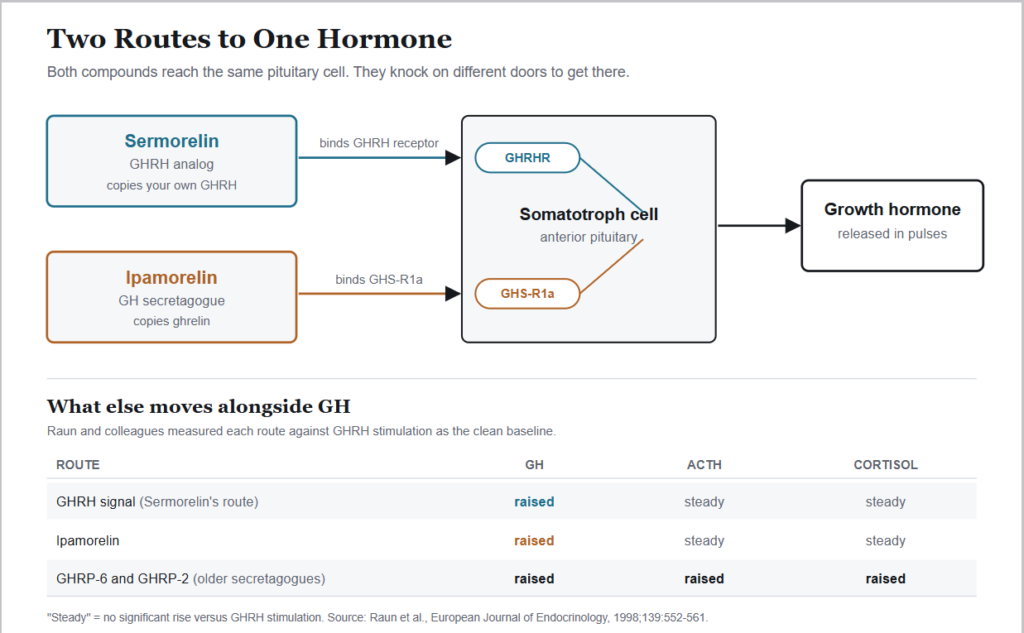
Raun and colleagues in the European Journal of Endocrinology (1998;139:552-561) put Ipamorelin up against the older secretagogues GHRP-6 and GHRP-2 and found “very surprisingly, ipamorelin did not release ACTH or cortisol in levels significantly different from those observed following GHRH stimulation.”
Their conclusion: “Ipamorelin is the first GHRP-receptor agonist with a selectivity for GH release similar to that displayed by GHRH.”
Ipamorelin vs Sermorelin: Key Differences
Mechanism of Action
Sermorelin talks to the GHRH receptor on your pituitary somatotrophs. Ipamorelin talks to GHS-R1a, the ghrelin receptor. Same endpoint, different wiring.
Peptide Class
Sermorelin is a GHRH analog copied from a hormone you already make. Ipamorelin is a synthetic pentapeptide with no natural counterpart. Class tells you the comparators: Sermorelin with CJC-1295 and tesamorelin; Ipamorelin with GHRP-2, GHRP-6, and MK-677.
Research History
Sermorelin has been around longer. Ipamorelin is newer, so its human data are more limited. Its biggest randomized study, from Beck and colleagues in the International Journal of Colorectal Disease (2014;29:1527-1534, NCT00672074), enrolled 117 patients and found no significant differences between ipamorelin and placebo. It tested a gut recovery endpoint after surgery, though, which says little about GH work. Tolerability looked good.
Selectivity
Ipamorelin shines in selectivity. The Raun data show GH going up without the ACTH and cortisol bump that GHRP-6 and GHRP-2 brought along. Sermorelin gets there by a different road. It copies a natural GHRH signal, and that signal only ever talks to the GH system, so cortisol never rises.
Duration of Action
The Raun paper measured potency across rat pituitary cells, rats, and swine: ED50, the dose that gets you half the maximum response, and Emax, the ceiling on that response. Both answer how much, never how long. No research reports plasma half-life for these compounds yet.
Evidence
No direct head-to-head trial of these two has been published, so comparisons rely on separate studies with different participants, protocols, and endpoints. The closest human evidence examines pathway families.
In 25 healthy adults, Veldhuis and Bowers in the American Journal of Physiology (2011, PMC3197337) found the descending rank order of mean peptide effects was combined peptides >>GHRH=GHRP-2>>saline. On their own, each pathway raised GH by about the same amount.
Ipamorelin vs Sermorelin: Results Timeline
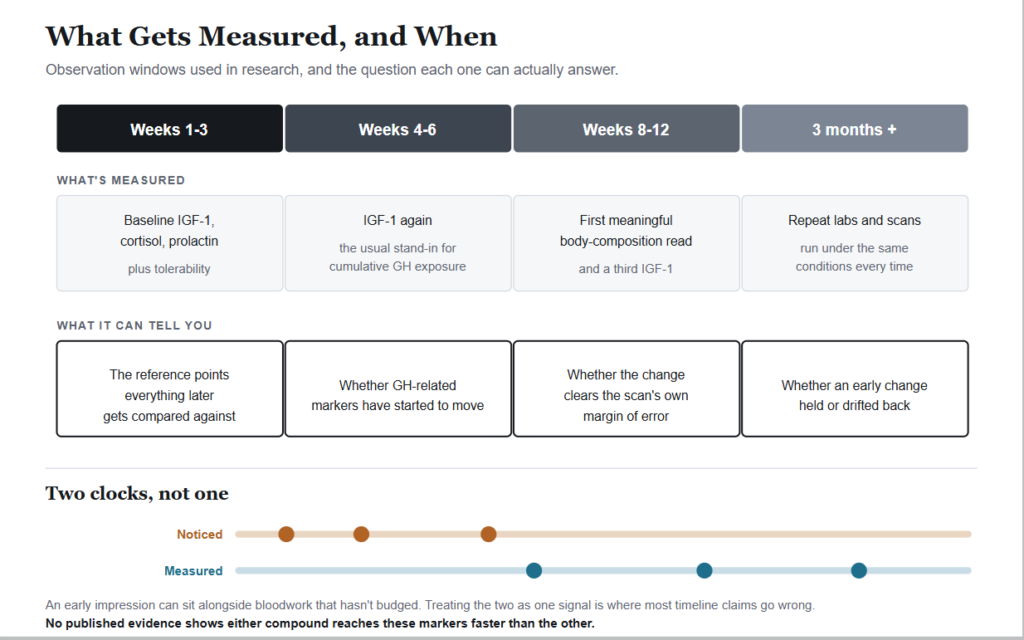
First Few Weeks
Early on, the focus is tolerability and baseline numbers for IGF-1, cortisol, and prolactin. Subjective impressions and lab values move independently, so somebody noticing a change early might have bloodwork that hasn’t budged.
Around 4-6 Weeks
Four to six weeks is roughly when IGF-1 may start showing measurable movement in some research settings. IGF-1 works as the stand-in because it reflects cumulative GH exposure, while GH itself is a moving target that comes out in pulses. Pituitary reserve, age, sex, and sleep all feed the response.
Around 8-12 Weeks
Eight to twelve weeks is the first point where body-composition numbers say much. Lean mass and fat mass move slowly, and over a few weeks the real change is often smaller than the scan’s margin of error. So, a true shift and a bad reading can look identical. Two to three months gives any genuine change room to clear that margin.
Beyond 3 Months
Over the past three months, the question shifts from “did anything move” to “did it stay moved.” Studies here check whether an earlier change holds steady or drifts back toward where it started. Self-reported impressions get shakier over this stretch, because the longer someone takes part, the more their expectations shape what they notice. So the weight falls on repeat lab work and body-composition scans run the same way every time.
Important Note on the Timeline
You’ve probably seen many articles say that Ipamorelin works faster than Sermorelin. No published study backs that up. Studies differ in who they enrolled, what protocol they ran, and what they measured, so the numbers don’t stack. IGF-1 at six weeks and GH pulse amplitude over 24 hours answer different questions.
Who Should Be Interested in Sermorelin?
Sermorelin makes sense when you’re studying the GHRH receptor. It’s worth a look if your question involves GHRH-mediated GH release, how the pituitary responds to a GHRH signal, the longer track record of GHRH analogs, GH secretion patterns, or any design where the GHRH pathway is the main hero of the protocol.
Why Choose Sermorelin for Research?
Its link to GHRH signaling is direct, so you measure the pathway rather than infer it. And if your question is about the GHRH receptor, a secretagogue won’t answer it.
Who Should Be Interested in Ipamorelin?
Ipamorelin fits when your study is about the ghrelin receptor and secretagogue selectivity. It’s worth a look if you’re working on ghrelin-receptor-mediated GH release, selective secretagogue activity, GH pulse signaling, metabolic and recovery questions, or the differences between the GHRH and GHS-R routes.
Why Choose Ipamorelin for Research?
Its mechanism differs from Sermorelin’s, making it a natural comparator in pathway studies. And for GHS-R1a work, it’s the benchmark newer secretagogues get measured against.
Ipamorelin vs Sermorelin: Which Fits Different Research Goals?
Start with the receptor you want to study, and the choice mostly makes itself. Here’s how that maps out.
| Research focus | More relevant compound |
| GHRH receptor signaling | Sermorelin |
| Ghrelin/GHS-R1a signaling | Ipamorelin |
| Studying GHRH analogs | Sermorelin |
| Studying selective GH secretagogues | Ipamorelin |
| Comparing two different GH pathways | Both |
| Longer-established research history | Sermorelin |
Can Ipamorelin and Sermorelin Be Used Together?
They hit separate receptors, so asking what happens when both pathways fire at once is a fair scientific question. The Veldhuis and Bowers finding, where combined peptides landed well above either pathway solo, is the strongest human hint in that direction. The volunteers received GHRH and GHRP-2, two compounds from the same pathway families as Sermorelin and Ipamorelin. This shows how the two routes behave together.
Ipamorelin vs Sermorelin: Safety and Regulatory Considerations
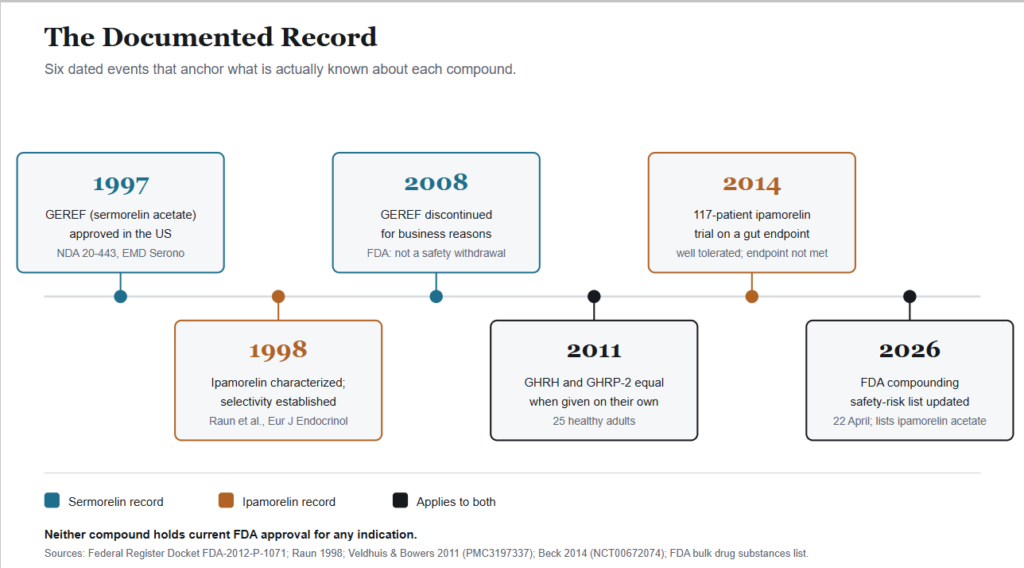
Neither holds current FDA approval. The FDA’s list of certain bulk drug substances for use in compounding that may present significant safety risks, updated April 22, 2026, includes ipamorelin acetate, noting that “compounded drugs containing Ipamorelin acetate may pose risk for immunogenicity.” Sermorelin isn’t on it. Fair context: the list covers compounding drugs for people, so it flags an open question about immune response.
On the material itself, you can verify identity, purity, and paperwork using a lot-matched COA from an accredited independent lab. Vendors like Kylo Peptides publish it upfront on their website.

Ipamorelin vs Sermorelin: Which Is Better?
The choice depends on the research objective. When GHRH signaling is the target, Sermorelin is your compound. It has the research trail and former US approval.
When GHS-R1a and the ghrelin receptor are the target, Ipamorelin is your compound. It has the cleanest selectivity in its peptide class.
So, what drives your pick?
- The mechanism you’re studying
- What you’re trying to find out
- How good the evidence is for each compound, and
- The regulatory rules that apply to the work you’re doing.
The limitations? Neither is FDA-approved yet; the modern research base for both is thin. No head-to-head trial exists, and the closest human comparison found the two pathways dead even when run separately.
FAQs
What is the main difference between Ipamorelin and Sermorelin?
The receptor. Sermorelin is a GHRH analog working through the GHRH receptor. Ipamorelin is a secretagogue working through GHS-R1a, the ghrelin receptor. Both raise GH by separate routes.
Does Ipamorelin work through the same pathway as Sermorelin?
No. Sermorelin activates the GHRH receptor, copying a signal your body already sends. Ipamorelin activates GHS-R1a. That split is why researchers want to know what happens when both fire.
Which has been studied longer?
Sermorelin, comfortably. It was approved in the US as GEREF under NDA 20-443 on September 26, 1997, then discontinued in 2008. Ipamorelin arrived in 1998 with a smaller human file.
How long does it take to see results from Sermorelin?
Research settings usually check IGF-1 around four to six weeks, then body-composition endpoints closer to eight or twelve. Variation is wide, so treat any timeframe as a rough guide.
How long does it take to see results from Ipamorelin?
Same windows, same caution. No published evidence pins down a reliable timeline, and no controlled study has compared its pace against Sermorelin’s.
Is Ipamorelin stronger than Sermorelin?
No published head-to-head supports that. The closest human comparison, from Veldhuis and Bowers in 2011, found GHRH and GHRP-2 performed similarly on their own, with the combination beating both.
Can Ipamorelin and Sermorelin be combined?
They work on separate receptors, so combining them has solid mechanistic logic. Human data on this pair is missing, though. The existing combination evidence used GHRH with GHRP-2.
Are Ipamorelin and Sermorelin FDA-approved?
Neither one. Sermorelin’s old GEREF approval ended with the 2008 discontinuation, which the FDA determined was “not withdrawn for reasons of safety or effectiveness.” Ipamorelin acetate sits on the FDA’s compounding safety-risk list.
Which peptide is better for research on GH signaling?
Depends on your pathway. Sermorelin for GHRH receptor questions, Ipamorelin for GHS-R1a questions, and both when you’re comparing the routes.
Conclusion
The Ipamorelin vs Sermorelin comparison always comes back to the receptor. Ipamorelin goes through GHS-R1a; Sermorelin goes through the GHRH receptor. Every other difference grows out of that one fact.
The timeline is fuzzy. IGF-1 might show movement around four to six weeks in some settings; body-composition endpoints need eight to twelve or longer. Sermorelin suits GHRH-focused work and brings the deeper history. Ipamorelin suits ghrelin-receptor work and brings the cleanest selectivity in its class.
Disclaimer: This article is for informational purposes only and does not constitute medical advice. Ipamorelin and sermorelin are research compounds. Neither holds current FDA approval, and neither is intended for human or veterinary use. Consult a qualified healthcare professional with any health question.