

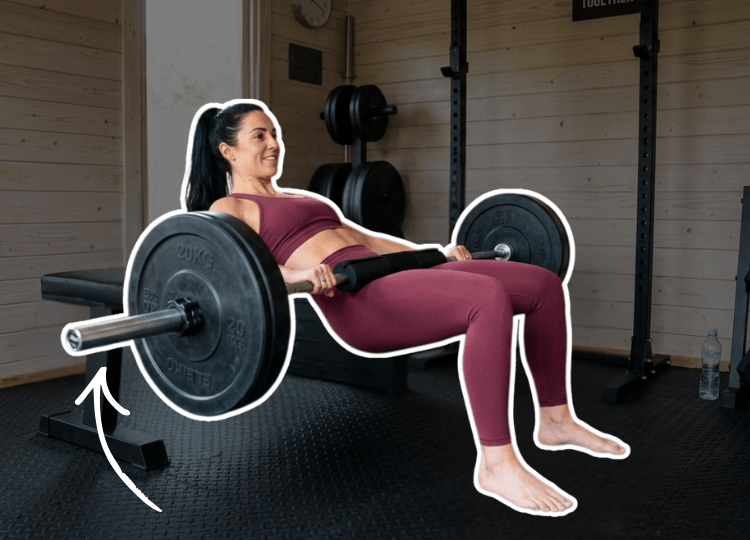
The hip thrust has become one of the most popular lower body exercises in the gym… and for good reason.
Research consistently shows it produces among the highest levels of gluteus maximus activation of any loaded exercise, making it one of the most effective tools available for building glute strength and size.
But one question comes up more than almost any other: how much should I actually be lifting?
It is a reasonable thing to want to know, and the honest answer is that it depends on a number of factors, including your training experience, your body weight, your age and your gender.
What matters more than hitting a specific number, though, is understanding what a good hip thrust actually looks like in practice, because the research is clear that form and muscle activation matter considerably more than the weight on the bar.
This guide covers realistic weight targets by experience level, gender and age, what the research says about how to get the most from the exercise, and why chasing heavier loads is not always the most productive goal.
What Counts as a Good Hip Thrust Weight?
Before getting into specific numbers, it is worth framing this correctly. Unlike the squat or deadlift, almost nobody actually tests a one-rep maximum on the hip thrust.
The setup is cumbersome, the movement does not lend itself well to near-maximal loading, and the risk to reward ratio of going to absolute failure on a hip thrust is not particularly good.
A far more practical and realistic benchmark is a 10-rep max (10RM), which is the heaviest weight you can perform for 10 clean, controlled reps with full hip extension at the top. This maps directly to how most people actually train the exercise, since hip thrust programming typically falls in the 8 to 15 rep range, and it is straightforward to self-assess without a spotter.
The figures below are expressed as 10RM estimates, based on aggregated strength data and widely referenced bodyweight-relative standards.
They are intended as a general orientation rather than a precise benchmark. Individual factors including body weight, limb length and training history all influence what is achievable, so treat these as reference points rather than targets to hit by a specific date.
All weights include the barbell, which typically weighs 20kg / 44lbs.
Average Hip Thrust Benchmarks for Women (10RM)
| Age Group | Weight (kg) | Weight (lbs) |
|---|---|---|
| Under 30 | 55 to 80kg | 121 to 176lbs |
| 30 to 39 | 50 to 75kg | 110 to 165lbs |
| 40 to 49 | 45 to 70kg | 99 to 154lbs |
| 50 to 59 | 40 to 60kg | 88 to 132lbs |
| 60 and over | 30 to 50kg | 66 to 110lbs |
Progression Standards for Women
| Level | Weight (kg) | Weight (lbs) |
|---|---|---|
| Beginner | 20 to 40kg | 44 to 88lbs |
| Intermediate | 45 to 75kg | 99 to 165lbs |
| Advanced | 80 to 105kg | 176 to 231lbs |
| Elite | 105kg+ | 231lbs+ |
Beginner refers to those who have been training the hip thrust for less than six months. Starting with just the barbell (20kg / 44lbs) or even lighter using a resistance band or dumbbell is completely appropriate while learning the movement. A well-performed hip thrust with 20 to 40kg for 10 reps is considerably more effective than a sloppy one with twice the weight.
Intermediate covers those with six months to two years of consistent training. At this level, the movement pattern is established and progressive overload is producing consistent strength gains.
Advanced applies to those with two or more years of focused training on the hip thrust and lower body work more broadly.
Elite is competitive-level performance and represents the upper end of what most recreational lifters will realistically reach.
Average Hip Thrust Benchmarks for Men (10RM)
| Age Group | Weight (kg) | Weight (lbs) |
|---|---|---|
| Under 30 | 80 to 120kg | 176 to 264lbs |
| 30 to 39 | 75 to 110kg | 165 to 242lbs |
| 40 to 49 | 70 to 100kg | 154 to 220lbs |
| 50 to 59 | 60 to 90kg | 132 to 198lbs |
| 60 and over | 50 to 75kg | 110 to 165lbs |
Progression Standards for Men
| Level | Weight (kg) | Weight (lbs) |
|---|---|---|
| Beginner | 30 to 55kg | 66 to 121lbs |
| Intermediate | 60 to 100kg | 132 to 220lbs |
| Advanced | 100 to 135kg | 220 to 298lbs |
| Elite | 135kg+ | 298lbs+ |
Men typically hip thrust more than women in absolute terms, largely due to differences in average body weight and muscle mass. However, relative to body weight, the standards converge more closely between genders than most people expect.
A useful bodyweight-relative benchmark from glute training research is that performing 10 reps with twice your bodyweight represents an impressive and advanced level of strength.
For a 70kg woman, that would be 140kg for 10 reps. For an 80kg man, 160kg for 10 reps. These are advanced targets that most gym-goers will not reach quickly, but they provide a meaningful long-term goal relative to your own body rather than an arbitrary number.
How Does Age Affect Hip Thrust Weight?
Age is a relevant factor that most strength standard guides do not address clearly. Here is a practical breakdown.
Under 30: This is typically when strength peaks. The standards in the tables above apply most directly to this age group. Progressive overload is generally faster and recovery between sessions is quicker, meaning strength tends to accumulate more readily with consistent training.
30 to 50: Strength can still improve meaningfully in this age group, particularly for those who are newer to training. Recovery begins to take slightly longer, which means adequate rest between sessions becomes more important. Working weights in the intermediate to advanced range remain realistic goals with consistent effort over time.
Over 50: Muscle mass and strength do decline with age, a process known as sarcopenia, but research consistently shows that resistance training significantly slows this process. For those over 50 who are new to the hip thrust, the beginner targets above are appropriate starting points. Those who have been training consistently for years can maintain advanced-level performance well into their 60s and beyond.
The priority in this age group shifts slightly toward maintaining the movement quality and muscle mass needed for functional independence, rather than chasing maximum load.
For all age groups, the key principle is the same: the weight should be appropriate for your current level, challenging enough to provide a meaningful stimulus, but never at the expense of form.
Weight is Not the Whole Story
This is perhaps the most important section in the article, because the research on hip thrust training consistently points to something that gets overlooked in the pursuit of heavier loads.
A comprehensive biomechanical analysis of the barbell hip thrust published in PMC found that the hip thrust maintains a consistent hip extensor moment throughout the entire lifting phase, including at positions close to full hip extension. This is in contrast to the back squat, where the hip extensor moment drops significantly near the end range.
In practical terms, this means the glutes are working hard throughout the whole movement in the hip thrust, not just at the bottom.
The implication is significant.
The hip thrust is already a highly effective exercise for loading the glutes throughout their working range. Adding more weight is only beneficial if it does not compromise the key elements of good technique.
The most common technical error that undermines this is lumbar hyperextension at the top of the movement, where the lower back arches excessively instead of the hips fully extending. This happens when the load is too heavy to control properly, and it shifts the work away from the glutes and onto the lower back.
A hip thrust performed at a weight where you can fully extend the hips, pause briefly at the top and feel a genuine glute contraction throughout every rep will produce better results than a heavier version where the lower back is doing the work.
Slower tempo and paused reps are two particularly effective ways to increase the stimulus from the hip thrust without adding more weight. Pausing for one to two seconds at the top of each rep, with full hip extension and an active glute squeeze, significantly increases the time under tension and improves the mind-muscle connection that research suggests is relevant to glute development.
How to Progress Your Hip Thrust Weight Sensibly
Progressive overload, which means gradually increasing the challenge over time, is fundamental to continued strength and muscle development.
For the hip thrust, this does not always mean adding more weight to the bar. Here are the most effective ways to progress.
- Add small increments regularly – increasing load by 2.5 to 5kg / 5 to 10lbs when a given weight feels comfortably controlled across all sets is a sustainable and effective approach.
- Increase reps before weight – if you can complete the top end of your target rep range with good form across all sets, that is the signal to add load at the next session.
- Use tempo – slowing the lowering phase to two to three seconds and pausing at the top increases the demand without changing the load at all.
- Pause reps – holding the top position for one to two seconds per rep is one of the most effective ways to improve glute activation and mind-muscle connection.
- Single-leg variation – the single-leg b-stance hip thrust is a highly effective progression that builds unilateral glute strength and exposes imbalances between sides.
Things to Consider
Start lighter than you think
Most people new to the hip thrust are surprised by how effective the movement feels with relatively modest loads. Starting with just the barbell and focusing entirely on technique before adding weight is the right approach.
The barbell pad matters
The hip crease is not designed to have a loaded barbell resting on it for extended sets. A barbell pad or folded mat is not optional at working weights, it is what makes the exercise sustainable over the long term.
Foot position affects glute activation
Feet positioned too far from the hips tend to shift the demand toward the hamstrings. Experiment with foot placement until you feel the glutes working clearly throughout the movement, particularly at the top.
Bodyweight varies
Because the hip thrust is a bodyweight-relative exercise in terms of what is achievable, two people of the same training level but different body weights will likely thrust different amounts. Comparing your numbers to someone significantly heavier or lighter than you is not particularly meaningful.
If you feel it in your lower back, reduce the weight
Lower back discomfort during or after hip thrusts is almost always a sign of lumbar hyperextension at the top of the movement, which in turn is almost always a load management issue. Reducing the weight, focusing on a posterior pelvic tilt throughout, and building back up gradually resolves this in the vast majority of cases.
Bottom Line
A good hip thrust weight is one that challenges you meaningfully, allows full hip extension at the top of every rep, and produces a genuine glute contraction throughout the movement. The specific number is secondary to the quality of what you are doing with it.
The tables above give the most practical reference point for where you should be. For most consistently training women under 30, a 10RM in the range of 55 to 80kg / 121 to 176lbs is a solid benchmark.
For men in the same age group, 80 to 120kg / 176 to 264lbs is a realistic target. These figures reduce gradually with age in line with the research on strength decline, but consistent training significantly slows that process at every decade. The progression standards give you a longer term view of where the journey can take you over time.
Whatever your starting point, consistent progressive overload, good technique and patience will get you there. The hip thrust rewards people who take it seriously at lighter loads far more than those who chase numbers at the expense of form.
Related Articles
Best Gluteus Minimus Exercises for Hip Strength, Power and Stability