
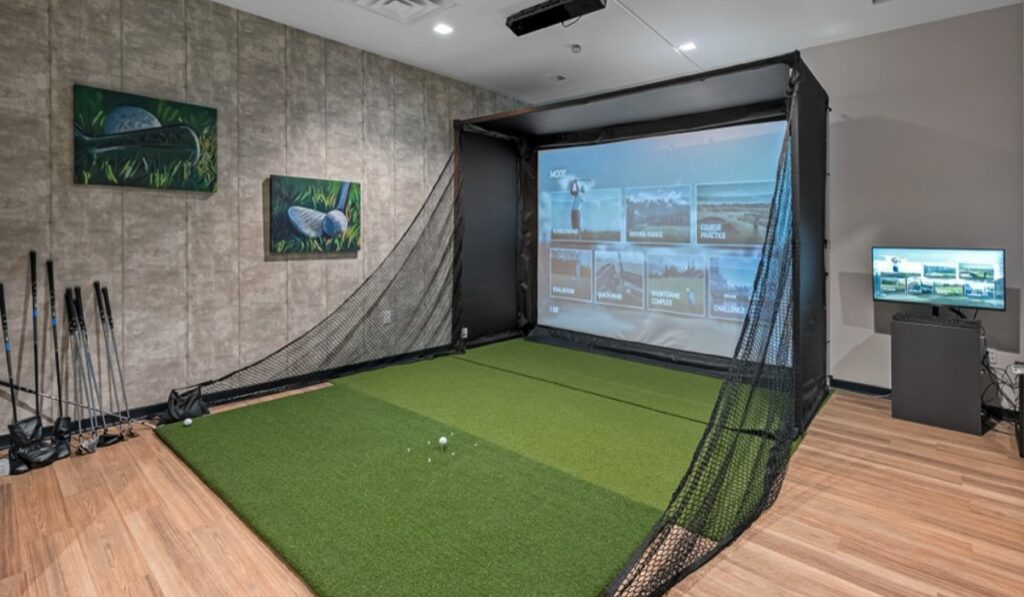
Photo from Rain or Shine Golf Instagram
Improving your golf game at home has never been easier thanks to data-driven techniques. By using metrics and technology, golfers can focus on their fitness and refine their swing with precision. These tricks help elevate both performance and endurance without stepping onto the course.
Home golf fitness combines strength, balance, and flexibility training with analysis tools like launch monitors. This approach allows players to track progress and make informed adjustments. Whether you are a beginner or an experienced golfer, applying these tricks can enhance your practice and results.
1. Use a Launch Monitor to Power-Up Strength & Speed
Portable units capture crucial data points like clubhead speed, ball speed, smash factor, carry distance, and peak height. For those exploring their options, learning about Rain or Shine Golf’s home advanced golf simulator projectors can help make data collection effortless.
Among these metrics, clubhead speed is the clearest window into raw power, and when it plateaus, your body likely needs a fresh stimulus.
If your average speed stalls, insert explosive lower-body and rotational drills into your routine. These can include medicine-ball rotational throws, split-squat jumps, and kettlebell swings. Track your average clubhead speed before and after implementing these workouts for best results.
Here is a sample speed circuit you can perform for three rounds. Rest for 90 seconds between exercises.
- Split-Squat Jumps, 8 per leg
- Medicine-Ball Chest Pass, 10 reps
- Kettlebell Swings, 12 reps
- Rest-Pause Push-Ups, as many reps as possible (AMRAP)
Create a simple spreadsheet with columns for date, session average swing speed, total reps, load, and your rate of perceived exertion. Export launch-monitor data weekly and paste the numbers. This provides iron-clad accountability for your training.
| Key Insight: Clubhead speed isn’t just a swing metric; it’s a direct reflection of your physical power. If your speed plateaus, the solution is likely in the gym with explosive exercises, not just more range time. |
2. Turn Your Living Room into a Simulator-Driven Mobility Lab
Full-swing simulators log your shot count, dispersion maps, and club-by-club workload. High shot volumes paired with limited mobility can be a recipe for injury. Sprinkling in active-recovery stretches between virtual holes is a simple way to offset that risk and improve performance.
Incorporate these simple movements into your simulator sessions:
- Hip Opener (World’s Greatest Stretch)
- Open-Book Thoracic Rotation
- Full-Body Turn Drill with an Alignment Stick
After every three virtual holes, perform the following between-holes mobility protocol.
- Hip Opener, 30 seconds each side
- Open-Book Rotation, 8 reps each side
- Slow Full-Body Turns, 5 reps
Use your shot count to dose your mobility work. Perform the protocol once for every 15 swings. If your simulator shows you took 90 shots over 18 holes, you’ll complete six mini-mobility blocks.
| Warning/Important: High-volume simulator sessions without mobility work are a direct path to stiffness and injury. Treat virtual rounds like real ones by incorporating active recovery stretches between holes to maintain flexibility and prevent setbacks. |
3. Harness Swing-Analytics Apps & Wearables to Refine Technique & Core Stability
Modern wearables and phone-based apps can visualize your kinematic sequence, tempo ratio, and rotational speed. These numbers provide direct feedback on your movement efficiency. This data can be invaluable for identifying areas that need improvement.
If your data shows your pelvis fires late in the sequence, integrate Dead-Bug progressions to teach core-led sequencing. If your tempo is inconsistent, practice with a metronome. Using a speed stick can help you build a consistent rhythm.
Try this core stability mini-workout for two rounds.
- Resistance-Band Dead-Bug, 10 reps per side
- Anti-Rotation Plank, 30 seconds per side
- Half-Kneeling Cable Chop, 12 reps per side
Snap screenshots of your kinematic graphs each week and overlay them month-to-month. You are looking for smoother, whip-like acceleration curves. Aim for a tempo variance under ±0.1 for the best results.
| Pro Tip: Use swing data to diagnose physical limitations, not just swing faults. If your app shows a late pelvic rotation, it’s a cue to strengthen your core with exercises like Dead-Bugs to build a more efficient sequence. |
Tracking Progress & Setting Evidence-Based Goals
To ensure your training is effective, follow this structured approach.
- Baseline Metrics: Before you start, record your average clubhead speed, greens in regulation, and session RPE.
- SMART Goals: Set specific, measurable goals like add 4 mph to clubhead speed in 8 weeks while keeping tempo variance under 0.1.
- Weekly Review Ritual: Export launch-monitor data, save simulator dispersion screenshots, and note your subjective feel and confidence.
- Adjust Load: Use the Acute: Chronic Workload Ratio to manage fatigue, targeting a range of 0.8–1.3.
- Deload or Reassess: If your numbers exceed 1.5 or your perceived exertion spikes for two consecutive sessions, it’s time to pull back and recover.
| Key Insight: The core principle of data-driven fitness is simple. If you don’t measure it, you can’t improve it. Consistent tracking transforms your training from guesswork into a proven system for lowering your handicap. |
The Path Forward
Data provides an unflinching reality check. It doesn’t lie, so you must diligently track it, rigorously train with it, and then witness the positive impact on your scorecard. To transition from reading this guidance to actively improving your home golf fitness, here is a structured implementation plan:
- Choose one tech pillar to focus on this week, such as a launch monitor, simulator, or wearable.
- Run the matching workout exactly as written for four sessions.
- Post your baseline swing speed, dispersion, or kinematic sequence numbers to keep yourself accountable.
Review Your Data and Set New SMART Goals. Use your compiled weekly data, including average clubhead speed, tempo variance, and perceived exertion, to evaluate your progress. Based on this evidence, set the next specific, measurable, achievable, relevant, and time-bound SMART goal. Your goal might shift from increasing speed to refining the consistency of your tempo ratio.
Embracing a data-driven approach is the single most effective way to transform your home practice into consistent on-course improvement.
By systematically tracking metrics like clubhead speed, mobility dose, and kinematic sequence, you replace guesswork with a proven, evidence-based system for success. Commit to this structured path, stay accountable to your numbers, and you will undoubtedly watch your performance and confidence reach new levels.