
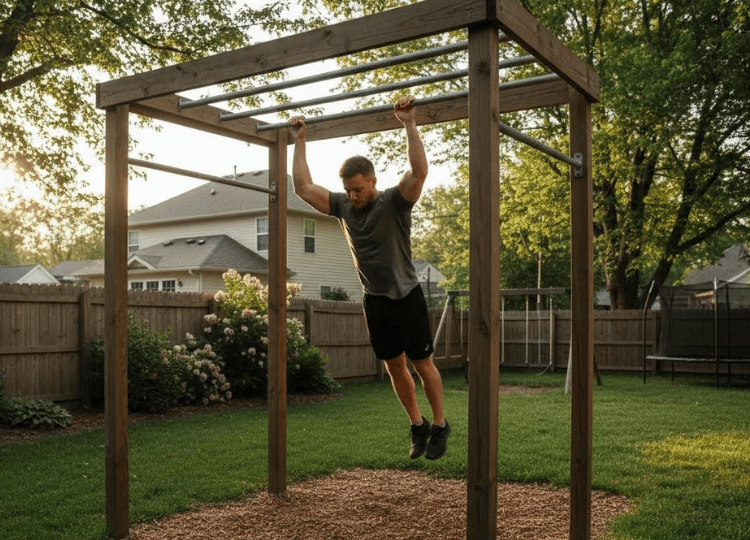
Most backyard ninja setups are built for variety, not performance. Athletes install dynamic obstacles before developing the strength required to control them under fatigue. When intensity increases, structural weakness shows up quickly and limits output. Engineering your space means building it to absorb force first and showcase complexity second.
Weighted pulling exposes instability immediately. If a rack shifts under load, tension leaks, and joints absorb unnecessary stress. Progressive overload requires rigid framing and reliable hardware connections. Real adaptation occurs only when force transfers cleanly through the structure without distortion.
A serious backyard training space should function like a controlled strength environment. Every component must tolerate increasing load over time without compromise. Obstacles are layered onto that base once capacity supports them safely. Infrastructure ultimately defines how far performance can progress.
Engineering also requires intention. You are designing a system that must withstand repeated high-force cycles. That includes eccentric stress, isometric tension, and rotational torque. The structure must remain stable under each demand. Performance depends on that stability.
Establish Structural Load Capacity
Your pull-up structure must remain solid during heavy-weighted reps. Long eccentrics and extended isometric holds create sustained tension through bolts and welds. Any sway under load reduces effective force transfer and increases elbow strain. Structural rigidity protects both measurable strength gains and connective tissue health.
Horizontal pulling balances the scapular demand created by high hanging volume. Strong retraction improves transition control and stabilizes shoulder positioning under rotation. Hip hinge strength increases swing efficiency and reduces forearm overload during repeated attempts. Loaded carries reinforce trunk stiffness and improve total body tension under fatigue.
These foundational patterns directly influence obstacle consistency and energy conservation. When trunk stiffness improves, transitions become tighter and more deliberate. When hinge strength increases, swings require less compensatory effort. Strength development supports skill precision rather than competing with it.
Racks must tolerate incremental plate increases without distortion. Commercial load standards define that threshold in serious strength environments where progressive overload is expected. Fitness Superstore gym equipment is engineered around those standards to handle sustained high-intensity loading cycles. Structural tolerance at that level allows progressive overload without frame shift, hardware fatigue, or force leakage during heavy pulling sessions.
Structural load capacity also affects safety margins. Hardware that approaches tolerance limits too quickly increases failure risk. A well-engineered rack maintains integrity well below its maximum rating. That buffer protects long-term progression and preserves confidence under heavy effort.
When the base supports true overload, obstacle execution accelerates. Lock-offs remain stable under prolonged tension. Transitions stay controlled even when grip fatigue sets in late in a run. Strength supports execution instead of limiting it.
Separate Strength Development From Skill Exposure
Dynamic obstacles demand force absorption and reapplication under stress. Momentum may complete a repetition, but it does not increase output capacity. Under fatigue, strength determines whether movement quality holds or collapses. Capacity protects execution consistency across multiple attempts.
Maximal pulling strength improves hand placement accuracy and reduces wasted motion during transitions. Horizontal pulling reinforces scapular control and protects shoulder alignment during rotational forces. Hip hinge development enhances swing timing and landing mechanics under fatigue. Each of these qualities transfers directly into complex obstacle sequences.
Strength sessions must drive measurable weekly load progression. Obstacle sessions should refine timing, coordination, and efficiency within that expanded capacity. Separating those roles prevents chronic tendon irritation and preserves long-term durability. Structured exposure accelerates adaptation more effectively than daily maximal testing.
Skill exposure without strength progression often leads to stagnation. Repeating difficult obstacles without increasing capacity only reinforces current limits. Engineering the process means increasing force potential first. Skill work then expresses that improved output.
Grip work also requires deliberate structure. Constant maximal hangs overload tendons faster than they adapt. Rotating grip angles and adjusting time under tension distribute stress more evenly. Capacity improves when exposure is calculated and documented.
Implement Controlled Progression
Unstructured backyard access encourages daily testing and impulsive intensity. Daily maximal attempts increase elbow irritation and stall measurable progress. Random effort creates fatigue without adaptation. Planned progression builds strength that compounds over time.
Dedicate one session each week to heavy strength development. Use strict tempo and documented plate increases for weighted pulls and hinge patterns. Progress resistance conservatively while maintaining technical precision throughout each repetition. Stop before mechanics degrade under fatigue to protect long-term progress.
Reserve separate sessions for grip endurance and obstacle refinement. Rotate grip demands to manage tendon load distribution across different angles and holds. Finish with loaded carries to reinforce trunk stability and fatigue tolerance. Consistency across weeks produces predictable gains.
Track load, volume, and perceived effort with objective metrics. Data removes guesswork from training decisions and prevents emotional programming. Strength should increase gradually and consistently across cycles. Engineering the process preserves longevity.
Progression should follow phases. Build capacity during accumulation blocks. Increase intensity during strength emphasis phases. Reduce volume periodically to allow recovery. Structured cycling prevents overuse and preserves joint health.
Engineer for Long-Term Output
Inspect anchor points under full load regularly and verify hardware stability during maximal pulling sessions. Clearance must account for peak force output and full swing amplitude. Environmental stability directly influences movement precision and safety.
Upgrade infrastructure when strength begins to exceed equipment tolerance. Frame movement during loading limits adaptation and increases mechanical stress on joints. Equipment should never restrict force development or compromise alignment. The structure must evolve alongside increasing capacity.
Recovery must also be engineered into the system. Tendons adapt more slowly than muscle tissue under repeated high-intensity loading. Planned deload phases reduce accumulated stress and preserve joint integrity. Sustainable progression requires calculated exposure rather than constant maximal effort.
Long-term output depends on consistency. Consistency depends on durability. Durability depends on engineering. A system designed for progressive overload will outperform a space built for novelty.
A properly engineered backyard ninja training space handles increasing force without structural compromise. It supports measurable overload, repeatable execution, and controlled progression across seasons. Performance improves because the environment allows it to improve. That is how backyard training translates into real competitive advantage.