

The latissimus dorsi is one of the largest muscles in the body, spanning the entire width of the mid and lower back. Most people associate strong lats with the V-shaped back common in bodybuilding, but the functional case for training them is far more compelling than the aesthetic one.
Strong lats support the spine, stabilise the shoulder joint, improve posture and contribute to almost every pulling movement in daily life, from lifting shopping bags to getting up from the floor. Neglecting them is one of the most common reasons people develop upper back weakness and chronic shoulder issues over time.
The good news is that you do not need a cable machine or a pull-up bar to train them effectively. A pair of dumbbells and a bench are enough to build meaningful lat strength at home.
The 8 exercises below cover the full range of lat training with dumbbells, from compound rows to isolation work, and include a ready-to-follow workout plan at the end.

Quick Summary
- The latissimus dorsi is one of the largest muscles in the body and plays a key role in spinal support, shoulder stability and posture
- Exercises covered: dumbbell row on bench, bent over row, renegade row, pullover, deadlift, standing single arm row, reverse fly and isometric row hold
- All 8 exercises can be done at home with just a pair of dumbbells and a bench, with no gym or cable machines required.
Best Dumbbell Lat Exercises for Home Workouts
- Dumbbell Row on Bench
- Dumbbell Bent Over Row
- Dumbbell Deadlift
- Dumbbell Renegade Row
- Dumbbell Reverse Fly
- Isometric Dumbbell Row Hold
- Dumbbell Single Arm Row (Standing)
- Dumbbell Pullover
What Do the Lats Do?
The latissimus dorsi is responsible for pulling the arm downward and backward, which is why it is engaged in every rowing, pulling and lifting movement you perform. It also plays a significant role in spinal stability, acting as a brace for the lower back during heavy compound lifts. Weakness in the lats is one of the most common contributors to poor posture, rounded shoulders and chronic upper back tightness, particularly in those who spend long periods sitting at a desk.
Dumbbell Row on Bench
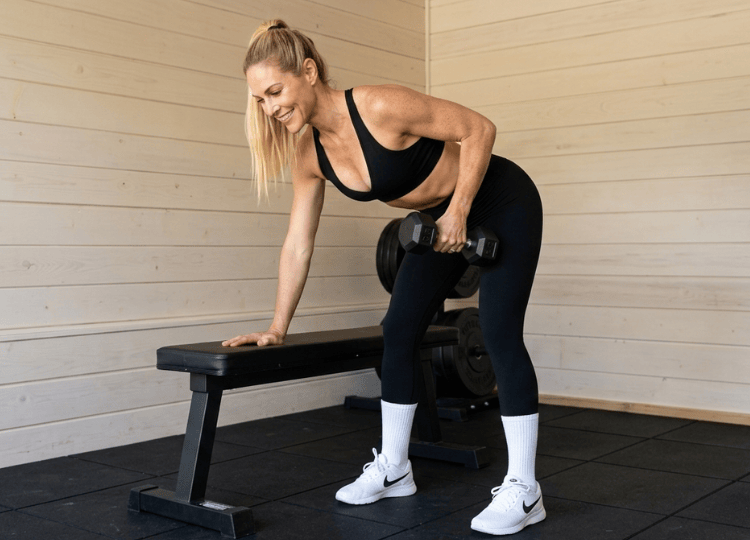
The single arm dumbbell row on a bench is one of the most effective lat exercises available with dumbbells. The bench support removes lower back stress and allows you to focus entirely on the lat contraction, making it a reliable choice for both beginners and experienced lifters.
How to do it:
- Place your left knee and left hand on a bench for support. Your back should be flat and roughly parallel to the floor.
- Hold a dumbbell in your right hand, letting it hang directly below the shoulder.
- Row the dumbbell toward your hip, leading with the elbow and keeping it close to the body.
- Squeeze the lat at the top for a moment, then lower with control.
- Complete all reps on one side before switching.
Coach’s Tip – Think about driving the elbow toward the ceiling rather than lifting the dumbbell with the hand. This shifts the focus away from the bicep and onto the lat where it belongs.
Dumbbell Bent Over Row
The bent over row is a foundational back exercise that builds lat strength alongside the rhomboids, rear delts and the entire posterior chain. Standing unsupported makes this a more demanding movement than the bench row and one that translates well to functional strength.
How to do it:
- Stand with feet hip-width apart holding a dumbbell in each hand.
- Hinge at the hips until the torso is roughly parallel to the floor, keeping the back flat and the core braced.
- Let the dumbbells hang directly below the shoulders.
- Row both dumbbells toward the hips simultaneously, leading with the elbows.
- Pause at the top, then lower with control.
Coach’s Tip – Avoid any jerking or swinging motion to initiate the row. If momentum is needed to lift the weight, it is too heavy. Slow, controlled reps with a full range of motion will always produce better results than heavier sloppy ones.
Dumbbell Deadlift
No lat exercise guide is complete without a deadlift variation. While the primary movers in a deadlift are the glutes, hamstrings and lower back, the lats play a critical stabilising role throughout the lift, keeping the dumbbells close to the body and preventing the shoulders from rounding forward under load.
The dumbbell deadlift works well in a number of variations, from the standard hinge to the single leg variation, b-stance, and sumo deadlift, making it one of the most adaptable exercises on this list.
How to do it:
- Stand with feet shoulder-width apart with a dumbbell on either side of each foot.
- Hinge at the hips and bend the knees to grip the dumbbells, keeping the chest tall and the back flat.
- Drive through the floor to stand, keeping the dumbbells close to the legs throughout.
- Squeeze the glutes at the top, then hinge back down with control to return to the start.
Coach’s Tip – Before initiating the lift, think about pulling the shoulders back and down and squeezing the lats as if trying to put them in the back pockets. This bracing cue keeps the upper back tight and protects the spine under load.
Dumbbell Renegade Row
The renegade row combines a plank hold with a unilateral row, making it one of the most demanding lat exercises on this list. It challenges the core, the lats and the stabilising muscles of the shoulder simultaneously and requires no bench or additional support.
How to do it:
- Place two dumbbells on the floor shoulder-width apart and adopt a high plank position, gripping the handles.
- Keeping the hips square to the floor, row the right dumbbell toward the hip by bending the elbow.
- Lower it back to the floor with control, then repeat on the left side.
- Alternate sides for the desired number of reps.
Coach’s Tip – Hex dumbbells with flat edges make this exercise considerably more stable. If you only have round dumbbells, place a folded mat under each one. Keep the hips as still as possible throughout. Any rotation is a sign the core is not working hard enough.
Dumbbell Reverse Fly
The reverse fly targets the rear deltoids and rhomboids directly and is one of the most effective exercises for improving posture and upper back strength. The lats assist throughout the movement, particularly at the top of the range of motion.
How to do it:
- Stand with feet hip-width apart holding a dumbbell in each hand.
- Hinge at the hips to lean forward, keeping the back flat and the knees softly bent.
- With a slight bend in the elbows, raise both dumbbells out to the sides in a wide arc until they are roughly in line with the shoulders.
- Squeeze the shoulder blades together at the top, then lower with control.
Coach’s Tip – Start lighter than you think necessary. The reverse fly is a small movement and the rear deltoids fatigue quickly. Using a weight that is too heavy leads to shrugging and swinging, which shifts the work away from the target muscles entirely.
Isometric Dumbbell Row Hold
The isometric row hold is the only static exercise on this list and a particularly effective finisher at the end of a back session. Holding the contracted position builds muscular endurance and time under tension in the lats and upper back in a way that standard rowing repetitions cannot replicate.
How to do it:
- Hold a dumbbell in each hand and hinge at the hips until the torso is roughly parallel to the floor.
- Row both dumbbells to the hip position and hold there for 30 to 60 seconds.
- Focus on squeezing the shoulder blades together and keeping the lats fully contracted throughout.
- Lower with control and rest before repeating.
Coach’s Tip – This exercise is far harder than it looks. Start with a lighter weight than you would use for regular bent over rows and focus entirely on maintaining the contracted position rather than fighting with a weight that is too heavy to hold steady.
Dumbbell Single Arm Row (Standing)
The standing single arm row is a useful alternative to the bench row for those without access to a bench at home. It requires more core stability and balance than the supported version and trains each side independently, which helps identify and address strength imbalances between left and right.
How to do it:
- Stand with feet staggered, left foot forward. Hold a dumbbell in the right hand.
- Hinge at the hips and rest the left forearm on the left thigh for light support.
- Let the dumbbell hang below the shoulder, then row it toward the hip leading with the elbow.
- Lower with control and complete all reps before switching sides.
Coach’s Tip – Keep the thigh support light. The forearm is there to assist balance, not to take the load. The back and lat should be doing the work throughout.
Dumbbell Pullover
The dumbbell pullover is one of the few exercises that trains the lats through a long range of motion with the arms overhead, a position most rowing movements cannot reach. It is a direct lat isolation exercise and a valuable addition to any dumbbell back session.
How to do it:
- Lie perpendicular across a bench with only the upper back supported and the hips dropped toward the floor.
- Hold a single dumbbell with both hands, palms flat against the inner plate, arms extended above the chest.
- With a slight bend in the elbows, lower the dumbbell back and overhead in a controlled arc until the arms are roughly in line with the torso.
- Pull the dumbbell back to the starting position, driving through the lats.
Coach’s Tip – Keep a slight bend in the elbows throughout to reduce stress on the elbow joint. The movement should feel like a long sweeping arc, not a press. If the lower back arches excessively as the weight goes overhead, reduce the range of motion.
Things to Consider
- Form always comes before load. The lats respond best to controlled movements with a full range of motion. Using a weight that forces momentum or compromises posture shifts the work to the lower back and biceps rather than the target muscle.
- Pair lat work with pushing exercises. The lats are a pulling muscle group. Pairing them with chest or shoulder pressing work in the same session, or on alternating days, creates a balanced programme that reduces the risk of postural imbalances developing over time.
- Adjustable dumbbells are worth the investment. Lat exercises cover a wide range of loads. A pullover and a deadlift, for example, require very different weights. Adjustable dumbbells allow quick changes between exercises without needing a full rack.
- Unilateral exercises reveal imbalances. Single arm exercises like the bench row and standing single arm row are worth including regularly because they expose strength differences between sides that bilateral exercises allow the dominant side to compensate for.
Dumbbell Lat Workout
Select five exercises from the list above and perform 3 sets of each. Pair with bicep exercises in the same session if desired, as both muscle groups share the same pulling motion and work well together.
| Exercise | Sets | Reps |
|---|---|---|
| Dumbbell Row on Bench | 3 | 8 to 10 each side |
| Dumbbell Bent Over Row | 3 | 10 to 12 |
| Dumbbell Renegade Row | 3 | 8 to 10 each side |
| Dumbbell Pullover | 3 | 10 to 12 |
| Dumbbell Deadlift | 3 | 8 to 10 |
| Standing Single Arm Row | 3 | 10 to 12 each side |
| Dumbbell Reverse Fly | 3 | 12 to 15 |
| Isometric Dumbbell Row Hold | 3 | 30 to 45 seconds |
Benefits of Using Dumbbells to Target the Lats
Unilateral training reveals and corrects imbalances
Most people have a stronger side and bilateral exercises like the barbell row allow the dominant side to compensate. Dumbbell exercises train each side independently, which exposes and gradually corrects these imbalances over time.
Greater range of motion than a barbell
Dumbbells are not constrained by a fixed bar path, which means exercises like the single arm row and pullover allow a fuller range of motion than their barbell equivalents. More range of motion generally means more muscle fibre recruitment.
Accessible and affordable
A single pair of dumbbells is enough to follow a complete lat training programme at home. No gym membership, no cable machines and no pull-up bar required.
Suitable for all levels
Dumbbells come in a wide range of weights and every exercise on this list can be scaled up or down simply by adjusting the load. This makes dumbbell lat training as appropriate for a complete beginner as it is for an experienced lifter.
Develops stability and coordination
Because dumbbells move independently of each other, the stabilising muscles of the shoulder, core and upper back have to work harder to control the movement than they would with a fixed barbell. This builds functional strength that transfers well beyond the gym.
FAQ
How do you target the lats with dumbbells?
The most effective way to target the lats with dumbbells is through rowing movements and the pullover. Rowing exercises train the lats through shoulder extension and adduction, while the pullover adds overhead range of motion that rows cannot reach. Focus on driving the elbow rather than pulling with the hand to keep the emphasis on the lat rather than the bicep.
Where are the lats?
The latissimus dorsi is a large, flat muscle that covers the majority of the mid and lower back. It originates from the lower spine and pelvis and inserts at the upper arm, which is why it is involved in any movement that pulls the arm downward or backward.
What is the best dumbbell lat workout?
Select four to five exercises that cover different movement patterns, including at least one row, one unilateral exercise and one isolation movement such as the pullover. Perform 3 sets of 8 to 12 reps per exercise with a weight that is challenging for the final two to three reps of each set.
Bottom Line
The lats are one of the most functionally important muscle groups in the body and one of the most undertrained. A pair of dumbbells is genuinely all you need to build meaningful strength here, and the 8 exercises above cover the full range of what is possible without a cable machine or pull-up bar.
Pick 4-5 exercises, perform three sets of each, and aim to train the lats twice a week as part of a balanced programme. Focus on controlled reps, drive the elbows rather than the hands, and progress the weight gradually as each exercise becomes more comfortable. The strength and postural benefits will follow.
Related Articles
Skater Squats – Benefits and How They Compares to Pistol Squats
How to do the Dumbbell Overhead Squat
9 Hamstring Exercises You Can Do At Home (No Equipment Needed)