

If you want bigger, better-developed biceps, you’ve probably already got dumbbell curls and barbell curls covered.
But there’s a good chance you’re missing one of the most effective bicep exercises available, and it’s one that most people walk straight past in the gym without a second glance.
Facing away cable curls, also commonly known as Bayesian curls, are gaining serious traction among strength coaches and hypertrophy-focused lifters… and for good reason.
By making one simple change to how you position yourself at the cable machine, you can load the biceps in a way that standard curls simply can’t replicate.
The result is more tension through the full range of motion, a deeper stretch at the bottom, and better overall bicep development.
In this guide, we cover everything you need to know… including how to perform them correctly, the muscles worked, benefits, and things to consider before adding them to your arm workouts.
What Are Facing Away Cable Curls?
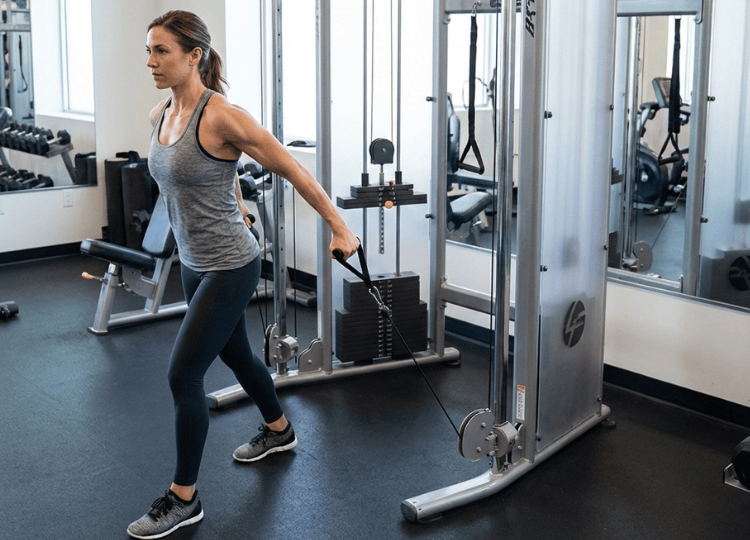
Bayesian facing away cable curls are a bicep curl variation performed with your back to the cable machine rather than facing it.
With the pulley set at its lowest position and a single handle attachment, you stand facing away, step forward to create tension on the cable, and curl the weight up from a position where the arm is behind the body.
What makes this variation distinct from a regular cable curl isn’t just the change in direction. It’s what that change in direction does to the resistance profile of the movement, and understanding this is key to understanding why the exercise is worth doing.
How to Perform Bayesian Facing Away Cable Curls
To perform Bayesian Facing Away Cable Curls:
- Set the cable pulley to its lowest position – at or near floor level. This is the standard setup and the one that best replicates the exercise’s intended resistance profile.
- Attach a single D-handle to the cable. Select a weight that’s lighter than you’d typically use for standard cable curls – the loaded stretch at the starting position makes the exercise feel considerably heavier than it looks.
- Stand facing away from the cable machine and take hold of the handle with an underhand (supinated) grip. Step forward until there is tension on the cable and your arm is drawn back slightly behind your body – your elbow should sit just behind your lat, not several inches behind it. Stagger your feet for balance, one foot slightly ahead of the other.
- Before you begin your first rep, you should already feel a mild stretch in the bicep. If you don’t, step further forward from the machine. If the cable is pulling your arm back uncomfortably, step slightly closer.
- From this starting position, curl the handle upward toward your shoulder by contracting the biceps, keeping the elbow fixed in place. As you curl up, lean very slightly forward with your torso – this maintains tension at the top of the movement and prevents the cable from going slack.
- At the top, squeeze the bicep firmly, then slowly lower your arm back to the starting position, allowing it to travel behind your body again for the full stretch.
Perform all reps on one side before switching arms.
Coach’s Tip
The most common mistake is not stepping far enough forward from the cable machine, which means the arm never gets behind the body and the key benefit of the exercise is lost. The other is allowing the cable to touch your forearm during the curl – if this happens, you’re not leaning forward enough and tension on the bicep is dropping close to zero at the top.
Facing Away vs Facing the Cable Machine
This is the most important thing to understand about this exercise, so it’s worth spending a moment on it.
When you perform a standard cable curl facing the machine, the cable pulls your arm forward and down. This means resistance is highest at the midpoint of the curl, roughly when the elbow is at 90 degrees, and drops off significantly at the bottom of the movement when the arm is extended.
In other words, the biceps are getting very little resistance at the point where they’re most stretched.
When you face away from the machine, the cable pulls your arm backward and behind your body. Now the resistance is highest at the bottom of the movement, when the arm is extended and the biceps are in their most stretched position. This is the opposite resistance profile to a standard curl.
Why does this matter?
The science here is interesting. The long head of the biceps is barely active at all when the muscle is fully shortened, and the short head loses around 80% of its maximum tensile strength in that position too.
Most standard bicep exercises, like dumbbell curls, barbell curls, even regular cable curls, apply very little tension at the bottom where the biceps are fully stretched, which is precisely where the muscle can generate the most force.
Facing away cable curls fix this directly.
Best of both worlds
The two variations aren’t mutually exclusive. Standard curls load the bicep hardest in the mid-range and at the top. Facing away cable curls load it hardest at the bottom. Using both in your training means the biceps are getting a meaningful stimulus across their full range – which is the most complete approach to bicep development.
Is This Better for the Long Head or Short Head?
Facing away cable curls preferentially target the long head of the biceps.
The long head runs along the outer part of the upper arm and is the muscle primarily responsible for the height and peak of the bicep… the part that’s most visible when you flex. It crosses the shoulder joint and is most fully lengthened when the elbow is positioned behind the torso, which is exactly the starting position of this exercise.
The short head – which sits on the inner part of the arm and contributes more to overall thickness – is also engaged throughout the curl, but it’s the long head that gets the most specific benefit from the arm-behind-body position.
If developing the peak and height of the biceps is a priority, this makes facing away cable curls one of the most targeted tools available for that specific goal. For complete bicep development, pair it with exercises that train the short head more directly – preacher curls and concentration curls being the most common examples.
Muscles Worked
Biceps Brachii
The biceps brachii is the primary target, specifically, as discussed above, with a particular emphasis on the long head due to the arm position behind the body. Both heads work throughout the movement to flex the elbow and supinate the forearm, but the long head is under significantly greater stretch and load from the very start of each rep.
Brachialis
The brachialis sits underneath the biceps and is an important secondary mover during elbow flexion. Developing the brachialis increases the overall mass of the upper arm and physically pushes the biceps upward, making it an important muscle for anyone focused on aesthetics as well as strength. It’s engaged throughout the curl alongside the biceps.
Brachioradialis
The brachioradialis is the large muscle on the outer forearm that assists with elbow flexion, particularly during the mid-range of the movement. It gets meaningful secondary work during facing away cable curls.
Wrist Flexors
The wrist flexors are also engaged during the movement to maintain grip on the handle throughout each rep… a minor but worth noting contribution.
Core and Stabilisers
Maintaining an upright, stable position with the cable pulling your arm backward requires consistent core engagement. This is a modest but useful secondary benefit of the standing, unilateral nature of the exercise.
Bayesian (Face Away) Cable Curl Benefits
Loads the Bicep in the Stretched Position
This is the defining benefit. Most curls apply the least tension when the biceps are most stretched, and facing away cable curls invert that completely. Loading the muscle in its lengthened position creates a meaningful hypertrophy stimulus that most standard curl variations miss – making this a genuinely valuable addition rather than just another variation for its own sake.
Targets the Long Head Specifically
For those specifically wanting to develop the peak and height of the bicep, this exercise is one of the most direct tools available. The arm-behind-body position places the long head under load in a way that standard curls, which keep the elbow at the side, don’t replicate.
Constant Tension Throughout
Cable machines maintain tension on the muscle throughout the entire range of motion in a way that free weights can’t. Dumbbells rely on gravity, which means tension reduces at certain points in the arc. The cable provides consistent resistance from the bottom of the curl all the way to the top, which is excellent for time under tension and overall bicep activation.
Addresses Muscular Imbalances
Because this is a unilateral exercise, training one arm at a time… each side of the body is forced to work independently. This makes it a useful tool for identifying and addressing strength or size differences between arms, since neither side can compensate for the other.
Strict Form by Design
The nature of the movement makes it difficult to cheat. The cable pulling behind you removes the temptation to swing or use momentum from the lower body… both common faults during heavier barbell and dumbbell curls. The biceps are doing the work on every rep, which is ultimately what drives growth.
Things to Consider
Use a Single Handle Rather Than a Bar
If your cable machine has a bar attachment, performing this exercise with it is awkward – the cable would need to run between your legs to maintain the correct line of pull, which is uncomfortable and creates a poor resistance angle.
A single D-handle is the right attachment for this exercise. Train one arm at a time with the cable sitting at your side. If your gym has a dual cable station, using both handles simultaneously is possible, but most lifters find the single arm variation easier to control and more effective for feeling the target muscle.
Start Much Lighter Than You Think
The loaded stretch at the start of each rep catches most people off guard the first time.
The weight feels significantly heavier in the stretched position than it does during a standard curl, and trying to use too much weight means the cable pulls your arm too far behind your body, which actually reduces tension on the biceps at both the top and bottom of the rep. Start light, nail the technique, and build from there.
Elbow Position is Everything
The elbow should sit just slightly behind the lat throughout the movement, not pinned to the side as in a standard curl, but not wrenched several inches behind the body either.
Too far back and you lose tension at both ends of the rep. The sweet spot is feeling a clear stretch in the bicep at the bottom without the shoulder being pulled into an uncomfortable position.
Not Suitable for Everyone
Some people find the shoulder position required causes discomfort in the front of the shoulder rather than a stretch through the bicep. If this is the case, first check your setup – you may be standing too far from the machine. If the discomfort persists regardless of positioning, incline dumbbell curls are the most accessible alternative that trains the biceps in a similarly stretched position without the same shoulder extension demands.
Bottom Line
Facing away cable curls, or Bayesian curls, are one of the most effective and underused bicep exercises available. By flipping your position at the cable machine, you shift the resistance to where most curls leave a gap: the stretched position at the bottom of the movement.
They’re not a replacement for your existing curl variations, they’re a complement to them. Add them after your compound pulling movements, use a single D-handle, start lighter than you think you need to, and focus on that full stretch at the bottom of every rep.
Do that consistently and you’ll quickly understand why this exercise has built such a devoted following.
Related Articles