
Quick Answer
Balance exercises for seniors work when they feel slightly unsteady and add up to more than three hours each week. A practical session blends standing holds, weight shifts, heel-to-toe walking, and hip and ankle range-of-motion work, starting with a seat for support and removing it as steadiness improves. Sustained across three to six months, the routine measurably lowers fall rate and protects independent movement.
Introduction
Most fall-prevention routines are too gentle to change anything. A Cochrane review of 108 trials found that balance exercises for seniors cut the rate of falls by 24%, and Sherrington’s meta-analysis pushes that figure to 39% when a program pairs a genuine challenge to steadiness with more than three hours of weekly practice. Routines that never put stability under pressure showed no fall-prevention effect at all.
Reaching that threshold alone at home is where most people come unstuck, so the structure around the exercise matters more than the choice of movement. Senior residences have built around that problem, pairing a staffed fitness centre like Currie Green with instructor-led sessions, indoor courts for pickleball and badminton, and landscaped walking paths.
Mobility Exercises for Seniors and the Systems That Keep You Upright
Standing upright looks passive and is anything but. The body samples its own position several times a second, compares those readings, and corrects the drift before it reaches conscious attention.
The Inputs the Body Cross-Checks
Postural control draws on far more than leg strength, which is why a confident walker can still feel shaky on a dim staircase. Each input below feeds the same correction loop, and when one fades the others absorb the extra load.
- Inner ear: fluid movement in the vestibular organs registers head position and acceleration.
- Vision: the eyes supply a horizon reference, so unsteadiness worsens in dim light.
- Foot and joint sensation: receptors in the soles report where body weight actually sits.
- Lower-body strength: hips, quadriceps and calves produce the correction once it is called for.
- Reaction speed: the stepping response decides whether a stumble ends in recovery or on the floor.
Aging dulls these inputs at uneven rates, and vision often compensates for a vestibular system that has been slipping for years, so night-time trips are where the gap finally shows.
Why Strength Sets the Ceiling
Sensing a wobble achieves nothing without the force to answer it within a fraction of a second. The ankle handles small corrections, the hip takes the larger ones, and both rely on muscle that shrinks unless it is loaded regularly. Clinicians size up the shortfall with the 30-second chair stand from the CDC’s STEADI toolkit, counting how many times a person rises from a seat without using their arms.
What a Real Challenge Feels Like
An exercise trains steadiness only while it feels slightly precarious, and gripping a rail with both hands turns a standing hold into a rest. The usable signal is a mild wobble with something solid within arm’s reach.
Chair Exercises for Seniors and the Moment to Stand Unsupported
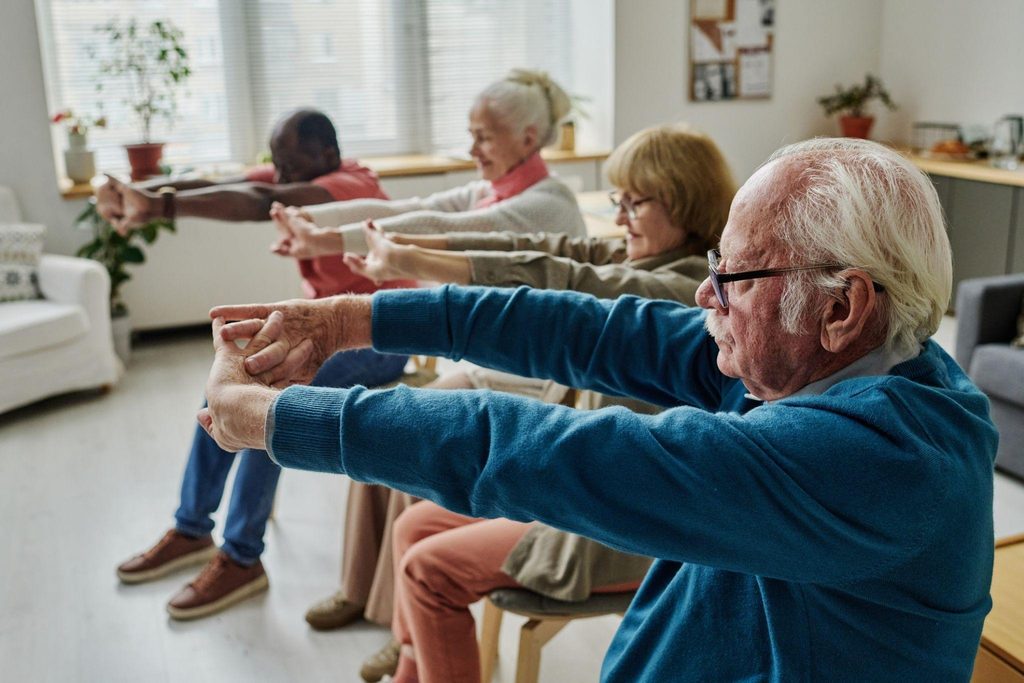
A seat is scaffolding rather than a destination. Seated work builds the hip and ankle strength that standing corrections draw on, and it lets someone recovering from illness begin in the same week instead of waiting for a good day.
Where a Seated Routine Earns Its Place
A seated start suits the first few weeks, an arthritis flare, or the stretch after a hospital stay. The tasks below load the muscles that answer a wobble, with no fall exposure attached.
- Sit-to-stand repetitions, arms folded across the chest once the legs can manage it
- Seated marching, driving each knee high enough to feel the hip flexor working
- Heel and toe raises, loading the calf and shin that steer ankle corrections
- Trunk rotations, so turning toward a doorway stays a rib movement rather than a whole-body shuffle
- Ankle circles in both directions, restoring the joint range that uneven ground demands
The Weekly Volume That Moves the Number
The three-hour threshold is a scheduling problem dressed as a fitness one. Split across the week, it lands near 25 minutes a day, or four sessions of 45 minutes, with the work counted in minutes of genuine standing challenge rather than total time in the gym. Anything below that line produced far weaker results in the trial data behind it.
Raising the Challenge Without Raising the Risk
Progression runs through support rather than through new movements, so the ladder below shifts one variable at a time.
| Stage | Hand support | Sample task | Ready to progress when |
| 1 | Both hands on the seat back | Narrow stance hold, 30 seconds | The full 30 seconds passes without a correction |
| 2 | Fingertips resting only | Feet together, then one foot half a step ahead | Two sets feel steady on both sides |
| 3 | Hand hovering, no contact | Heel-to-toe stand, 20 seconds each side | Three sessions pass without touching down |
| 4 | Unsupported, something solid within reach | Heel-to-toe walking, 10 steps | Pace stays even and the head stays up |
Each rung holds until the wobble fades, at which point the next one restores it, and stepping back down after an illness counts as maintenance rather than failure.
What Senior Fitness Classes in Calgary Add That a Living Room Cannot
Solo routines rarely end with a decision, and they usually fade because nothing in the day marks a missed session. Group programming answers that with other people’s eyes and a fixed slot on the calendar.
Supervision Catches What a Mirror Cannot
An instructor sees the compensations the person performing them cannot feel: a hand drifting back to the rail, a stance widening by a few centimetres, a hold ending early. Programming built around a staffed fitness centre also removes the judgment call about when to drop support, because someone else tracks the progression and records it.
The Months When Outdoor Walking Stops
Ice and snow close the easiest option for a long stretch of the Calgary year, and a routine built on garden paths quietly suspends itself in November. Residences that run their walking routes alongside indoor courts keep low impact exercises for seniors going through the cold months, when the home routine would otherwise lapse.
Questions Worth Asking About Any Program
The answers separate structured training from pleasant activity.
- Does the session progress in stages, or repeat the same routine every week?
- Who decides when a participant is ready to reduce hand support?
- How many minutes of standing balance work does each hour actually contain?
- Is attendance recorded, with follow-up when someone stops coming?
Pro Tip: Count weekly minutes rather than sessions, because two 45-minute sessions leave a 90-minute shortfall against the threshold, closed with 15 minutes of standing work on the days in between.
Balance Training and Mobility Gains That Outlast the Winter
The difference between a routine that works and one that merely fills time comes down to two settings: how hard each repetition feels, and how many minutes accumulate by Sunday. Both are adjustable at home, and both are easier to hold when someone else is counting.
Treat the wobble as the dial: when a hold stops being difficult, balance exercises for seniors have done their job at that level, and the next step is less support rather than a longer session.