


Choosing a training split is one of the more consequential decisions you make when setting up a programme.
Get it right and your training has structure, your muscles recover properly, and you make consistent progress. Get it wrong and you are either leaving gains on the table or accumulating fatigue faster than you can recover from it.
Two of the most popular and well-established splits for intermediate and advanced lifters are the Arnold split and the PPL, or push, pull, legs, split.
Both involve 3 distinct training days repeated twice per week.
Where they differ is in how they organise the upper body work, and that difference has meaningful implications depending on your goals, your recovery capacity, and which muscle groups you want to prioritise.
This guide breaks down exactly how each split works, the pros and cons of each, sample workouts for every session, and a clear guide to who each split is best suited to.
At a Glance – Arnold Split Vs PPL Split
The Arnold Split and PPL are both 3 day splits (typically repeated twice a week), but the difference is in how you train your upper body. With the Arnold split, one day is allocated to your chest and back, and the other day is allocated to shoulders and arms. With the PPL split, one day is allocated to pushing exercises and the other day is allocated to pulling exercises. Both splits train the legs (and core) for the remaining day.
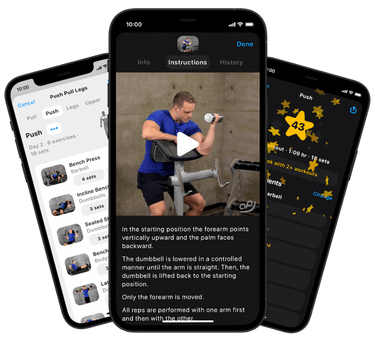
Achieve your fitness goals quicker with help from Alpha Progression, our top pick for fitness apps this year.👇
ADVERTISEMENT
Arnold Split
What is an Arnold Split?
The Arnold split was popularised by Arnold Schwarzenegger during his competitive bodybuilding career in the 1970s and outlined in detail in his 1985 book The New Encyclopedia of Modern Bodybuilding.
It is built around the principle of agonist-antagonist training, pairing opposing muscle groups in the same session so that one muscle rests while its counterpart works.
Day 1 pairs chest and back. Day 2 pairs shoulders and arms. Day 3 is dedicated to legs. Each session is then repeated across a six-day week.
The defining characteristic of the Arnold split, beyond the muscle groupings, is what it does for arm development specifically. In a PPL split, the biceps and triceps are trained toward the end of pull and push sessions respectively, meaning they arrive at their own work already fatigued from compound movements.
In the Arnold split, they get a dedicated session alongside shoulders where they are relatively fresh, which research suggests produces better arm development and allows heavier, more productive loading on isolation work.
If you’re a beginner, it’s probably best to stick with 3 days, so you have enough time for recovery and rest, or follow a less intense training program. 6 days involves lifting a lot of volume, and if you’re not experienced, you’ll struggle to keep up.
Arnold Split Workout Plan
The table below illustrates the sorts of muscles associated with each day.
| Day 1 | Day 2 | Day 3 |
|---|---|---|
| Chest | Shoulders | Glutes |
| Back | Biceps | Hamstrings |
| Triceps | Quads | |
| Calves | ||
| Core |
Pros of the Arnold Split
- Arms are trained fresh on their dedicated day rather than after compound pressing and pulling, which supports better isolation work and arm development.
- Chest and back pairing lends itself well to supersets, keeping sessions time-efficient and creating sustained upper body pump through the session.
- Twice-weekly frequency for every muscle group aligns with the research on optimal training frequency for hypertrophy.
- Well suited to those who want to prioritise shoulder and arm development alongside overall upper body size.
Cons of the Arnold Split
- Shoulders arrive at Day 2 carrying some residual fatigue from the pressing work on Day 1, which can limit overhead pressing performance.
- The chest and back day covers a lot of high-demand compound lifts in a single session, meaning exercise order has a significant impact on performance.
- Six days per week is a substantial time and recovery commitment that is not practical for everyone.
What is a PPL Split?
The PPL split divides training by movement function rather than muscle opposition. Push days train the muscles responsible for pushing movements: chest, shoulders and triceps. Pull days train the muscles responsible for pulling movements: back and biceps. The legs day covers everything below the waist.
Like the Arnold split, PPL is typically run as a 3-day programme repeated twice across a 6-day week, giving each muscle group two training sessions per week.
The PPL split has a strong following in strength training communities because the movement-based grouping aligns naturally with compound lifts. On a push day, the bench press, overhead press and tricep work all complement each other.
On a pull day, rows, pulldowns and curl variations flow logically. This organisation makes it easier to build sessions around the big compound movements and to progress them systematically over time.
The trade-off is that by the time you reach tricep and bicep isolation work at the end of push and pull sessions, those muscles have already been working as secondary movers throughout the compound movements. This is less of an issue for those whose primary goal is overall strength, but it matters for those specifically targeting arm development.
PPL Workout Plan
The table below illustrates the sorts of muscles associated with each day.
| Push | Pull | Legs and Core |
|---|---|---|
| Chest | Back | Glutes |
| Shoulders | Biceps | Hamstrings |
| Triceps | Quads | |
| Calves | ||
| Core |
Does the workout order matter with PPL?
The order you train will impact your workouts, so depending on what exercises you’re doing, you may want to change the order to see if that helps with your progress. This is probably more important if you’re doubling up and training 6 days a week.
Pros of the PPL Split
- Movement-based groupings align naturally with compound lifts, making it easier to structure sessions around bench press, deadlift and squat progressions.
- Each session has a clear, logical focus that avoids the overlap and fatigue management challenges of pairing opposing muscle groups.
- Slightly more forgiving in terms of shoulder fatigue, since shoulders are not being taxed on a preceding day before the push session.
- Well suited to those whose primary goal is strength and who want to centre their programme around progressive compound lifting.
Cons of the PPL Split
- Push days tend to be the longest sessions, covering chest, shoulders and triceps with sufficient volume for each.
- Biceps and triceps are trained toward the end of their respective sessions when they are already partially fatigued from compound work, which can limit the quality of isolation work.
- Supersets are harder to implement effectively on push and pull days due to overlapping muscle involvement between exercises.
Who is Arnold and PPL Split Best Suited To?
Choose the Arnold Split if:
You want to prioritise arm and shoulder development. The dedicated shoulders and arms day means these muscle groups are trained fresh, which is a meaningful advantage for anyone specifically targeting upper arm size.
It also suits those who enjoy agonist-antagonist supersets and want to make their chest and back sessions particularly intense and time-efficient.
Choose the PPL Split if:
Your primary goal is strength and you want to build your programme around the big compound lifts. The movement-based structure makes it easier to progress bench press, overhead press, rows and squats systematically, and the sessions have a cleaner, more straightforward flow.
It is also generally considered slightly more beginner-friendly of the two, though both are best suited to those with at least six to twelve months of consistent training experience.
If you are unsure:
The honest answer is that for most people the difference in results between the two splits will be modest. Research suggests neither is inherently better, and the best split is often the one you find most engaging and can stick with consistently.
Consistency over months and years matters far more than the specific organisation of your training days. If arm development is a priority, lean toward the Arnold split.
If strength and compound progression are the priority, lean toward PPL. If you enjoy both, a PPL x Arnold hybrid that runs three days of each across a six-day week is a legitimate option worth exploring.
Exercises, Intensity and Volume
The exercises you select, along with the intensity and total volume (reps/sets), will largely have a greater impact on your fitness than the choice between an Arnold or PPL split. Whatever program you pick, ensure you are also doing the right amount of reps/weight for your goals (strength, hypertrophy, etc).
Bottom Line
Both the Arnold split and the PPL split are effective, well-evidenced approaches to building muscle and strength for intermediate and advanced lifters. They share the same core structure, the same twice-weekly muscle frequency, and the same emphasis on compound movements and progressive overload.
The difference is in the detail of how upper body work is organised and which muscle groups get trained fresh.
For arm and shoulder development, the Arnold split has a practical edge. For strength-focused training built around compound lifts, the PPL split flows more naturally.
For most lifters, the best choice is the one that fits their goals, keeps them engaged, and that they can sustain consistently over the long term.
If you are running either split six days per week, recovery becomes as important as the training itself. Dial in your nutrition, protect your sleep, and progress gradually rather than piling on volume before your body is ready for it.
Related Articles