
When a hospital is short a therapist or a tech, patient care cannot wait. Staffing agencies exist to close that gap fast, with the right credentialed professional.
A single unfilled clinical role does not stay a quiet problem for long. Say a rehab unit loses a therapist, or an imaging department cannot cover nights. The effects spread quickly. Appointments back up, beds sit unused, and the remaining staff absorb more than they can safely carry. Facilities cannot simply wait months for a traditional hire to work through, because the need is immediate and the stakes are patient care. That pressure is why an entire discipline exists around placing qualified clinicians on short notice. This is a look at how that system works, why hospitals and clinics lean on it, and what separates a dependable staffing partner from a risky one.
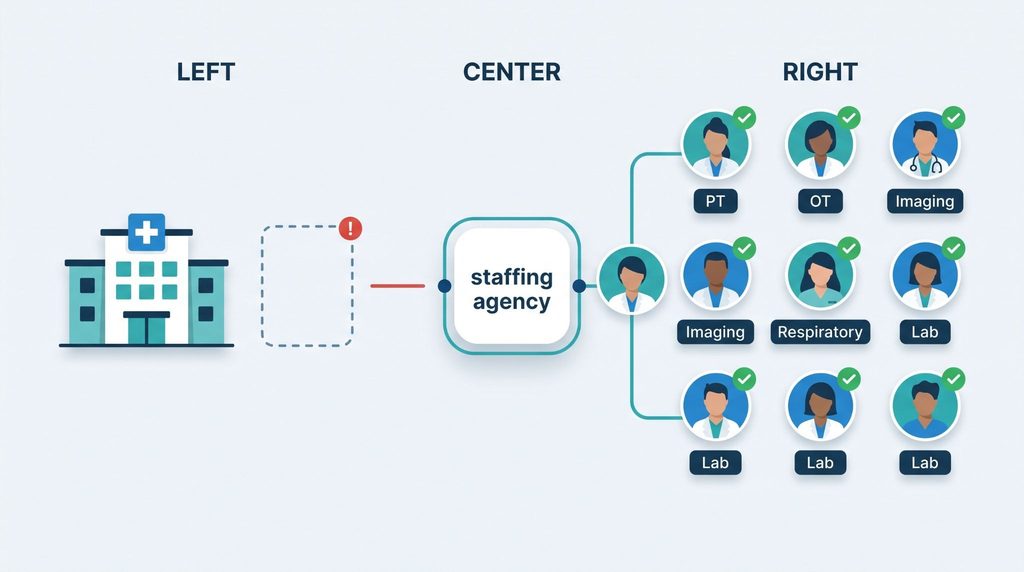
Staffing bridges an open role to a pool of credentialed clinicians, so a shortage never stalls patient care.
What allied health staffing actually is
Start with the two halves of the term. Allied health covers the large group of licensed clinical professionals who are not doctors or nurses: physical, occupational, and speech therapists, radiology and imaging technologists, surgical technologists, respiratory therapists, and laboratory technicians, among many others. Staffing is the process of matching those professionals to facilities that need them, through an agency rather than a direct posting. A dedicated agency maintains a network of credentialed allied health professionals and places them where a shortage is urgent, on terms that fit the situation. It is a distinct discipline from ordinary recruiting. Speed, licensing, and compliance all have to be handled at once. And a role left open costs the facility something every single day.
Why facilities rely on allied health staffing
Demand for this kind of support keeps climbing, and the reasons stack on top of each other. The population is aging, which drives steady growth in rehabilitation, imaging, and respiratory care. Clinician burnout thins the existing workforce, and seasonal surges, parental leaves, and sudden departures open gaps with no warning. When a new unit opens, it needs staff on day one, not in a quarter. Behind all of it sits a simple cost calculation: an unfilled role is never quiet. It closes beds, lengthens wait times, forces expensive overtime, and pushes the current team toward the same burnout that created the gap. Staffing support exists to stop that spiral before it starts.
The allied health staffing models: travel, per diem, and permanent
There is no single way to fill a role, because the shortage that opens it varies. The three main models each solve a different problem, and a good agency helps a facility pick the right one rather than forcing everything into one shape. Travel contracts cover an acute, defined gap, usually for about thirteen weeks, often bringing a clinician in from another state. Per diem covers shifts flexibly, filling a schedule day by day when coverage is unpredictable. Permanent placement solves a long-term need, finding a clinician who will stay. The table below lays out what each model is best suited to and how long it typically runs, so the fit is clear at a glance.
| Model | Best for | Typical length |
| Travel | An urgent, defined gap, often out of state | About 13 weeks, extendable |
| Per diem | Unpredictable, shift-by-shift coverage | Single shifts, ongoing |
| Permanent | A lasting need that requires stability | Direct hire, long-term |
Credentialing and compliance: the allied health part that protects patients
The work that matters most in staffing is the part a facility never sees. Before a clinician sets foot on site, an agency verifies that every credential is real, current, and appropriate for the role and the state. That protects patients, and it is also what lets a placement happen fast without cutting corners. A rushed hire with an expired certification is a liability, not a solution, so the checking is the value. A strong partner treats this as a standing process rather than a scramble at the last minute, which is exactly why a credentialed professional can start a contract in days instead of weeks. The list below covers what that verification usually includes before anyone is placed.
- Active, unrestricted state licensure for the specialty and the assignment location.
- Current certifications, including any required for the specific setting or equipment.
- Verified education, work history, and professional references.
- Up-to-date health records, immunizations, and any facility-specific screenings.
- Background checks and compliance documents required by the state and the facility.
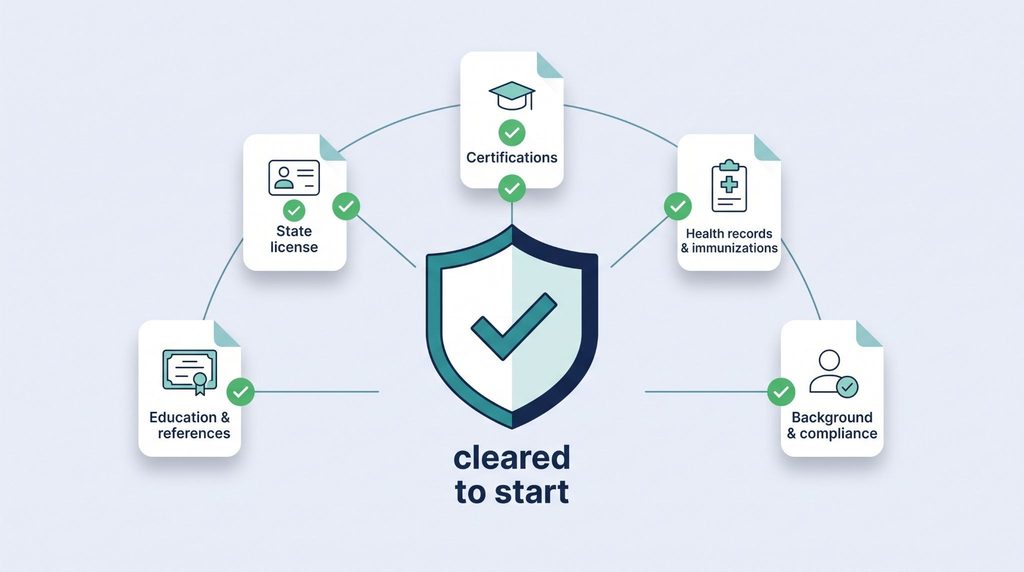
Behind every fast placement is a full credential check: license, certifications, records, and compliance.
Choosing an allied health staffing partner
Not every agency delivers the same thing, and the differences show up fast under pressure. The first question is reach. A partner with a deep network across many specialties can fill a wider range of roles without starting from zero each time. Speed matters next. Since the point of staffing is to close a gap before it does damage, a partner that keeps credentialing current can move in days rather than weeks. Support is easy to overlook and costly to skip: a dedicated recruiter, a credentialing team, and reliable payroll keep both the facility and the clinician from drowning in logistics. Flexibility rounds it out, and a non-exclusive arrangement lets a facility scale coverage up or down as real demand shifts, instead of being locked into one vendor.
- Network breadth, so one partner can cover many specialties and settings.
- Speed to fill, backed by credentialing that is kept current, not started from scratch.
- Full support, meaning a recruiter, a credentialing team, and dependable payroll.
- Flexible terms, including non-exclusive options that scale with actual demand.
Put simply, allied health staffing exists so a shortage never has to become a gap in patient care. Facilities get qualified, verified clinicians when and where they need them, without the long wait a traditional hire would take. Clinicians get assignments that fit the way they want to work. The right partner handles the licensing, the compliance, and the logistics in the background. That lets everyone focus on the reason the roles matter in the first place. At the end of the process is a patient, and the care that person is waiting on is the whole point of getting the staffing right.