

The yellow ball blurs against the clay as a Naples sunrise flares across your baseline. One shanked swing feels random—until every rally starts slipping. When glare starts dictating your footwork and headlights bully the drive home, it’s clear your eyes—not your topspin—need attention. Choosing the right cataract surgeon in Naples lets you match a lens to your dawn-tennis lifestyle, schedule recovery without losing court time, and regain the depth perception that fuels quick reactions. Here’s how to make that choice and step back to the baseline seeing as sharply as you expect to play.
Why Naples Light Exposes Contrast Loss
Southwest Florida’s midday UV index often peaks at 10–11, some of the highest readings in the continental United States. The same low-angle sun that makes dawn tennis feel golden also flattens depth and funnels glare straight into your sight line.
Step from clubhouse shade to the baseline and the court floods with reflected light. Water surfaces can bounce up to 10 percent of UV rays back toward your eyes, so nearby canals and damp clay intensify the washout that hides a dipping topspin.
Evening drives flip the script. Pupils still wide from bright Florida daylight now face oncoming headlights, and that sudden light swing reveals early cataract haze long before an eye-chart score drops.
Because prolonged UV-B exposure is a documented cataract risk, polarized sunglasses, a wide-brim hat, and routine eye exams belong in your kit if you split days between sunrise sets, midday boating, and dusk drives along Tamiami Trail.
When an Eye Exam Becomes the Next Training Decision
Schedule a comprehensive eye exam as soon as vision changes start dictating shot choice, night-drive routes, or balance on boat docks; functional hits matter more than a birthday or eye-chart score.
Bring a short, sport-specific checklist to the appointment:
- Losing the ball in topspin rallies
- Avoiding evening drives after doubles
- Hesitating on dock steps or ladder drills
Concrete cues help your doctor separate a developing cataract from a simple prescription tweak, tear-film haze, or an early retinal issue. Ask whether one eye is judging depth alone and how that imbalance affects footwork or stairs. The exam reveals not just if cataracts exist but when surgery could restore full-court confidence, so vision becomes one more metric you track like string tension or split-step cadence.
Confirm the Surgeon’s Credentials and Role
Start with two non-negotiables:
- Active Florida medical license. Search the Florida Department of Health Practitioner Profile to confirm status and any disciplinary history.
- Current board certification in ophthalmology. The American Board of Ophthalmology lists each surgeon and latest recertification date.
Next, identify the person who will be in the OR. Large practices may promote many providers, but only one pair of hands guides the scalpel. Ask about that surgeon’s results with:
- Astigmatism cases
- Post-LASIK eyes
- Athletes who expect crisp distance vision
Clarify logistics before you commit: where the procedure takes place, which office handles follow-ups, and who answers after-hours calls if concerns arise.
Remember, ophthalmologists perform surgery; optometrists focus on exams and co-management. Treat online star ratings as conversation starters, not proof of quality, and rely on verified credentials that protect both your sight and your serve.
Ask How the Eye Is Measured and the Plan Is Built
Accurate biometry, not flashy operating room gadgets, drives cataract results. Surgeons calculate lens power from three core numbers:
- Axial length (front-to-back size of the eye)
- Corneal curvature/astigmatism measured with modern keratometry or topography
- Anterior chamber and lens position formulas that predict where the implant will sit
Studies show small errors here can shift the final prescription by a full diopter, and untreated dry eye can skew keratometry readings.
Ask the surgeon to walk you through your data and explain exactly how it guided the lens choice. When you hear “advanced technology,” follow up with “What did it reveal about my eye, and how did that change the plan?” Clear answers signal clear thinking.
Bring up any wild cards such as prior LASIK, corneal astigmatism, dominant-eye preference, and the distances you value most (baseline rallies, dashboards, phone texts). Equipment only supports the decision; it never guarantees the outcome.
A solid benchmark is the Snead Eye Group ophthalmology team in Southwest Florida, which pairs a $1 million imaging system with Dr. Brad Snead’s precise manual technique. That kind of clarity about equipment and who performs the surgery is a standard to expect from any Naples provider you interview.
Snead Eye Group homepage (screenshot: sneadeye.com)
Judge Communication, Precision, and Follow-Through
A surgeon’s conversation style predicts satisfaction as much as the surgical tech, according to patient-experience studies.
Look for cues that the doctor:
- Asks about your serves, night driving, boating, and screen use before discussing lenses
- Explains glasses expectations, low-light trade-offs, and who handles each follow-up visit
- Welcomes a second opinion and answers without rushing, a sign of confidence rather than insecurity
Skip ads that promise “perfect vision” or showcase only five-star ratings. Choose the professional who speaks plainly, sets realistic goals, and stays involved until you’re back attacking short balls with conviction.
Define the Vision Distances Your Active Life Requires
Cataract-lens success hinges on three distinct ranges—far, intermediate, and near—each tied to different moments on and off the court.
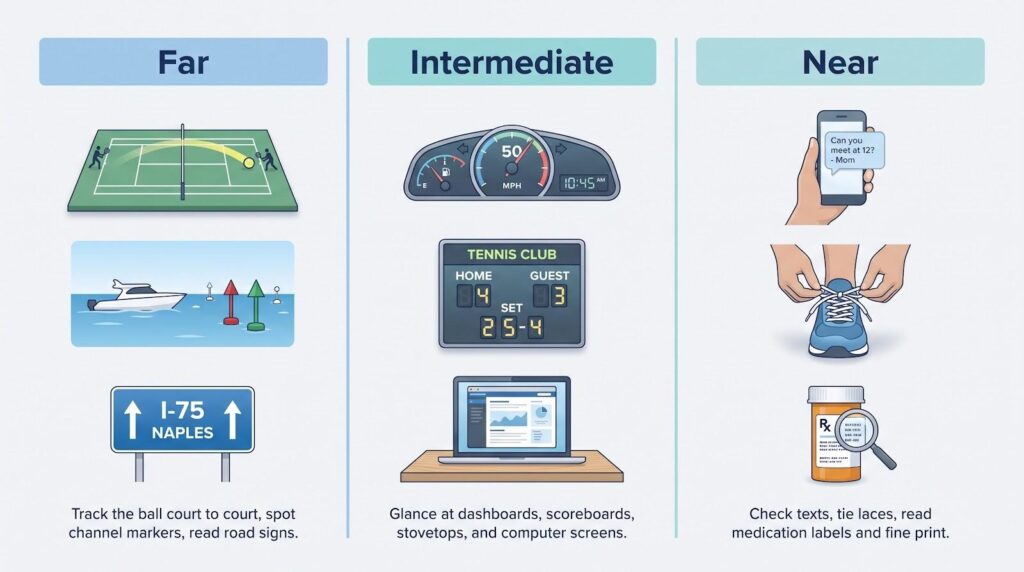
- Far: Track the ball baseline to baseline, spot channel markers from the bow, read interstate signs without squinting.
- Intermediate: Glance at dashboards, scoreboards, stovetops, or computer screens; clarity here prevents the posture creep that drains energy faster than any drill.
- Near: Check a text, tie laces, read medication labels; these tasks happen inside arm’s length dozens of times a day.
Rank these zones in order of personal value, then decide how willing you are to slip on readers, how pristine night driving must stay, and whether halos would rattle your serve. No single lens is “best.” The winner serves your priorities, not a marketing slogan.
Compare Standard and Premium IOL Options
Start by matching each lens to your top-priority distance, then weigh its common trade-offs; no implant wins every rally.
| IOL path | Plain-language goal | Active-life fit | Key trade-offs* |
| Standard monofocal | Sharpest focus at one range (usually far) | Tracks lobs and reads road signs; readers handle near tasks | Glasses for scoresheets and texts; outcome still hinges on measurement accuracy |
| Toric monofocal | Adds built-in astigmatism correction | Keeps baseline rallies crisp when corneal blur would smear the ball | Rotation more than 10° can cut correction by about 33 percent; confirm expected residual astigmatism |
| Vivity EDOF | Extends clarity from far into dashboard distance | Covers tennis, boating instruments, and computer work with minimal halos | Fine print often still needs readers; discuss low-light contrast |
| Multifocal | Splits light for near, mid, and far ranges | Can shrink glasses use across daily tasks | Halos and reduced contrast may bother night drivers; adaptation varies by eye |
| Light Adjustable Lens | Post-op light treatments fine-tune prescription | Lets you test-drive vision, then “lock in” what feels right | Requires extra visits and UV-blocking glasses; FDA study (600 patients) doubled unaided 20/20 rate versus monofocal |
*Trade-off percentages vary by eye health and surgeon technique; use these points as discussion starters, not guarantees.
Set Expectations Before Choosing a Lens
Premium lenses cut down on glasses time but raise the chance of halos and glare, while standard lenses keep optical side-effects low and rely on readers for near work. In a recent meta-analysis of patient-reported outcomes, halos were noticed by about 44 percent of patients with trifocal lenses, though fewer than 5 percent called them severe; reports were minimal with standard monofocals.
Ask yourself:
- How much night driving do I do, and how tolerant am I of possible halos?
- Am I willing to use readers for fine print if distance clarity is perfect?
- Does my retinal or corneal health limit what any lens can deliver?
Share night-driving worries early. Halo tolerance often decides whether a multifocal delights or disappoints. Precise measurement plus realistic goals beat any “perfect-vision” ad.
A quick technique note: Dr. Brad Snead is known for a precise manual technique rather than laser, which is a reminder that surgical technique and lens selection are separate decisions you will weigh together.
What Medicare Part B Usually Pays For
Medicare Part B covers medically necessary cataract surgery with a conventional intraocular lens and then applies standard cost-sharing: Medicare pays 80 percent and you pay 20 percent after the annual deductible.
What is included in that covered 80 percent?
- Surgeon’s professional fee
- Outpatient surgery-center or hospital facility charge
- Standard postoperative visits
- One pair of basic eyeglasses or contact lenses per operated eye, a benefit many patients overlook
Before you set a date, confirm how any Medicare Advantage plan, Medigap policy, or secondary insurance layers onto those numbers. Network status, facility choice, and whether the surgeon accepts assignment can all change your cost. Get the specifics in writing, just as you would with a racquet-stringing quote, so the only surprise is how clear the ball looks afterward.
How to Compare Written Estimates Without Guessing
A side-by-side worksheet beats gut feelings: your goal is to spot hidden gaps before they hit your wallet. Lay two quotes on the table and run the same checklist:
- Medicare status: Does the surgeon accept assignment or will you owe the gap between the practice charge and the Medicare-approved amount?
- Match the big three: Are the facility fee, anesthesia provider, and lens model identical in both quotes? If one hides behind “premium package,” ask for the recipe.
- Elective add-ons: Laser astigmatism correction, extended drop regimens, enhancement guarantees; note whether perks expire after 6 or 12 months.
- Financing math: Calculate total repayment, not the teaser monthly payment; small installments can hide interest charges equal to a season of string jobs.
- Pressure check: If numbers swing wildly or the office pushes “lock in savings today,” step back and collect a fresh opinion. A clear quote should feel as steady as your service toss, not like a surprise backhand slice.
Protect the Eye While Keeping the Body Moving
Most patients can walk the same day but must avoid sweat, dust, and impact until the surgeon clears them.
- Day-of: arrange a ride home and keep the clear shield over the eye
- First week: neighborhood walks, gentle stretching, core work; keep the racket in the bag
- Non-negotiables: no rubbing, no dusty yard work, no pool or Gulf splashes, drops on schedule, shield at night, wraparound sunglasses outdoors
Healing timelines vary, so treat your surgeon’s sheet like personalized coaching. Call if you notice redness, sudden blur, or pain; protecting vision gains now is like babying a tender knee between matches.
Return to Tennis and Pickleball in Stages
Most surgeons clear light court activity after the first post-op check, but full serves usually wait 3–4 weeks or longer, depending on eye pressure and wound stability.
| Phase | Typical timing* | Allowed court work | Still off-limits | Gear |
| Walk and shadow | Days 1–7 | Brisk walks, shadow swings, footwork ladders | Balls, overhead motions | Shield at night, wraparound sunglasses |
| Mini-rallies | Weeks 1–2 | Soft dinks, half-court volleys, no jump stops | Serves, overheads, power drives | Non-impact sports glasses |
| Controlled play | Weeks 3–4 | Full-court rallies below 70 percent power | Snap serves, rapid head turns | Sports glasses |
| Full return | Surgeon-cleared | Serves, overheads, match-speed play | None | Optional eye protectors |
*Timelines vary; follow your surgeon’s clearance, not the calendar. One stray bounce to an unhealed eye can reset the clock, so move forward only after each follow-up visit confirms stable pressure and clean incisions. Conservative now beats a hard stop later.
Coordinate Boating, Swimming, Night Driving, and Travel
Plan trips and water time around your surgeon’s clearance, not the calendar, to avoid infection and glare surprises.
| Activity | Typical hold | What to confirm before you go |
| Swimming (pool, Gulf, hot tub) | 2–4 weeks or until the incision is sealed | Surgeon’s sign-off that water exposure is safe |
| Boating and open-deck sun | 1 week for gentle rides; longer for windy or high-speed trips | UV-blocking sunglasses, splash risk, next follow-up date |
| Night driving | Start with familiar streets after the first follow-up | Glare comfort test; arrange a backup driver |
| Air or cruise travel | Book after mandatory post-op checks (often 1 week and 1 month) | Access to drops, emergency contact, seat that limits lifting overhead bags |
Conclusion
Choosing a cataract surgeon in Naples comes down to a clear sequence. Confirm who will perform the surgery and how your eye will be measured, then rank the distances your game and your week depend on before you compare lenses. Get a written estimate that separates Medicare-covered care from optional upgrades, and plan your return to tennis in stages that follow your surgeon’s clearance, not the calendar. Pack extra drops, written instructions, and your clinic’s after-hours number each time you travel; one forgotten bottle can create more havoc than a well-placed passing shot.