
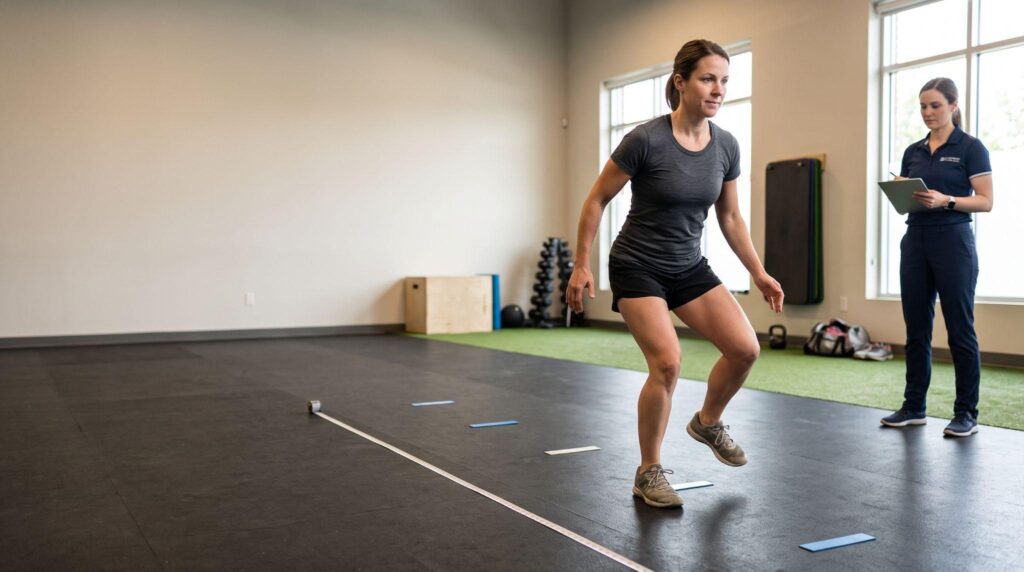
Pain is down, day-to-day movement feels easier and the temptation to jump back into training is strong. For many active adults, that is the point where things start to feel normal again. But feeling better and being ready for unrestricted sport are not always the same thing.
Return-to-sport testing is a structured way to look at whether the body – and the athlete – are prepared for the real demands of training again. That includes more than symptoms. It can involve strength, movement quality, power, endurance, confidence and the ability to tolerate sport-specific tasks without a meaningful setback. In Canada, sport participation remains common among adults: about 55% of people aged 15 and older reported taking part in sport, with activities such as swimming, cycling and running among the most commonly reported.
What Does Return-to-Sport Testing Actually Measure?
Return-to-sport testing is not one universal exam that clears every athlete in the same way. It is a group of assessments chosen according to the body area involved, the type and severity of the injury, whether surgery was involved, the athlete’s previous ability and the specific demands of the sport or activity they want to resume.
In practical terms, the process asks a simple question: can this person tolerate the physical and psychological demands of returning without obvious warning signs that they are underprepared? That may mean evaluating movement, force production, balance, coordination, fatigue response and confidence.
A widely used framework describes a progression from return to participation, to return to sport, to return to performance. Someone may be ready to do modified drills, partial training or reduced-volume sessions before they are ready for unrestricted competition or pre-injury performance. That distinction matters because participating again is not always the same as being fully prepared.
Why Time and Pain Alone Are Not Enough
Time matters in recovery, but it does not tell the whole story. Tissue healing does not automatically mean that speed, coordination, strength, power and confidence have returned to the level an activity requires. Someone can be several weeks or months removed from an injury and still lack the capacity needed for running, cutting, lifting or repeated high-effort training.
Pain has limits as a readiness measure too. Symptoms often improve before strength and control fully return. Reduced training during recovery can also lower conditioning, which means fatigue may appear sooner and expose problems that are not obvious when the athlete is fresh. Protective movement patterns may linger even after everyday life feels normal, and fear of reinjury can change how someone moves or reacts under pressure.
The demands of sport matter as well. The same ankle, knee or shoulder may cope well with cycling but struggle with basketball, hockey or sprinting. Pain is one useful piece of information, but treating pain-free movement as the only sign of readiness can miss important gaps in function and tolerance.
The Main Areas a Return-to-Sport Assessment Should Cover
Symptoms and Medical Safety
A return-to-sport assessment should begin with the current clinical picture. That includes whether pain is settling, whether swelling is controlled, whether there is a sense of instability and whether there are neurological symptoms such as numbness, tingling or unusual weakness. It also helps to look at how the body responds not only during activity, but in the 24 hours afterward. A session that feels manageable in the moment may still be too aggressive if it leads to a pronounced flare-up later that day or the following morning.
This is also where general advice reaches its limit. Post-operative injuries, suspected concussions and more serious injuries need the appropriate medical pathway rather than self-testing. Concussion return requires a staged process with medical oversight because symptom changes, cognitive load and risk factors are different from a typical musculoskeletal strain or sprain. PubMed
Mobility and Range of Motion
Mobility matters, but not in a simplistic “more is always better” way. An athlete needs enough usable movement for the demands of their activity, and that movement needs to be controlled. A runner may need smooth hip and ankle motion over repeated strides. A hockey player may need enough rotation, depth and edge control to tolerate skating mechanics. A lifter may need the mobility to reach sound positions under load without obvious compensation.
Comparison can be helpful, but it must be interpreted carefully. Previous ability is often a better benchmark than a generic flexibility standard, and the opposite side can offer useful context, though it is not always a perfect reference. Some people naturally have side-to-side differences, and a sport itself may create asymmetry over time. The goal is not perfect symmetry at all costs. The goal is functional movement that matches the athlete’s needs.
Strength, Power and Muscular Endurance
These qualities are related, but they are not interchangeable. Strength is the ability to produce force. Power is the ability to produce force quickly. Muscular endurance is the ability to repeat an effort without excessive decline. An athlete returning after injury may appear fine in one of those areas and still be underprepared in another.
A runner may need enough endurance and lower-limb control to tolerate repeated impact over time. A hockey or soccer player may need strength and power for starts, stops and contact. A weightlifter may need high force output with sound technique under load. A cyclist may rely heavily on repeated force production and fatigue resistance. If assessment focuses on one quality alone, it can miss the way sport actually stresses the body.
This is one reason universal symmetry targets can be misleading in public-facing advice. Different injuries and sports require different benchmarks, and testing is most useful when it reflects the athlete’s real performance demands rather than a single number applied to everyone.
Balance and Movement Control
Balance and movement control are often where hidden deficits show up. Someone may have decent isolated strength and still struggle with single-leg control, landing mechanics, trunk position or the ability to react cleanly to a change in direction. Those issues do not always appear during slow, predictable tasks.
Sport is rarely predictable. A clinic-based movement test may happen on a flat surface, at a planned speed and without the distractions or fatigue that come with real competition. That does not make it useless – it just means the results need context. A person can perform well in a controlled environment and still need more progression before their body is ready for the uncertainty of field, court or gym settings.
For that reason, movement quality matters as much as task completion. Getting through a drill is not the same as doing it with confidence, coordination and acceptable control.
Sport-Specific Movement
The final stages of recovery should look increasingly similar to the athlete’s actual activity. General rehabilitation is important, but eventually the body has to show that it can tolerate the specific movement patterns, speeds and decisions required in training.
That may include acceleration and controlled deceleration, jumping and landing, repeated changes of direction, upper-body contact tolerance, overhead work, rotation or sustained repetitive loading. A runner may need to tolerate pace changes and uneven terrain. A field-sport athlete may need to react under fatigue. A gym-based athlete may need to control technique as load and speed increase.
When progress stalls or the demands of a sport are difficult to reproduce independently, a provider experienced in sports injury rehabilitation in Toronto can help translate those demands into measurable progression criteria.
This is also where modified participation can be useful. Someone may return first to warm-ups, selected drills or reduced-contact practice before full training and competition. That stepwise process is often more informative than one all-or-nothing decision.
Psychological Readiness
Physical recovery is only part of the picture. An athlete can appear physically capable and still hesitate because of fear of reinjury, loss of trust in the injured area or uncertainty about how the body will respond under pressure. That hesitation can affect movement, decision-making and willingness to load the body fully.
Psychological readiness does not mean pretending there is no concern. It means recognizing that confidence is part of performance and part of safety. If someone is consistently bracing, avoiding certain movements or second-guessing themselves, that can influence how they train and how much force or speed they are willing to express.
This is especially relevant in activities that involve quick reactions, body contact, heavy loading or high-speed transitions. A return-to-sport plan is usually stronger when it addresses both measurable physical capacity and the athlete’s confidence in using it.
How Training Should Be Reintroduced
Even when testing is going well, a full return usually works best as a progression rather than an instant jump back to previous volume or intensity. A person may begin with shorter sessions, lower loads, fewer exposures per week or modified drills before building toward full participation.
Reintroduction should also reflect the actual activity. Someone returning to distance running may progress differently from someone returning to hockey, CrossFit, recreational soccer or strength training. Volume, speed, impact, external load, directional change and fatigue exposure all matter. The next-day response matters too. If symptoms, swelling, limping or loss of movement increase meaningfully afterward, that is useful feedback that the current demand may be too high.
A well-managed return is not passive, but it is also not reckless. The goal is to build enough capacity that training can resume consistently rather than relying on one good session as proof that everything is back to normal.
When a Professional Assessment May Be Appropriate
General guidance can help people understand the process, but it cannot replace an individualized assessment. Professional input may be especially useful when someone has ongoing pain, recurrent setbacks, uncertainty about what is safe to resume or difficulty matching rehabilitation to the demands of their sport.
Assessment is also particularly relevant after surgery, after a more significant ligament or tendon injury, after fracture, or when concussion is part of the picture. In those cases, return-to-sport decisions often involve more than simple symptom improvement. They may require condition-specific precautions, staged progression and clearer criteria for what comes next.
Coaches and personal trainers can play an important role in supporting graded return, but persistent warning signs, medical uncertainty or repeated flare-ups deserve qualified clinical review.
FAQs
What is the difference between being pain-free and being ready for sport?
Pain-free movement is helpful, but it does not guarantee that strength, power, conditioning, balance and confidence are fully restored. Someone may feel fine during basic activity and still be underprepared for sprinting, cutting, jumping, heavy lifting or repeated training loads.
Can I test myself at home to know if I am ready?
General self-monitoring can be useful, especially for tracking symptoms, confidence and response to gradually increased activity. But return-to-sport testing is usually more reliable when it considers the injury, sport and performance demands in a structured way rather than relying on a single home test.
Why does fatigue matter in return-to-sport decisions?
Fatigue can expose control problems, compensation patterns and reduced capacity that may not be obvious when the athlete is fresh. That matters because many injuries become more likely to flare up when technique or body position breaks down later in a session.
Does every athlete need the same tests?
No. Testing should be selected based on the body area involved, the nature of the injury, whether surgery occurred, the person’s previous level and the demands of the activity they want to return to. A runner, cyclist, hockey player and recreational lifter may all need different types of assessment.
When should someone avoid self-directed return and get assessed?
That is more important when symptoms are worsening, swelling or instability is increasing, progress keeps stalling, the injury was serious, surgery was involved or concussion is suspected. Those situations usually need more individualized guidance.
Medical disclaimer: This article provides general information only and does not replace assessment, diagnosis or treatment advice from a qualified healthcare professional.
Return-to-sport testing is most useful when it is treated as a process, not a single pass-or-fail moment. The more closely the assessment reflects the real demands of the activity – and the way the athlete responds to them – the better the return plan tends to be.