
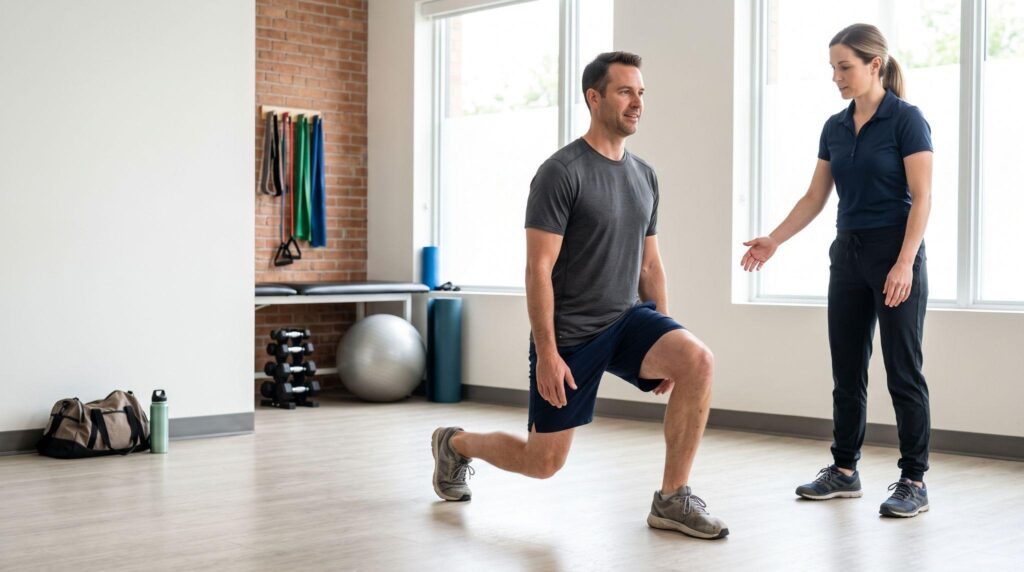
Getting back to exercise after an injury can feel deceptively simple. Pain may be easing, daily tasks may be getting easier and the urge to return to the gym, the road or the court can come back quickly. But feeling better is not always the same as being ready for previous training loads.
Two common mistakes tend to slow recovery: jumping back in at full intensity too soon, or avoiding movement longer than necessary out of caution. A safer return is usually not one decision made on a single day. It is a progression based on how the body is moving, how symptoms respond, how much strength and control have returned and how confident the person feels during activity. Recovery timelines also vary widely depending on the type of injury, its severity and the demands of the activity someone wants to resume.
What does “ready to exercise again” actually mean?
Being ready to exercise again usually means more than simply having less pain while resting. Many people feel improved during everyday life before the injured area is ready for the stress of running, lifting, jumping or sport. Readiness is better judged by function than by the calendar alone.
In practical terms, several signs often matter. Pain and swelling should be reasonably controlled. Everyday tasks such as walking, climbing stairs, getting up from a chair or reaching should feel comfortable or close to normal. The injured area should have regained useful range of motion, and strength should be improving rather than feeling obviously limited. Basic movements should also look and feel controlled, without marked favouring, hesitation or loss of balance.
Confidence matters too. If someone still feels guarded or fearful with simple movement, they may not yet be ready for higher-demand exercise. It is also useful to watch what happens later that day and the following day. A session that feels acceptable during exercise but causes a noticeable flare-up afterward may still be too much.
Readiness also depends on the activity itself. Walking comfortably is not the same as being ready for distance running, heavy lifting or a sport that involves quick stops and direction changes.
Why returning too quickly can delay recovery
One reason people return too soon is that symptoms often improve before the recovering tissue has regained its previous capacity. In other words, pain relief can arrive before the body is fully prepared for the loads that exercise places on it.
Problems often arise when someone makes a sudden jump in training volume or intensity. A person may also start compensating without realizing it, shifting stress to another joint or muscle group. In some cases, they return to the same movement pattern or workload that contributed to the original problem. If balance, coordination or movement control have not recovered, higher-demand exercise can become harder to tolerate.
Another trap is assuming that one good workout proves full recovery. Many setbacks happen not during the session itself, but several hours later or the next day. A flare-up does not automatically mean there is new tissue damage, but it is still useful feedback. It often suggests that the current workload, intensity, technique or recovery time needs to be adjusted before progressing further.
A staged return to exercise
This framework is general guidance, not an individual treatment plan. If a physician, physiotherapist or surgeon has given specific instructions, those directions should take priority.
Stage 1 — Clarify the injury and current restrictions
Before returning to exercise, it helps to understand what was injured and whether imaging, bracing, surgery or another form of treatment was required. Someone should also know whether there are current restrictions on weight-bearing, lifting, running, sport participation or impact activity.
This stage is especially important because not all injuries can be managed with the same assumptions. Fractures, dislocations, surgery, concussions and more serious tendon or ligament injuries require condition-specific guidance. It is also important to know which symptoms should prompt reassessment, such as worsening pain, increasing swelling or difficulty using the area normally.
Without that clarity, people can either do too much too soon or become unnecessarily inactive.
Stage 2 — Restore comfortable everyday movement
The next step is usually regaining tolerance for normal daily movement. That may include walking, climbing stairs, sitting and standing, reaching, squatting to a chair or handling light household activities.
The goal here is not athletic performance yet. It is to move usefully and comfortably without a substantial increase in pain, swelling, limping, guarding or compensation. If a person cannot manage basic daily movements well, returning to demanding exercise is likely premature.
This stage also helps rebuild trust in the injured area. A body part that feels stiff, weak or unreliable during ordinary movement will often struggle under faster, heavier or more repetitive demands.
Stage 3 — Rebuild strength, mobility and control
Once basic movement is tolerable, the focus usually shifts to rebuilding the physical qualities needed for exercise. That may include improving range of motion, strength around the injured area, balance, joint control, trunk stability when relevant, movement technique and tolerance for repeated effort.
This matters because exercise is rarely limited by flexibility alone. Stretching may help in some cases, but it is seldom a complete return-to-exercise strategy by itself. Someone may regain motion yet still lack the strength, coordination or endurance needed for safe participation.
This stage is often where differences between activities become more obvious. Returning to recreational walking may require a different standard than returning to deadlifts, tennis, interval running or group classes.
Stage 4 — Reintroduce exercise at reduced demand
When a person is ready to test exercise again, it usually makes sense to lower the demands first. That reduction might involve less weight or resistance, fewer sets and repetitions, slower speed, shorter distance, less impact, reduced workout duration or fewer sessions in a week.
A lighter session can serve as an initial test of tolerance. The point is not to prove toughness. The point is to see how the body responds during the session and afterward. If symptoms stay manageable and movement quality remains solid, demand can be progressed gradually.
There is no single percentage reduction or weekly rule that suits every injury. The right starting point depends on the body area involved, the severity of the injury, the training history of the individual and the demands of the activity they are returning to.
Stage 5 — Add activity-specific demands
General recovery does not automatically prepare someone for their exact activity. A person may feel stronger overall but still be underprepared for the specific speed, impact, coordination or repetition their exercise requires.
For example, a runner may move from walking to walk-jog intervals before returning to continuous running. A weightlifter may spend time refining technique with a lighter load before building back toward heavier efforts. A court-sport athlete may need to restore acceleration, deceleration and directional changes. Someone returning to a group fitness class may need modified movements before completing the full workout as written.
This stage helps close the gap between rehabilitation and real-world exercise demands. It is where confidence and capacity are tested together.
Stage 6 — Return fully while continuing prevention work
Even after the first successful full workout, the process is not necessarily complete. A full return often goes better when people continue working on the habits that supported recovery in the first place.
That may include maintaining appropriate strength, mobility, warm-up and recovery practices while increasing overall workload gradually. It also means paying attention to how the body responds over the next day or two, not just during the workout itself.
A thoughtful return is less about declaring the injury finished and more about continuing to build capacity as training becomes normal again.
How to interpret symptoms during the return
One practical way to think about symptoms is a simple green, yellow and red framework.
Green indicators
- No meaningful increase in pain.
- No new swelling.
- Normal or improving movement.
- Good control and confidence.
- Symptoms return to their normal baseline after activity.
These signs suggest that the current level of exercise is being tolerated well and may be appropriate to continue.
Yellow indicators
- Mild stiffness or discomfort.
- Earlier fatigue than expected.
- Minor loss of technique as the session continues.
- Symptoms that last longer than expected after the workout.
Yellow indicators usually suggest caution rather than stopping altogether. They often mean the workload should be reduced, the movement should be modified or more recovery time is needed before the next session.
Red indicators
- Sharp or worsening pain.
- New or increasing swelling.
- A noticeable loss of movement or strength.
- Inability to bear weight normally.
- Symptoms become progressively worse with each session.
These signs suggest the aggravating activity should stop for now and that appropriate professional guidance is warranted before progressing.
Why professional assessment can be valuable
A professional assessment can help because returning to exercise is not only about the painful spot. A physiotherapist may look at mobility, strength, balance, movement patterns, the demands of a person’s activity and the goals they are trying to return to. That broader view can help identify what has recovered, what still needs work and what type of progression makes sense.
People recovering from an injury can explore physiotherapy in Langley when they need an individualized assessment and guidance for returning to activity.
That kind of guidance can help determine an appropriate starting point, identify movements that need temporary modification, select exercises suited to the injury, progress workload safely and prepare for the demands of work, recreation or sport. It can also help identify when further medical assessment may be appropriate. Physiotherapy does not guarantee faster healing or prevent every recurrence, but it can provide a more individualized framework than guesswork alone.
Common return-to-exercise mistakes
1. Returning at the previous intensity immediately
Tolerance usually needs to be rebuilt. Going straight back to old loads, distances or workout volume can exceed what the recovering area is ready to handle.
2. Using pain as the only readiness test
Pain matters, but so do strength, movement quality, control and confidence. Someone can have less pain and still be underprepared for exercise demands.
3. Following a generic online rehabilitation program
Similar symptoms can come from different problems and may come with different restrictions. A general program may not match the stage or type of recovery involved.
4. Doing only stretching
Flexibility may be one piece of recovery, but many people also need strength, balance, coordination and tolerance for repeated loading.
5. Ignoring the following day’s response
Delayed symptoms can reveal that a session was too demanding even if it felt acceptable at the time.
6. Skipping rest and recovery
Sleep, recovery days and reasonable workload management still matter while the body is adapting again.
7. Letting fear prevent all movement
Avoiding every uncomfortable movement for too long can make returning harder. Graded, appropriate activity often helps rebuild confidence alongside function.
When should someone seek an assessment before exercising?
An assessment is especially worth considering when pain is severe, sharp or getting worse, when swelling or bruising is substantial or increasing or when someone cannot bear weight or use the area normally. Professional input is also sensible when movement or strength has noticeably declined, when the injury follows significant trauma or when symptoms are not improving as expected.
It is also important to seek guidance before returning after surgery, fracture, dislocation or a significant tendon or ligament injury. In those situations, specific restrictions and timelines may apply. Assessment can also help when the person is simply unsure which activities are safe to resume and which still need to wait.
FAQs
1. How soon can I exercise after an injury?
There is no single timeline that applies to every injury. Readiness depends on the type of injury, its severity, the demands of the activity and how your body responds to movement. Many people are ready for some level of activity before they are ready for full training, which is why a gradual, function-based return is usually safer than relying on the calendar alone.
2. Is it normal to feel sore when returning to exercise?
Mild soreness, stiffness or fatigue can be normal when activity is reintroduced, especially after time away from training. What matters is whether symptoms settle back to baseline and whether movement stays controlled. Sharp pain, increasing swelling or symptoms that worsen from session to session are signs that the workload may be too high and should be reassessed.
3. Should I stop exercising completely until I feel 100% better?
Not always. In many cases, avoiding all movement for too long can make it harder to rebuild strength, mobility and confidence. A better approach is often to modify activity so the body can tolerate it, while avoiding exercises or workloads that clearly aggravate symptoms. The right amount of activity will vary depending on the injury and any medical restrictions.
4. When is physiotherapy helpful during recovery?
Physiotherapy can be helpful when you are unsure whether you are ready to return, when symptoms are not improving as expected or when you need a plan for rebuilding strength, movement and exercise tolerance. It can also be useful after a more significant injury, such as surgery, fracture, dislocation or a major tendon or ligament injury, when the return-to-exercise process may need closer guidance.
This article provides general information and does not replace an individual assessment or treatment advice from a qualified healthcare professional.
Conclusion: Build capacity before rebuilding intensity
Returning to exercise safely after an injury is usually less about waiting for an arbitrary number of days and more about rebuilding function, tolerance and confidence. A sensible progression often moves from comfortable everyday movement to improved strength and control, then toward reduced-demand exercise and finally activity-specific training.
When symptoms persist, the injury is more significant or the next step feels unclear, professional guidance can be useful. Steady progress tends to be more durable than rushed progress, and a measured return can help people get back to activity with greater confidence.
The general principles above align with NHS and AAOS guidance that recovery timelines vary, that strenuous activity may need to be delayed depending on the injury and that a structured conditioning approach supports return to activity.