
Most golfers who are chasing more distance start in the wrong place. They test a new driver, switch balls, or tinker with their grip, hoping the extra yards are hiding somewhere in their equipment. Sometimes they are. More often, the ceiling is physical. The clubhead can only move as fast as the body swinging it, and a body that cannot produce force quickly will always leave distance behind.
Why Power Starts in Your Body, Not Your Equipment
The golf swing is a sequence, not a single motion. Force starts at the ground, travels up through the legs and hips, gets amplified by the rotation of the trunk, and finally releases through the arms and into the club. Break any link in that chain, and speed leaks out before it ever reaches the ball.
This is why the strongest, most explosive golfers tend to be the fastest ones. A meta-analysis of the physical traits linked to clubhead speed found that measures like vertical jump height and isometric mid-thigh pull force show consistent associations with how fast a golfer swings. In simple terms, the players who can push hardest into the ground and rotate fastest are usually the ones who hit the ball the farthest.
As a general guideline, every extra mile per hour of clubhead speed adds about two to three yards of driver carry, which is why speed is the metric that serious golfers keep coming back to. There is an equipment factor to consider as well, and it is worth understanding before you spend money on new gear. As you get stronger and your swing speed increases, your clubs begin to behave differently in your hands.
A faster swing loads the shaft with more force, and a regular flex that felt perfect last season can start to feel whippy and unpredictable once you add eight or ten mph. That is why golfers who make real speed gains often end up revisiting their driver setup. It is also why specialist retailers such as Next2NewGolf organise their drivers and shafts by flex rather than by brand alone. The right flex for your current swing is what keeps new power translating into straighter, longer shots instead of wilder ones.
The Muscles That Actually Create Clubhead Speed
Before picking exercises, it helps to know which muscles are doing the work. Power in the swing does not come from one place. It is produced and passed along by several groups working in a set order:
- Glutes and legs generate the initial ground force and stabilise the lower body as you rotate.
- Core and obliques transfer that force from the lower body to the upper body and control how fast the trunk rotates.
- Lats and shoulders connect the arms to the torso and help deliver the club through impact.
- Forearms and grip hold everything together and influence how efficiently speed reaches the clubhead.
Train only your arms, or only your core, and you build one fast link attached to slow ones. The point of golf strength training is to develop a chain that moves well as a single unit, because that is how the swing actually works.
The Best Exercises to Build Real Swing Power
The most effective golf exercises are not the ones that make you look strong in the mirror. They are the ones that build force you can produce quickly and rotational power you can control. In one eight-week study of collegiate golfers, a program that combined heavy barbell lifts with rotational and power movements produced measurable gains in clubhead speed. That mix is a useful template, and the categories below cover the movements that matter most.
Rotational Power
Golf is a rotational sport, so rotational power sits at the centre of any serious program. These movements train the trunk to accelerate and decelerate quickly, which is exactly what happens in the downswing.
- Cable or band rotations: Stand side-on to a cable stack or anchored band, rotate through the torso, and return under control. Fast and explosive on the way out, slow and controlled on the way back.
- Medicine ball rotational throws: Throw a medicine ball into a wall with a rotational motion that mimics the swing. This is one of the few gym movements that trains rotation at genuinely high speed.
- Landmine rotations: Hold the end of a barbell anchored in a landmine and swing it across your body, building power through a similar arc to your swing.
Start light and prioritise speed of movement over load. Rotational power is about how fast you can move, not how much weight you can grind through.
Ground Force and Leg Drive
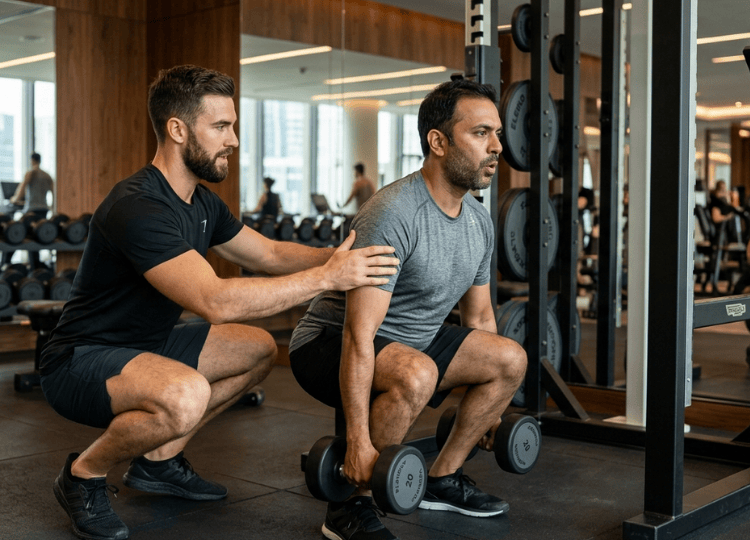
Every fast swing pushes hard into the ground, and that push starts in the legs and hips. Building lower-body strength gives you more force to send up the chain, so this is where the biggest, most fundamental strength movements earn their place.
- Deadlifts and Romanian deadlifts: These build the posterior chain of glutes, hamstrings, and lower back that drives hip extension in the swing.
- Single-leg Romanian deadlifts: A single-leg version adds the balance and one-sided strength that matter in a movement where your weight shifts from one side to the other.
- Squats and step-ups: Straightforward leg strength that underpins your ability to push into the ground and stay stable while you rotate.
You do not need to lift like a powerlifter. You need enough strength that producing force through your legs feels so easy and quick that it happens fast.
Explosive Jumps
Jump training is one of the most direct ways to build the fast, ground-based power that vertical jump testing keeps linking to clubhead speed. Jumps teach the legs and hips to fire quickly, which is the exact quality the downswing demands.
- Countermovement jumps: Dip down and jump as high as you can, landing softly. A clean, simple way to train explosive leg drive.
- Box jumps: Jump onto a sturdy box or platform. The height gives you a clear target and keeps landings a little easier on the joints.
- Broad jumps: Jump forward for distance instead of height, training the horizontal power that carries over to the shift and push of the swing.
Keep the volume low and the effort high. A handful of crisp, maximal jumps does far more than dozens of tired ones.
Anti-Rotation Core
Here is the part most golfers get backwards. The core’s main job in the swing is to resist rotation as much as to create it, staying stable so the force from your lower body transfers cleanly instead of leaking out through a soft midsection. Anti-rotation training builds exactly that.
- Pallof press: Press a cable or band straight out from your chest while it tries to twist you sideways. Your core works to keep you square. Simple and effective.
- The stir-the-pot exercise: A plank variation on a stability ball where you make small circles with your forearms, forcing your core to resist movement in every direction at once.
- Suitcase carries: Walk while holding a heavy weight in one hand. The load tries to pull you over, and your core resists, building the same stability that anchors your swing.
A strong, stable core is what allows a fast lower body to actually produce a fast clubhead.
Grip and Forearm Strength
It is easy to overlook the hands, but grip strength affects how efficiently the speed you generate reaches the club. A weak grip makes you hold on tighter, which adds tension and quietly slows the swing.
- Farmer’s carries: Walk while holding heavy dumbbells or kettlebells. It’s one of the best grip builders there is, and it works the whole body too.
- Plate pinches: Pinch weight plates together and hold for time. This targets the exact pinching grip you use on the club.
You do not need a crushing grip, just enough that holding the club never becomes the thing holding you back.
How to Structure a Golf Strength Routine
Knowing the exercises is one thing. Putting them into a routine that fits around your golf is another. A few principles keep this simple.
Train two to three times a week, with at least a day between sessions, so you actually recover. Each session can follow the same rough shape: one or two heavy strength movements such as a deadlift or squat variation, one or two rotational power movements, and one anti-rotation core movement. That covers the whole chain without turning your training into a second job.
Prioritise power over fatigue. You are training to move fast, not to feel wrecked. Keep reps low on the power movements, around three to five explosive reps per set, and stop well before your form falls apart. Grinding out slow, exhausted reps develops the wrong adaptations for a sport that rewards speed.
Be realistic about the timeline. A systematic review of strength and conditioning programs for golfers found average gains in clubhead speed, ball speed, and distance of roughly four to 6.4 percent when the programs worked. That might not sound dramatic, but on a 250-yard tee shot, it adds another ten to fifteen yards, and the gains carry through the rest of the bag. Give it eight to twelve weeks of consistent work before you judge the results.
Do Not Trade Your Swing for Muscle
One worry comes up constantly: will lifting make me stiff and wreck my swing? Done sensibly, no. The golfers who lose mobility from training are usually the ones who only ever lift heavy through short ranges and never move through a full, swing-like range of motion.
The fix is to keep mobility work in the mix alongside the strength work. Full-range squats, Romanian deadlifts through a complete stretch, and rotational movements all build strength and range at the same time. Strength and flexibility are not opponents. The most powerful swings belong to golfers who have both, and the fastest players tend to be those who move well, not those who simply lift the most.
Bringing It Together
Real distance is not something you buy. It is something you build, one session at a time, in the muscles that drive rotation and push against the ground. Get strong through the legs and hips, learn to rotate fast, and develop a core that transfers that force cleanly, and the extra yards start to show up on their own. The best equipment in the world cannot outswing a body that is not ready to use it.