
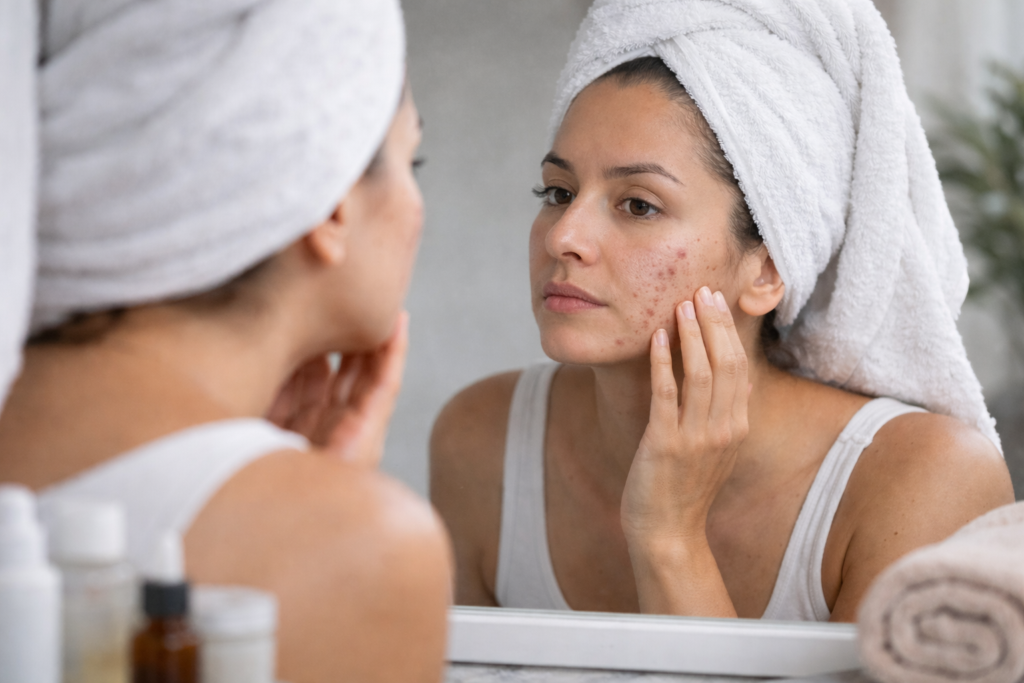
Many people hope acne scars fade with time, but it often does not happen the way they expect. The spots may stop being red, yet the skin can still look uneven months or even years later.
That is because acne can damage deeper layers of skin, not just the surface. When the inflammation is strong, it can break down the skin’s support structure.
It also explains why some marks go away and others do not. Two people can have acne in the same area, but heal in completely different ways.
In this article, we will explain how inflammation changes skin, why collagen loss is hard to fix, and when natural repair reaches its limit.
How Inflammation Alters Skin Structure
When acne is angry and swollen, the damage is not just on the surface. Even after the redness goes down, the skin underneath may have been stretched, broken down, or rebuilt in a less smooth way.
Here are 5 different ways this kind of skin stress can shift how your skin is built and how it heals.
1. Collagen Weakens Under Prolonged Skin Stress
Collagen is what gives skin its shape and bounce. When a spot is sore and swollen for a long time, the skin’s support can get damaged. Your body tries to patch it up, but it may not rebuild the same way as before.
That is why acne scars fade slowly. The surface can look calm, but the skin underneath may still be missing support.
2. Normal Repair Processes Get Thrown Off Balance
Healthy skin heals in a neat order: calm down, close the area, then rebuild. With acne, that order gets messy because the skin is fighting bacteria, oil, and swelling at the same time.
So the repair can be rushed, uneven, or incomplete. You might see a flat mark fade, but the texture does not always return to normal.
3. Skin Tissue Can Collapse in Damaged Areas
Deep spots can hurt the skin under the surface, not just the top layer you can see. When that deeper layer is damaged, the skin loses some of its “padding” and support.
After the swelling goes down, the area may not fill back in fully. So instead of healing flat, it can leave a small dip or uneven patch that stays put.
4. Healing Happens Unevenly Across the Affected Area
Skin does not heal like a printer that fills everything in evenly. One part may rebuild a bit too much, while another part does not rebuild enough.
That is why you can get a mix of texture changes in the same cheek, even from one breakout. It can also make acne scars fade at different speeds, so some spots improve while others hardly change.
5. Repeated Breakouts Compound Structural Damage
Each breakout is like a small hit to the same area of skin. If new spots keep forming before the skin has fully settled, the damage can stack up.
The skin stays in “repair mode” for longer, and the support layer can get weaker over time. That is why acne that comes back in the same zones often leads to deeper texture changes.
Why Collagen Loss Is Difficult to Reverse
When people hear “collagen loss”, they often picture a simple fix, like the skin just needs time to fill back in. But collagen is not like water you can pour back into a dent.
Once it has been broken down, your body can rebuild it, but it tends to rebuild slowly and not always in the exact same pattern as before.
There are a few reasons this is hard:
- Collagen production slows as we get older, so healing takes longer
- Acne damage often happens in the deeper layer, which is slower to repair
- If the skin is still breaking out, it keeps interrupting the healing process
- The body focuses on closing and calming the area first, not restoring perfect texture
Another thing people do not realise is that collagen repair is not a straight line. Some weeks your skin looks better, then it looks the same again. That is normal. The surface can improve before the deeper support catches up, which is why acne scars fade in colour faster than they fade in texture.
This is also why “DIY fixes” can be disappointing. Creams can help with dryness, pigment, and barrier health, but they cannot easily rebuild lost support tissue on their own.
For dents, pits, and deeper uneven texture, the skin often needs a stronger push to remodelling, and that usually takes more than one session and more than one month.
The goal is not instant change. It is steady change, with realistic expectations.
Acne Marks Versus True Scars
A lot of people use the word “scar” to describe any leftover sign of acne. But there is a big difference between a mark that fades and a true scar that changes the skin’s shape.
Here’s a close look at the difference between acne marks and true scars, so you can tell what you’re dealing with.
| Acne Marks | True Scars |
| Mainly a colour change on the skin (red, pink, brown, or darker patches). | A texture change in the skin (dents, pits, raised areas, or uneven surface). |
| Often fade over time, even without treatment, but it can take months. | Do not fully disappear on their own, and usually need targeted treatments to improve. |
| Skin feels mostly smooth when you run your fingers over it. | Skin feels uneven, rough, or indented when you touch it. |
| Can look worse after sun exposure if not protected. | Can look more obvious under certain lighting, especially side lighting. |
| Common after mild acne or spots that were picked. | More common after deep, inflamed acne like cysts or nodules. |
| Improves with skincare that supports the skin barrier and reduces pigment. | Improves with treatments that trigger collagen remodelling and rebuild support. |
| Usually changes faster in colour than in texture. | Texture changes slowly, often over months, even with treatment. |
Why Time Alone Does Not Restore Texture
It makes sense to hope your skin will level out if you just give it enough time. For many people, the redness or brown marks do fade slowly as the skin calms down and renews itself.
But dents and uneven texture are a different story. Time alone rarely changes texture once acne scars form within deeper layers of skin. That deeper layer is where the skin’s support sits, and once it has been damaged, the body does not always rebuild it back to the same shape.
This is why your skin can look clearer, yet the scars still show up in bright light or from the side. You might feel smoother in some spots, while other areas stay pitted no matter how long you wait.
If texture is the main issue, it usually needs more than patience. It needs the right kind of support to encourage stronger, more even repair.
When Skin Repair Reaches Its Limit
Skin is good at fixing small injuries, but it is not designed to rebuild perfect texture after deeper damage. Once acne has injured the support layer, your body will still try to heal it, but it often “settles” into a new normal.
That is when people feel stuck, like the scars look the same no matter what moisturiser, serum, or home remedy they try.
A few signs your skin has reached that limit include:
- The skin tone looks better, but the dents or uneven texture stay the same
- The scars look worse under side lighting, even when your skin feels smooth after skincare
- You have waited many months with little change in texture
- Breakouts have stopped, yet the pitted areas still do not lift
This does not mean improvement is impossible. It just means the body may not do the heavy lifting on its own anymore. At that point, real texture change usually comes from methods that trigger deeper remodelling, so the skin starts laying down new support in a more organised way.
It also helps to be realistic. Many treatments aim for visible improvement, not total erasing. For most people, the best results come from matching the right approach to the scar type, protecting the skin barrier, and giving the skin enough time between sessions to rebuild properly.
Conclusion
Acne scars can be slow to change because they are not just “leftover colour”. They are often a change in the skin’s structure.
Marks usually fade with time, but dents and uneven texture often do not. That is why acne scars fade unevenly, even when your skin looks calmer overall.
If you are not seeing change after months, it is not because you are doing something wrong. It often means the skin has healed as much as it can on its own.
The best next step is getting clear on what you have, then choosing options that match your scar type and your comfort level.