
Ten years ago, what you wore to the gym barely mattered.
You threw on something old, something stretched, something you would not be seen dead in outside of that one very specific environment. The gym was functional. Anonymous. A place you went to do the work and leave.
That is not what it is anymore.
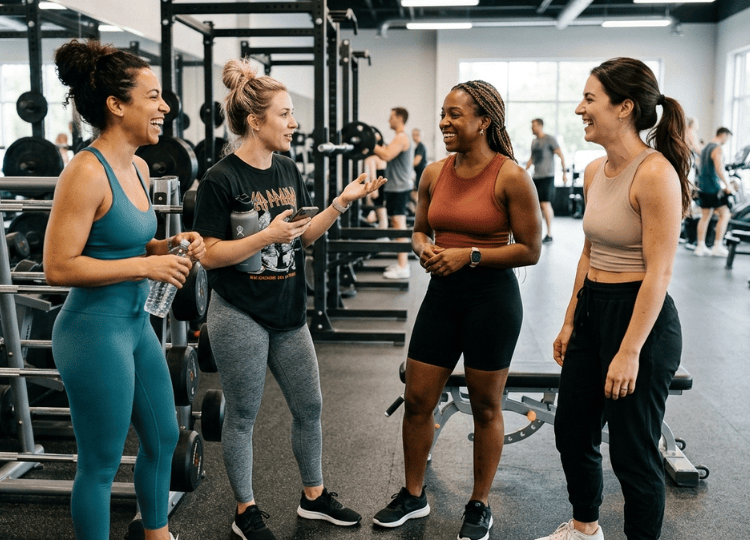
Walk into almost any well-equipped gym now and you will notice it immediately. The mirrors are not just for checking form. The outfits are coordinated. The lighting is being used deliberately. People are not just training. They are present.
The gym has quietly become one of the most important social environments in modern life.
Not in the obvious, loud, nightclub way. But in a more subtle, curated, slightly performative way that sits somewhere between self-improvement and self-expression.
And fashion has followed it there.
The Shift From Functional to Intentional
Gym wear used to be about comfort and durability.
Now it is about identity.
Matching sets, flared leggings, oversized hoodies, cropped layers, clean trainers that have never seen an actual run outside. There is a clear aesthetic language developing, and people are fluent in it.
For women in particular, the shift has been faster and more visible.
Brands have moved from basic activewear to full lifestyle positioning. You are not just buying leggings. You are buying into a version of yourself. Someone who trains, yes, but also someone who has their life together, drinks something green, and somehow makes a 7am session look effortless.
The interesting part is that this is not entirely artificial.
The gym is one of the few places left where self-improvement is happening in real time. You can see effort. You can see progress. You can feel the energy of people trying to get better.
That makes it a naturally attractive place to invest in how you present yourself.
The Gym as a Social Environment
There is a reason more people are meeting partners, friends, and even business contacts through fitness spaces.
It solves a problem that a lot of modern environments struggle with.
There is a shared context.
You already have something in common with everyone in the room. You have all chosen to be there. You are all opting into effort, discomfort, and improvement. That filters people in a way that very few other environments do.
Fashion becomes part of how you navigate that space.
It signals intent.
Turning up in a coordinated outfit says something different to turning up in an old university t-shirt. Neither is wrong. But they communicate different levels of investment in the environment.
And whether people admit it or not, that does get noticed.
The Female Lens on Gym Style
For women, gym fashion sits at an interesting intersection.
It needs to balance performance, comfort, confidence, and increasingly, aesthetics that translate beyond the gym floor.
Leggings are designed to sculpt, support, and photograph well. Sports bras are no longer hidden layers but central pieces. Colour palettes are considered. Neutral tones dominate, but bold sets have their moment.
There is also a growing awareness of practicality.
High impact training demands certain fabrics. Squat-proof materials are non-negotiable. Breathability matters. Fit matters even more.
But alongside all of that, there is a very real social layer.
Outfits are being chosen not just for how they perform, but for how they make someone feel walking into a room full of mirrors and people.
Jewellery in the Gym
This is where things get slightly more nuanced.
As gym environments become more social, people are less likely to strip everything back before training. Jewellery stays on. Rings, necklaces, earrings. Sometimes subtle, sometimes not.
And that raises a practical question.
Should you actually be wearing expensive jewellery while you train?
On paper, diamonds are one of the hardest materials available. They are incredibly resistant to scratching and general wear. From a purely physical standpoint, they can handle more than most other gemstones.
But that is not really the issue.
The issue is risk.
A crowded gym floor, weights moving around, chalk, sweat, changing rooms, distractions. It is not a controlled environment. Losing something valuable becomes far more likely than damaging it.
This becomes even more relevant when you consider pieces that fall into the category of rarest diamonds colors. These are not everyday items. They are often irreplaceable, both financially and sentimentally.
Wearing them into an environment where you are focused on a set of Bulgarian split squats is, at best, unnecessary.
At worst, it is careless.
A more practical approach is to treat gym style the same way you treat training itself.
You optimise for the environment you are in.
That might mean switching to simpler pieces. Durable metals. Lower-cost gemstones. Or removing jewellery entirely for certain sessions.
There are plenty of alternatives that maintain the aesthetic without carrying the same level of risk. Lab-grown stones, coloured gems, or even well-designed costume pieces can replicate the look without the stress.
The goal is not to strip away style.
It is to apply it intelligently.
Men Are Catching Up, Slowly
Men’s gym fashion has traditionally lagged behind.
Loose t-shirts, generic shorts, whatever trainers are available. Functional, but not particularly considered.
That is starting to change.
You are seeing more attention to fit. Slightly shorter shorts. Tapered joggers. Layering with lightweight jackets or hoodies. Neutral colour palettes that actually match.
It is not at the same level of detail as women’s gym fashion, but the direction is clear.
Men are becoming more aware that how they present themselves in the gym is part of the overall experience.
Not in a try-hard way.
But in a way that reflects a broader shift toward self-awareness and presentation.
Social Media Has Accelerated Everything
It would be difficult to talk about this shift without acknowledging the role of social media.
Platforms have turned the gym into content.
Workouts are filmed. Outfits are shared. Progress is documented. Entire brands are built around a specific look and feel inside a gym environment.
This has created a feedback loop.
People see a certain standard, consciously or not, and begin to move toward it. Brands respond by refining their offerings. The overall level of presentation increases.
The danger, as always, is comparison.
Not every session needs to be documented. Not every outfit needs to be perfect. The gym still needs to function as a place where you can train without pressure.
But there is no denying that the visual side of fitness has become part of the culture.
Performance Still Comes First
It is worth saying this clearly.
The best gym outfit in the world does not compensate for poor training.
If your leggings look great but restrict your movement, they are the wrong leggings. If your top distracts you during a session, it is not doing its job. If you are adjusting your outfit more than focusing on your sets, something has gone wrong.
Fashion should support performance.
Not compete with it.
The people who get this balance right tend to look the best anyway. Not because of what they are wearing, but because of how they move in it.
Where This Is Going
Gym fashion is not slowing down.
If anything, it is becoming more refined.
You will see more crossover between activewear and everyday clothing. Pieces that move seamlessly from a workout to a coffee shop. Fabrics that combine performance with comfort in a way that makes traditional clothing feel outdated.
You will also see more personalisation.
People are becoming more selective. Less interested in obvious branding, more interested in fit, feel, and subtle differentiation.
And the social aspect will continue to grow.
The gym is no longer just a place to train. It is a place to exist, to interact, to be seen if you choose to be.
Bottom Line
Gym fashion is not really about clothes.
It is about context.
As gyms have evolved into social environments, what you wear has naturally become part of the experience. For women especially, this has driven a shift toward more intentional, considered outfits that balance performance with presentation.
There is nothing inherently negative about that.
Wanting to feel confident in a space where you are pushing yourself physically makes sense.
The key is not to lose sight of why you are there.
Train well. Choose clothing that supports that. Be smart about things like jewellery, especially anything valuable or irreplaceable. There is a time and place for everything, and a heavy set of deadlifts is not always the right one.