

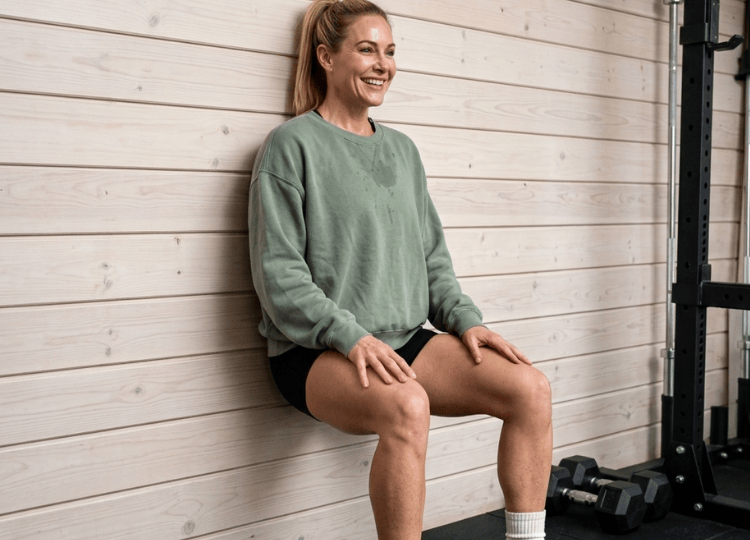
The wall sit is one of those exercises that looks deceptively simple. You slide your back down a wall, bend your knees to 90 degrees, and hold. No equipment, no movement, no technique to learn.
But what it reveals is more useful than most people realise. A timed wall sit gives you an honest, no-equipment snapshot of your isometric lower body strength, and as an exercise, the research behind it is genuinely compelling, particularly for blood pressure and long-term leg strength.
This guide covers exactly how long you should be able to hold a wall sit by age and gender, what your time actually means, and how to improve it from wherever you are starting.
First Thing’s First – How to Actually Perform the Wall Sit Properly
Stand with your back flat against a smooth wall. Walk your feet forward and slide down until your knees are at a 90 degree angle, as though you are sitting in an invisible chair. Your thighs should be parallel to the floor, your back flat against the wall, and your feet roughly shoulder-width apart with heels flat on the ground. Keep your arms either folded across your chest or resting on your thighs.
Do not rest your hands on your knees.
Start a timer when you reach the position and stop it the moment your form breaks, your thighs rise above parallel, or you can no longer hold the position.
Coach’s Tip
The most common mistake is setting the feet too close to the wall, which forces the knees forward over the toes and increases the strain on the joint significantly. Your shins should be roughly vertical when viewed from the side. If your knees are tracking well past your toes, walk your feet forward slightly before starting the timer.
Wall Sit Time Chart by Age and Gender
The table below gives three tiers across five age brackets for both men and women. Average reflects a reasonable baseline for someone who exercises moderately. Good reflects a level of lower body endurance that is above average for that age group. Excellent reflects a genuinely strong result that most people in that bracket would not reach without consistent training.
Times are expressed in seconds, with minutes noted where relevant.
Wall Sit Time Average for Women
| Age Group | Average | Good | Excellent |
|---|---|---|---|
| Under 30 | 60 to 90 sec | 90 to 120 sec | 2 min+ |
| 30 to 39 | 50 to 80 sec | 80 to 110 sec | 110 sec+ |
| 40 to 49 | 40 to 65 sec | 65 to 95 sec | 95 sec+ |
| 50 to 59 | 30 to 50 sec | 50 to 80 sec | 80 sec+ |
| 60 and over | 20 to 40 sec | 40 to 65 sec | 65 sec+ |
Wall Sit Time Average for Men
| Age Group | Average | Good | Excellent |
|---|---|---|---|
| Under 30 | 45 to 70 sec | 70 to 100 sec | 100 sec+ |
| 30 to 39 | 40 to 60 sec | 60 to 90 sec | 90 sec+ |
| 40 to 49 | 30 to 55 sec | 55 to 80 sec | 80 sec+ |
| 50 to 59 | 25 to 45 sec | 45 to 70 sec | 70 sec+ |
| 60 and over | 15 to 35 sec | 35 to 55 sec | 55 sec+ |
What the Numbers Tell You
A few things are worth understanding about these benchmarks before drawing conclusions.
Women tend to hold the wall sit longer than men, which may seem counterintuitive but is well supported by the research. A study comparing moderately active men and women found that women averaged 72.9 seconds against men’s average of 46 seconds.
This reflects a broader pattern in exercise science where women demonstrate greater relative muscular endurance than men on isometric holds, largely because they have a higher proportion of fatigue-resistant type I muscle fibres. The wall sit is one of the clearer examples of this difference in practice.
The decline across age groups reflects the well-documented reduction in quadriceps strength and type II muscle fibre density that occurs with age. Research shows that lower limb strength declines by roughly 10 to 15% per decade after the age of 40, with the rate accelerating after 60. Consistently training the wall sit slows this decline meaningfully.
Holding over 60 seconds at any age is a solid result. If you are significantly below the average range for your age group, it is a useful signal that quadriceps endurance is worth prioritising, both for the training benefits and for what it means for your functional fitness over time.
Benefits of Wall Sits
Reduces Blood Pressure
A 2023 meta-analysis published in the British Journal of Sports Medicine analysed 270 randomised controlled trials and found that isometric exercise produced the greatest reductions in resting blood pressure of any exercise modality tested, including aerobic training, HIIT and dynamic resistance training.
The wall sit specifically ranked as the single most effective isometric exercise for reducing systolic blood pressure, with average reductions of 8.24mmHg systolic and 4.00mmHg diastolic. The practical protocol behind these results is straightforward: four sets of two-minute holds with two minutes of rest between each, performed three to five times per week.
The Benefits of Isometric Exercises
Our guide on how long you should be able to hold a plank for also highlights the overall benefits of isometric exercises and why they are worth including in any fitness routine.
Builds Isometric Quadriceps Strength
The wall sit loads the quadriceps in a sustained isometric contraction at roughly 90 degrees of knee flexion, which is the angle of maximum quadriceps demand.
This builds muscular endurance in the quads in a way that dynamic exercises like squats do not replicate, since the muscle has to sustain tension rather than cycle through contractions.
Strong quads are directly linked to reduced fall risk, better knee stability and improved functional independence as you age.
No Equipment and No Space Required
A flat wall and enough room to extend your legs is all that is needed. This makes the wall sit one of the most genuinely accessible exercises available, suitable for home, travel, office or any environment where a traditional workout is not practical.
Useful for Knee Rehabilitation
The wall sit is widely used in physiotherapy and knee rehabilitation programmes because it loads the quadriceps without placing shear force on the knee joint in the way that dynamic squatting can.
For those returning from injury or managing knee discomfort, it provides a safe way to maintain and build lower limb strength. This should always be done under appropriate guidance when injury is involved.
A Reliable Self-Assessment Tool
Unlike many fitness tests that require equipment or a training partner, the wall sit can be performed and timed independently at any point. Testing yourself every few weeks gives a simple, objective measure of whether your lower body endurance is improving, maintaining or declining, which is useful information for adjusting your training accordingly.
This makes it a useful exercise to include in any sort of longevity workout routine.
Things to Consider
Knee angle matters
The 90 degree position is the standard for these benchmarks. A shallower angle, where the thighs are above parallel, is significantly easier and produces a very different result. Make sure the knees are genuinely at 90 degrees before starting the timer for a meaningful comparison against the chart above.
Avoid pushing through sharp knee pain
Mild muscular burning in the thighs is normal and expected during a wall sit. Sharp or pinching pain in or around the knee joint is a different matter and a signal to stop. The wall sit is generally considered joint-friendly, but it is not appropriate for everyone, particularly those with acute knee injuries or significant patellofemoral issues.
Bodyweight affects the result
The wall sit is a bodyweight exercise, meaning heavier individuals are working against a greater load. Two people of the same fitness level but different body weights will likely record different times. Keep this in mind when comparing your result to others rather than just to the chart.
Consistency over single attempts
A single wall sit test on a day when your legs are fresh will produce a different result than one performed after a lower body session. For a fair self-assessment, test consistently under similar conditions, ideally at the start of a session before other leg work.
How to Improve Your Wall Sit Time
- Practice the hold regularly – including two to three wall sit holds of 30 to 60 seconds in your training two to three times per week is the most direct way to improve endurance at the position.
- Build up duration gradually – if 30 seconds is your current limit, aim for 35 seconds next session rather than trying to double it. Small, consistent increments produce reliable progress.
- Strengthen the quads dynamically – squats, leg press, lunges and step-ups all build the underlying quad strength that transfers into longer wall sit times. Dynamic and isometric training complement each other well.
- Use the blood pressure protocol – four sets of two minutes with two minute rests, even if you cannot yet hold two minutes, is a structured way to build both endurance and the cardiovascular benefits simultaneously.
- Single-leg wall sit – once the standard version feels comfortable, progressing to a single-leg wall sit significantly increases the demand and builds unilateral leg strength alongside overall endurance.
Bottom Line
The wall sit is both a practical exercise and a useful self-assessment tool, and the research behind it is more compelling than most people realise. The 2023 British Journal of Sports Medicine meta-analysis confirmed it as the single most effective exercise subtype for reducing systolic blood pressure, which makes it particularly valuable for an over-40s audience for whom cardiovascular health becomes increasingly relevant.
The chart in this article gives a realistic reference point for where you should be at different ages and genders. For most consistently active women under 30, a hold of 60 to 90 seconds represents a solid average. For men in the same age group, 75 to 105 seconds is the comparable benchmark. These figures reduce gradually with age, but consistent training significantly slows that decline at every decade.
Related Articles