

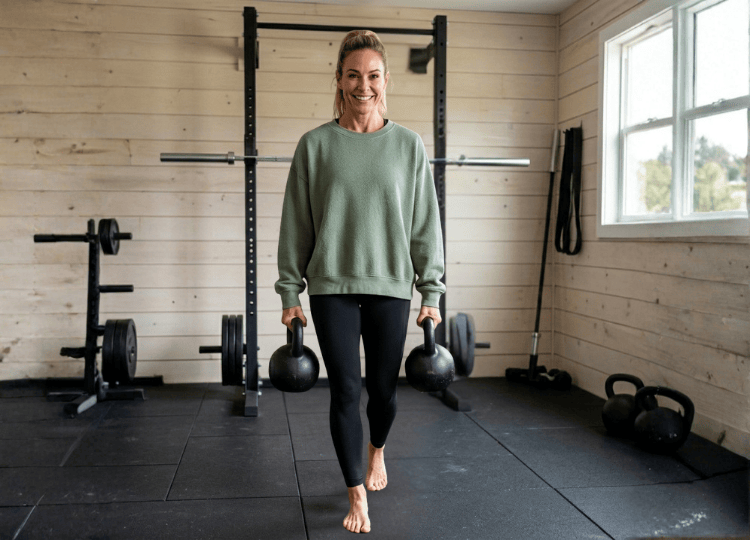
There are exercises that look impressive in the gym, and then there are exercises that actually prepare your body for life.
The farmer’s carry falls firmly into the second category, and the research behind it is more compelling than almost any other movement you could choose.
Pick up a weight in each hand, stand tall, and walk. That is the whole exercise. It requires no technical skill, no specialist equipment and no coaching background to understand.
Yet the physical demand it places on the grip, core, upper back, shoulders and legs simultaneously is considerable, and the evidence linking it to long-term health outcomes is genuinely striking.
This guide covers what a good farmer’s carry weight looks like across different ages and genders, why the exercise matters so much for longevity, how it fits into HYROX for those training for competition, and what to focus on beyond the number on the weight.
What is a Farmer’s Carry?
The farmer’s carry is a loaded carry exercise where you hold a weight in each hand and walk a set distance, keeping the torso upright and the core braced throughout. It is sometimes called a farmer’s walk, and the two terms refer to the same movement.
Farmer’s Carry – TL;DR
The case for the farmer’s carry as a longevity exercise starts with grip strength, and grip strength turns out to be one of the most well-researched biomarkers of long-term health available.
A meta-analysis of 42 studies found that individuals with low grip strength had a 67% higher risk of early death from all causes compared to those with high grip strength. A separate large-scale study found that each 5kg decrease in grip strength was associated with a 16% higher risk of all-cause mortality and a 21% increased risk of cardiovascular mortality, independent of other health factors.
A 2019 review published in Clinical Interventions in Aging concluded that grip strength is an indispensable biomarker for older adults, predicting disability, cognitive decline and mortality risk.
The farmer’s carry is the most direct and practical way to train and test grip strength under load. But grip is only part of the story.
How to Perform the Farmer’s Carry
Stand tall with a weight in each hand, shoulders packed back and down, core braced and chest up. Walk forward with controlled, deliberate steps for your target distance, keeping the weights stable and your posture honest throughout.
A University of Pittsburgh study published in the Journal of Strength and Conditioning Research found that men and women who could carry a meaningful percentage of their bodyweight for a sustained period had lower rates of frailty, higher bone density and a significantly reduced likelihood of developing chronic conditions including cardiovascular disease and Type 2 diabetes.
For every 10% increase in weight held beyond the baseline, the researchers noted a 5% decrease in all-cause mortality risk.
What is a Good Farmer’s Carry Weight?
Unlike the squat or bench press, the farmer’s carry does not have a single rep to test against. Load and distance are intertwined: a heavier carry means a shorter practical distance, and a lighter carry can be sustained for much longer. This is what makes standardising it slightly more complex than other exercises.
For the purposes of the benchmarks in this article, we are using a distance of 30 metres per hand as the standard.
This is long enough to be a genuine test of grip endurance and postural stability, short enough to be practical in most gym environments, and sits in the middle of the 20 to 40 metre range that strength coaches most commonly use for loaded carry training.
It is also a useful distance for repeated sets, which is how most people will include the exercise in their training.
The figures below represent a solid working benchmark for a reasonably trained, active person at each life stage, based on bodyweight-relative standards from the research literature and adjusted for age-related strength decline. They are not elite targets and not absolute beginner numbers. Think of them as a meaningful goal for someone who trains consistently and wants an honest reference point.
All weights are per hand.
Farmer’s Carry Benchmarks for Women – 30 Metres (Per Hand)
| Age Group | Weight (kg) | Weight (lbs) |
|---|---|---|
| Under 30 | 16 to 24kg | 35 to 53lbs |
| 30 to 39 | 14 to 22kg | 31 to 49lbs |
| 40 to 49 | 12 to 20kg | 26 to 44lbs |
| 50 to 59 | 10 to 16kg | 22 to 35lbs |
| 60 and over | 8 to 14kg | 18 to 31lbs |
Farmer’s Carry Benchmarks for Men – 30 Metres (Per Hand)
| Age Group | Weight (kg) | Weight (lbs) |
|---|---|---|
| Under 30 | 24 to 36kg | 53 to 79lbs |
| 30 to 39 | 22 to 32kg | 49 to 71lbs |
| 40 to 49 | 20 to 28kg | 44 to 62lbs |
| 50 to 59 | 16 to 24kg | 35 to 53lbs |
| 60 and over | 12 to 20kg | 26 to 44lbs |
Understanding the Numbers
These benchmarks are grounded in two key reference points from the research.
The University of Pittsburgh longevity study suggests that a meaningful target for men is carrying 50% of bodyweight per hand, and for women, around 37.5% of bodyweight per hand.
The figures in the tables above reflect roughly 30 to 45% of average bodyweight for men and 25 to 35% for women, adjusted down from peak values using the same age-related strength decline rates referenced in the research on sarcopenia, approximately 3 to 8% per decade after 30, with the rate accelerating after 60.
The ranges are intentionally broad because bodyweight, training history and individual grip strength vary considerably between people of the same age. Someone at the lower end of their bracket is not underperforming. They may simply be earlier in their training journey or working at a lighter bodyweight. Someone at the upper end has likely been training loaded carries consistently for a year or more.
A useful long-term goal, regardless of age, is working toward carrying half your own bodyweight per hand over 30 metres with good posture throughout. For a 70kg woman, that is 35kg in each hand. For an 85kg man, 42.5kg in each hand. These are advanced benchmarks that most people will not reach quickly, but they represent a genuine measure of functional strength that the research links directly to better health outcomes.
Programming Ideas
The farmer’s carry works best at the end of a strength session, after compound lifts, to avoid grip fatigue affecting heavier movements like deadlifts or rows. Two to three sets of 30 metres per session, two to three times per week, is a solid starting point for most people.
Muscles Worked
- Grip and Forearms – the primary limiting factor for most people, working continuously to maintain hold on the weight throughout the carry.
- Trapezius and Upper Back – work to keep the shoulders packed and prevent the upper body from rounding under load.
- Core and Obliques – brace throughout to maintain a neutral spine and resist the lateral pull of the weights with each step.
- Glutes and Hamstrings – drive each step and maintain hip extension throughout the movement.
- Quadriceps and Calves – contribute to controlled, stable footfall on every step.
- Cardiovascular System – responds to the sustained loaded effort, elevating heart rate meaningfully and building aerobic capacity under resistance.
Suitcase Carries
Another great variation of the farmer’s carry is the single-arm variation, known as a suitcase carry. Carrying the load in one hand rather than two forces the core to work significantly harder to resist lateral flexion and keep the torso upright, making it a particularly effective anti-rotation exercise alongside the standard carry.
The Farmer’s Carry in HYROX
For those training for HYROX, the farmer’s carry takes on a specific competitive dimension. It is station six in every HYROX race, arriving after six kilometres of running and five functional stations including the SkiErg, sled push, sled pull, burpee broad jumps and rowing. By the time athletes reach the farmer’s carry, both grip and cardiovascular capacity are already under considerable strain.
The HYROX farmer’s carry requires athletes to complete 200 metres with a kettlebell in each hand. The official weights by category are as follows:
- Open Women: 2 x 16kg
- Open Men: 2 x 24kg
- Pro Women: 2 x 24kg
- Pro Men: 2 x 32kg
What makes the HYROX farmer’s carry particularly demanding is not the weight in isolation but the context. Carrying 2 x 24kg for 200 metres in a controlled training environment is manageable for most intermediate gym-goers. Doing it after six kilometres of running and five intense stations is a different challenge entirely, and one that punishes undertrained grip and core stability quickly.
For HYROX athletes, training the farmer’s carry at or slightly above race weight over distances of 100 to 200 metres, ideally after a run or another conditioning piece to replicate race fatigue, is a more specific preparation strategy than simply lifting heavy over short distances.
Benefits of the Farmer’s Carry
Grip Strength is a Biomarker of Longevity
As outlined above, the research on grip strength and long-term health outcomes is among the most consistent in exercise science. The farmer’s carry is the most direct loaded carry exercise for building and testing grip strength in a functional context. For those training with longevity in mind, prioritising it is not optional, it is one of the highest-return investments you can make in your physical health.
Builds Functional Strength That Transfers to Real Life
Carrying heavy loads from one place to another is one of the most common physical tasks humans perform. Shopping, luggage, moving furniture, lifting children. The farmer’s carry trains exactly this pattern under progressive load, building the grip, core and postural strength that makes these tasks easier and safer as you age.
Supports Bone Density
Weight-bearing exercise stimulates bone remodelling and helps maintain bone density. This is particularly relevant for women over 50, for whom the risk of osteoporosis increases significantly after menopause. The farmer’s carry places load through the skeletal system in a way that supports bone health without the spinal compression of a barbell squat or deadlift.
Improves Posture and Gait
Maintaining an upright posture under bilateral load trains the muscles of the lower trapezius, neck and core to resist the forward pull that prolonged sitting and sedentary habits tend to reinforce. Research has found that improved gait mechanics and postural control from loaded carry training translate directly to reduced fall risk in older adults.
Cardiovascular Benefit Without High Impact
The farmer’s carry elevates heart rate and taxes the cardiovascular system meaningfully without the joint impact of running. For those managing knee or hip issues, or simply looking for conditioning work that does not involve repeated impact, loaded carries provide a genuine cardiovascular stimulus that complements rather than competes with lower body training.
Things to Consider
Form matters more than load
The most common error in the farmer’s carry is allowing the shoulders to round and the upper back to collapse as weight increases or fatigue builds. Keep the shoulders packed back and down, the chest tall and the core actively braced throughout. If your posture degrades before the distance is complete, the weight is too heavy.
Start lighter than you think
Most people new to the farmer’s carry are surprised by how quickly grip fatigue accumulates, particularly over longer distances. Starting at the lower end of the benchmark range and building gradually is the right approach. Grip strength takes time to develop and is often the limiting factor long before the legs or core give out.
Distance and load are both variables
Progressing the farmer’s carry does not always mean adding more weight. Increasing the distance, reducing rest between sets, or adding sets at the same weight are all legitimate forms of progressive overload that build endurance and work capacity alongside strength.
Implement choice affects the difficulty
Kettlebells, dumbbells and farmer’s carry handles all feel different in the hand. Kettlebells in particular have an offset centre of mass that makes them slightly more challenging to control than dumbbells of the same weight. If you are newer to the exercise, dumbbells are a more comfortable starting point.
Chalk is your friend
At working weights, grip slippage is often what ends a set before the muscles are actually fatigued. Lifting chalk eliminates most of this problem and allows you to train to genuine muscular fatigue rather than being limited by sweaty palms.
How to Progress Your Farmer’s Carry
- Increase distance – once 30 metres feels controlled and consistent, extend to 40 or 50 metres before adding load.
- Add weight incrementally – increasing load by 2 to 4kg per hand when the current weight feels well-managed across all sets is a sustainable approach.
- Reduce rest between sets – shortening rest periods increases the cardiovascular and grip endurance demand without changing the load.
- Suitcase carry – performing the carry with a single weight in one hand challenges the core to resist lateral flexion, increasing the anti-rotation demand considerably.
- Dead hang training – supplementing farmer’s carries with dead hangs from a pull-up bar is one of the most effective ways to accelerate grip strength development between sessions.
Bottom Line
The farmer’s carry is one of the most evidence-backed exercises you can include in your training for long-term health.
The research on grip strength as a predictor of longevity is among the most consistent in exercise science, and the farmer’s carry is the most direct tool available for building it under meaningful load.
The benchmarks in this article give a practical reference point across different ages and genders. For most consistently training women under 30, carrying 16 to 24kg per hand over 30 metres is a solid target.
For men in the same age group, 24 to 36kg per hand is a realistic benchmark. These figures reduce gradually with age in line with the research on strength decline, but consistent training significantly slows that process at every decade.
Related Articles