

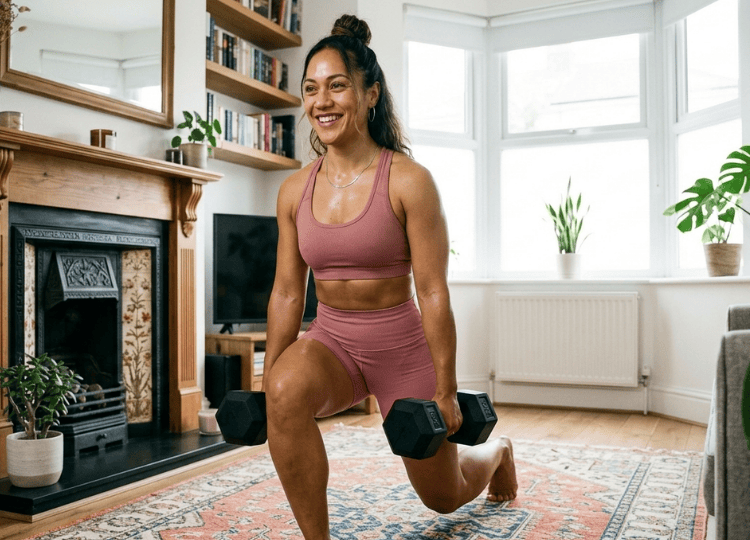
You do not need a squat rack, a leg press machine or a gym membership to build strong, functional legs. A pair of dumbbells and enough space to lunge is all that is required.
Leg training is one of the most important and most skipped categories of exercise.
The lower body contains the largest muscle groups in the body, which means training them produces some of the most significant returns in strength, calorie burn and functional fitness. Research consistently shows that stronger legs contribute to better balance, improved metabolism, reduced injury risk and greater independence as you age.
Dumbbells are particularly well suited to leg training for beginners. EMG research shows dumbbell movements like goblet squats and lunges engage more stabiliser muscles than machines, which builds functional strength that transfers to everyday life. They also allow a more natural range of motion than a barbell, are easy to scale up or down in weight, and require minimal space.
The 8 exercises below cover all the major muscle groups of the lower body and are designed to be performed at home with no specialist equipment. A complete dumbbell leg workout plan with sets and reps is included at the end.
Muscles Worked
- Core – braces the spine throughout all standing and unilateral exercises, providing stability under load
- Quadriceps – the four muscles at the front of the thigh, primarily responsible for knee extension and targeted by squats, lunges and step-ups
- Glutes – the gluteus maximus, medius and minimus, which drive hip extension and are targeted by deadlifts, lunges and hip thrusts
- Hamstrings – the muscles along the back of the thigh, trained through hip hinge movements like the Romanian deadlift and single leg deadlift
- Calves – the gastrocnemius and soleus, targeted directly by calf raises and engaged as stabilisers throughout most lower body exercises
What Weight Should I Use?
Start lighter than you think is necessary. The goal in the first few sessions is to learn the movement patterns and build confidence, not to challenge your strength limits. A weight that allows you to complete all reps with good form but feels genuinely challenging in the final two to three reps of each set is the right starting point.
As a rough guide, women new to dumbbell training typically start with 4 to 8kg per dumbbell for most exercises, while men typically start with 8 to 12kg. Calf raises and goblet squats can often be performed with a slightly heavier weight than lunges and single leg exercises, where balance is also a factor.
Dumbbell Goblet Squat
The goblet squat is one of the best introductory squat variations available. Holding the weight at the chest creates a natural counterbalance that helps maintain an upright torso and makes it easier to achieve good depth than most other squat variations. It targets the quads, glutes and core simultaneously.
How to do it:
- Hold a single dumbbell vertically at chest height with both hands, gripping the top of the weight.
- Stand with feet slightly wider than shoulder-width apart and toes turned slightly outward.
- Brace the core and lower into a squat, keeping the chest tall and the knees tracking over the toes.
- Pause briefly at the bottom, then drive through the heels to return to standing.
- Perform 3 sets of 8 to 12 reps.
Coach’s Tip: Use the dumbbell as a counterbalance by allowing the elbows to track inside the knees at the bottom of the squat. This naturally deepens the hip position and improves the quality of the movement.
Dumbbell Romanian Deadlift
The Romanian deadlift is the most effective dumbbell exercise for targeting the hamstrings and glutes through a hip hinge pattern. It builds posterior chain strength that supports lower back health and functional movement in everyday life.
How to do it:
- Hold a dumbbell in each hand in front of the thighs, palms facing the body.
- Stand with feet hip-width apart with a soft bend in the knees.
- Hinge at the hips and lower the dumbbells toward the floor, keeping them close to the legs and the back flat throughout.
- Feel the stretch through the hamstrings, then drive the hips forward to return to standing.
- Squeeze the glutes at the top and repeat.
- Perform 3 sets of 10 to 12 reps.
Coach’s Tip: Think about pushing the hips backward rather than bending forward. The movement initiates at the hips, not the lower back. If the back rounds, reduce the range of motion until hamstring flexibility improves.
Dumbbell Reverse Lunge
The reverse lunge (as well as the reverse deficit lunge) is more knee-friendly than a forward lunge for most beginners and allows better control of the movement. It targets the quads, glutes and hamstrings and trains each leg independently, which helps build balanced strength across both sides.
How to do it:
- Stand with feet hip-width apart holding a dumbbell in each hand.
- Step the right foot back and lower the right knee toward the floor, keeping the front shin vertical.
- The front knee should track over the toes and the torso should remain upright throughout.
- Drive through the front foot to return to standing.
- Complete all reps on one side or alternate legs.
- Perform 3 sets of 8 to 10 reps per side.
Coach’s Tip: A slight forward lean of the torso, around 10 to 20 degrees, shifts more of the load onto the glutes and hamstrings of the front leg. Staying too upright places more demand on the quad alone.
Dumbbell Split Squat
The split squat is a stationary lunge variation that allows greater focus on the working leg without the balance demands of a stepping movement. It is one of the most effective unilateral exercises for building quad and glute strength.
How to do it:
- Stand with feet staggered, right foot forward and left foot back. Hold a dumbbell in each hand.
- Lower the rear knee toward the floor, keeping the front shin vertical and the torso upright.
- Drive through the front foot to return to the starting position.
- Complete all reps on one side before switching.
- Perform 3 sets of 8 to 10 reps per side.
Coach’s Tip: For a greater challenge and more glute involvement, elevate the rear foot on a chair or bench. This is known as a Bulgarian split squat and significantly increases the range of motion and difficulty.
Single Leg Deadlift
The single leg deadlift builds unilateral hamstring and glute strength, challenges balance and exposes any strength differences between the left and right sides. Research consistently links single-leg strength and balance to reduced fall risk, making it particularly valuable for those focused on long-term functional fitness.
How to do it:
- Hold a dumbbell in the right hand and shift your weight onto the left leg.
- With a slight bend in the left knee, hinge forward at the hip and extend the right leg behind you as a counterbalance.
- Lower the dumbbell toward the floor, keeping the back flat and the hips square.
- Drive through the left heel to return to upright.
- Complete all reps on one side before switching.
- Perform 3 sets of 8 reps per side.
Coach’s Tip: If balance is a significant challenge, lightly touch a wall with the free hand while learning the movement. Progress to the unsupported version once control is established. The dumbbell should be held in the opposite hand to the working leg for the most natural movement pattern.
Dumbbell Step-Up
The step-up is a highly functional exercise that directly mimics the demands of stair climbing, stepping onto surfaces and everyday lower body movement. It targets the quads and glutes of the leading leg and is easy to scale by adjusting the height of the step.
Variations like the Petersen step up and Poliquin step up are worth considering if you want to focus on knee health.
How to do it:
- Stand facing a sturdy bench, box or step holding a dumbbell in each hand.
- Step the right foot onto the surface and drive through the right heel to lift the body up.
- Bring the left foot up to stand on the surface fully.
- Step back down with control, leading with the left foot.
- Complete all reps on one side before switching, or alternate legs.
- Perform 3 sets of 10 reps per side.
Coach’s Tip: Drive through the heel of the elevated foot rather than pushing off the back foot on the floor. Pushing off the floor reduces the demand on the working leg and defeats the purpose of the exercise.
Dumbbell Glute Bridge
The glute bridge is a beginner-friendly hip extension exercise that directly targets the glutes with minimal demand on the lower back or knees. It is a useful exercise for those new to lower body training and an effective activation drill before more demanding exercises.
How to do it:
- Lie on your back with knees bent and feet flat on the floor, hip-width apart.
- Place a dumbbell across the hips and hold it in place with both hands.
- Drive the hips upward by squeezing the glutes, forming a straight line from shoulders to knees at the top.
- Hold for a moment at the top, then lower with control.
- Perform 3 sets of 12 to 15 reps.
Coach’s Tip: Focus on squeezing the glutes at the top of the movement rather than simply lifting the hips as high as possible. The glute contraction is what makes the exercise effective, not the height of the bridge.
Dumbbell Calf Raise
The calf raise is the most direct exercise available for strengthening the calves and is easy to add to any lower body session. Performing it with a dumbbell adds load that bodyweight alone cannot provide.
How to do it:
- Stand with feet hip-width apart holding a dumbbell in each hand.
- Lift the heels off the floor as high as possible, rising onto the balls of the feet.
- Hold briefly at the top, then lower the heels back to the floor with control.
- For a greater range of motion, stand with the toes on a step and allow the heels to drop below the step level at the bottom of each rep.
- Perform 3 sets of 12 to 15 reps.
Coach’s Tip: Avoid bouncing between reps. A slow, controlled lowering phase of 2 to 3 seconds increases the time under tension in the calf and produces better results than fast, shallow reps.
Example Dumbbell Leg Workout Plan
Perform the exercises in the order listed. Rest 60 to 90 seconds between sets. The full session including warm-up and cool-down should take around 45 minutes.
| Exercise | Sets | Reps |
|---|---|---|
| Dumbbell Goblet Squat | 3 | 8 to 12 |
| Dumbbell Romanian Deadlift | 3 | 10 to 12 |
| Dumbbell Reverse Lunge | 3 | 8 to 10 each side |
| Dumbbell Split Squat | 3 | 8 to 10 each side |
| Single Leg Deadlift | 3 | 8 each side |
| Dumbbell Step-Up | 3 | 10 each side |
| Dumbbell Glute Bridge | 3 | 12 to 15 |
| Dumbbell Calf Raise | 3 | 12 to 15 |
Warm-up: 5 minutes of bodyweight movement including leg swings, hip circles and bodyweight squats before adding any load.
Cool-down: 5 minutes of static stretching targeting the quads, hamstrings, hip flexors and calves after the session.
Home Dumbbell Workout Plans
Check out our recent guide on the best home fitness apps for dumbbell workouts.
Benefits of Dumbbell Leg Training
Builds functional strength
Dumbbell leg exercises mimic the movement patterns used in everyday life, from climbing stairs to carrying shopping. Research consistently shows that stronger legs contribute to better balance and functional fitness, which is key for maintaining independence as you age.
Engages stabiliser muscles
Unlike leg press machines or Smith machines that guide the movement along a fixed path, dumbbells require the stabilising muscles of the hips, knees and ankles to work continuously throughout each exercise. This builds more complete and functional lower body strength.
Easy to progress
Dumbbell training allows straightforward progressive overload. Once a given weight feels well controlled for all reps across all sets, moving to the next weight up is all that is required to continue making progress.
Accessible and space-efficient
A pair of dumbbells and a small clear floor space is all that is needed to complete every exercise in this guide. Adjustable dumbbells make it even more convenient, allowing quick weight changes between exercises without needing multiple pairs.
Things to Consider
- Warm up before every session. Cold muscles are more prone to strains and tears. Five minutes of light movement before picking up any weight is non-negotiable.
- Form comes before load. The most common beginner mistake is using weights that are too heavy before the movement patterns are established. Start light and build gradually.
- Allow adequate recovery. The legs contain the largest muscles in the body and need adequate recovery between sessions. Two leg sessions per week with at least two rest days between them is the right starting frequency for most beginners.
- Progress gradually. Once a given weight feels comfortable across all sets for two consecutive sessions, that is the signal to move up. There is no benefit in rushing this process.
Bottom Line
A pair of dumbbells is genuinely all you need to build strong, functional legs at home. The eight exercises above cover every major muscle group in the lower body, from the quads and glutes to the hamstrings, calves and stabilising muscles, and are designed to be accessible for beginners while leaving plenty of room to progress as strength improves.
Two sessions per week, adequate rest between them, and a gradual increase in load over time is the formula that produces consistent results. Start with the lighter end of your weight range, focus on technique before adding load, and build from there.
Related Articles:
Best Postpartum Workout Apps for New Moms